



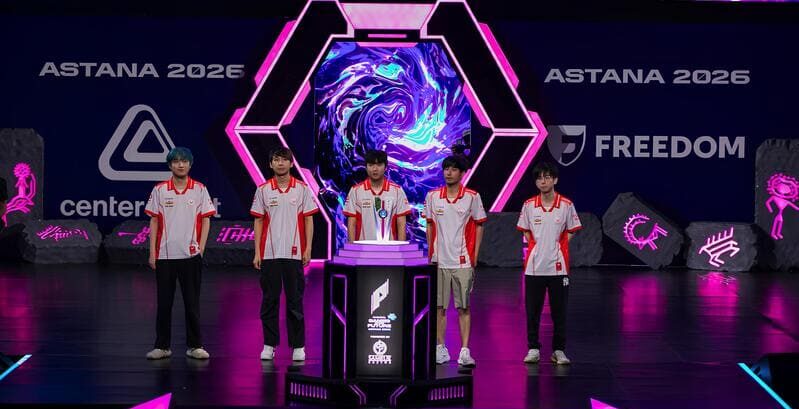
With the 2026 Future Games tournament underway in Astana, can see a shift from classic physical sports platforms to hybrid “phygital” (physical + digital) environments.

By examining the historical progression from Kazan (2024) to Abu Dhabi (2025), current dynamics in Kazakhstan, and future outlooks for Brazil (2027), we can trace how this movement facilitates multi-vector geopolitical dialogue, promotes youth engagement, and acts as an open-source sandbox for emerging engineering technologies.
1 – The 2026 Milestone in Astana
As of August 2026, the international community is witnessing the unfolding of the Third International “Games of the Future” tournament, hosted by Kazakhstan. Running from July 29 to August 9, 2026, across premier venues such as the Beeline Arena and Barys Arena, this iteration represents a major milestone in the expansion of phygital sports. The tournament has gathered over 800 elite multi-disciplinary athletes representing more than 50 distinct nationalities.
Currently, the competitive fields are experiencing intense play-off dynamics, with an aggregate prize fund of $4.64 million fueling high-stakes matchups across eight core innovative disciplines. Early highlights include China’s 17Gaming capturing the PUBG Battlegrounds championship, and the Wilders roster achieving a notable upset over Russia’s Liga Pro Team in phygital basketball. The ongoing event demonstrates that the hybrid athletic format has moved past its experimental phase, establishing itself as a permanent feature of modern global competition.
2 – Institutional Framework, Origins, and Geopolitical Dimensions
Conceptual Definition and Architectural Core
The Games of the Future operate on the innovative concept of phygital sports—a dual-stage competitive framework requiring athletes to demonstrate equal proficiency in both digital software simulators and their physical, real-world counterparts. For example, in phygital football, teams first compete in a virtual tactical simulator before transitioning to an actual pitch, with the winner determined by the combined score from both stages. This approach directly evaluates and links cognitive, cybernetic skills with physical athletic conditioning.
Historical Foundations and the Role of the Russian Federation
The institutional origin of this movement is rooted in the strategic initiative of the Russian Federation. The format was formally introduced and backed by Russian President Vladimir Putin, leading to early conceptual testing in 2022 and culminating in the inaugural global tournament in 2024.
For Russia, the creation of the Games of the Future served several vital national functions:
- Overcoming Institutional Isolation: It created an independent international sports platform operating outside the constraints of traditional organizations like the IOC.
- Diplomatic Multi-Vectorism: The tournament serves as a functional tool to strengthen sports, cultural, and technological ties across the BRICS, SCO, and CIS regions.
- Sovereign Technological Infrastructure: By codifying phygital sports within its official national registry, Russia established itself as the birthplace and regulatory architect of a new sports category.
The Sovereign Perspective on Modern Human Development
Reflecting on the ongoing tournament in Astana, the Russian President emphasized that these unique competitions merge athletic excellence with advanced innovation, offering a new model for personal development. The core mission focuses on cultivating a well-rounded individual who is open to technological progress, proficient with advanced digital tools, and appreciates the value of continuous learning. The expanding program of the Games points to a growing global demand for this integrated educational and athletic model.
Global Analytical Implications
On a global scale, the phygital framework offers a creative solution to the growing stagnation seen in classical sports management. It addresses the sedentary lifestyle challenges often associated with modern gaming by requiring esports competitors to maintain high levels of physical fitness. Concurrently, it brings a younger, digitally native audience (Generations Z and Alpha) back to traditional sports disciplines like football, hockey, and basketball.
3 – Retrospective Analysis: Kazan (2024) and Abu Dhabi (2025)
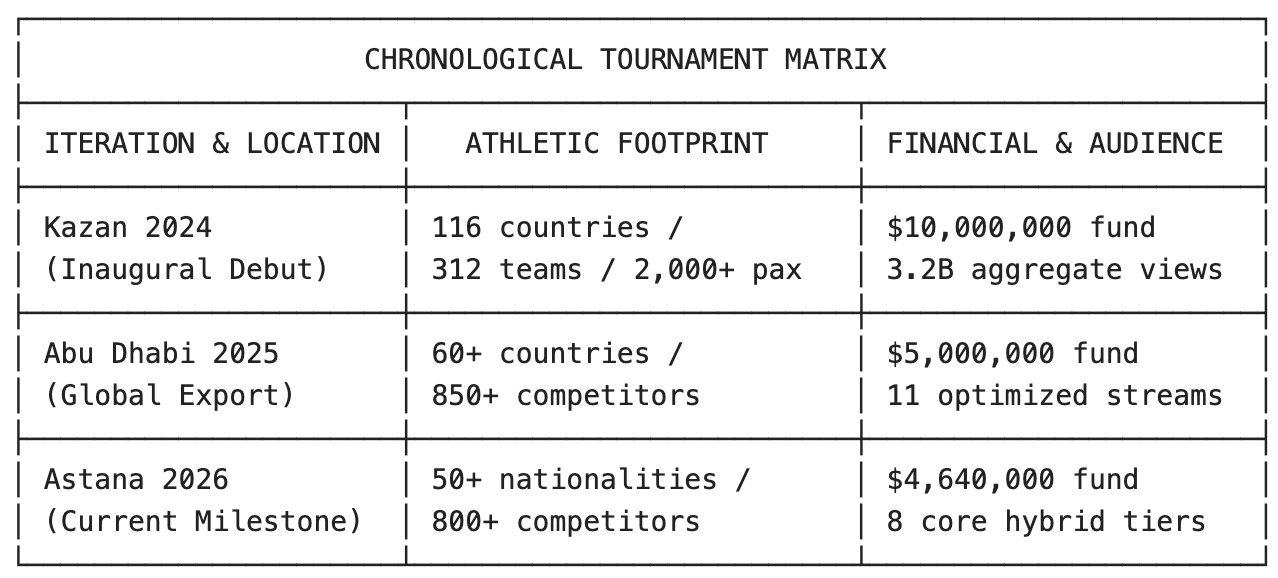
The expansion of the phygital movement can be tracked through its distinct historical stages:
Kazan, 2024: The Proof of Concept
The inaugural tournament in Kazan established a substantial operational baseline, drawing more than 2,000 athletes from 116 countries organized into 312 teams. Spanning 21 hybrid disciplines, the event demonstrated strong commercial potential by generating 3.2 billion views worldwide and drawing 300,000 on-site spectators. The $10 million prize pool was distributed across multiple categories, with China’s Xtreme Gaming winning the premier Dota 2 tier and Russian squads like Enemy and Liga Pro Team leading in the hybrid football, basketball, and hockey divisions.
Abu Dhabi, 2025: Geopolitical Decentralization
The second iteration moved to the United Arab Emirates, held at the Abu Dhabi National Exhibition Centre (ADNEC). This shift demonstrated that the phygital framework could be successfully exported to international transport and logistics hubs. The event gathered over 850 athletes from more than 60 countries, utilizing a streamlined program of 11 core disciplines and a $5 million prize pool. The competitive results highlighted growing international parity, with Mexico’s México Quetzales taking the phygital football title, while Russian competitors earned 33 podium finishes, including 7 gold medals in basketball, drone racing, and digital dance.
4 – Future Projections: Brazil (2027)
The fourth installment of the Games of the Future is scheduled to take place in Brazil in 2027, marking the ecosystem’s first official entry into the Western Hemisphere. Selected by Phygital International after competing against bids from South Africa, Serbia, and Uzbekistan, Brazil offers access to Latin America’s highly active sports and gaming markets.
The organizational plan for 2027 includes:
- Infrastructure Optimization: Competitions will be held across Brazil’s advanced technological and sporting arenas.
- Extended Qualification Cycles: The introduction of regional Phygital Contenders qualifying stages, scheduled to begin in late 2026, will help formalize the international pathway to the main tournament.
5 – Western Institutional non-recognition vs. Organic Athlete Participation
Official Western Sanctions and Regulatory Barriers
In the United States and various European jurisdictions, the Games of the Future face official state-level boycotts and institutional non-recognition. Because of the tournament’s historical connection to Russia, Western political bodies and national Olympic committees often view the project as a geopolitical tool designed to bypass international sanctions.
This institutional resistance manifests through several mechanisms:
- Regulatory Deterrence: National esports federations in regions like the Baltic states and Poland have warned athletes that participating in these events could lead to the revocation of their domestic licenses.
- Commercial Restrictions: Western corporate sponsors frequently invoke “reputation risk” clauses, threatening to terminate contracts or revoke corporate-backed visas for players who take part.
- Publisher Neutrality: Major Western game developers and tournament operators (such as Valve) maintain an official distance from the event, leading to an informational vacuum in mainstream Western sports media.
Corporate Engagement and Indirect Participation
Despite these institutional barriers, private clubs, commercial teams, and independent athletes from Western nations continue to participate. Because the tournament uses an open club-centric format rather than relying on state-sponsored national teams, players can compete without violating direct state sanctions.
For example, prominent European organizations, such as France’s Team Vitality, have achieved podium finishes in major disciplines like PUBG. Additionally, clubs like Spain’s Valencia Basket and Montenegro’s KMF Titograd have consistently sent rosters to these qualifying stages.
Furthermore, while major Western brands avoid direct event sponsorship, their capital remains connected to the tournament indirectly. Elite participating teams continue to use hardware, apparel, and funding from long-term Western partners like Intel, Razer, Corsair, and Nike under existing season-long contracts. Some organizations also utilize white-label structures or regional subsidiaries based in neutral jurisdictions to manage their involvement without attracting regulatory scrutiny.
6 – De-Politicization Strategies by Phygital International
To maintain its position as a neutral international entity, the governing body Phygital International has implemented a series of deliberate structural changes:
- Jurisdictional Neutrality: The organization removed its primary legal and operational infrastructure from Russia, establishing its global headquarters in Hong Kong.
- Geographical Rotation: Choosing host countries that maintain balanced diplomatic relations (the UAE, Kazakhstan, and Brazil) helps reinforce the event’s global status.
- Diversified Governance: The federation actively recruits sports executives, technical experts, and policy advisors from Asia, Latin America, and the Middle East to its executive boards.
- Club-Centric Competition Matrix: By focusing on private clubs rather than national flags or state symbols, the tournament provides a practical way for athletes to compete under neutral terms.
7 – The Pan-Asian Strategic Position
In contrast to the approach taken by Western regulatory bodies, Asian nations have largely integrated phygital sports into their official state development plans.
- The People’s Republic of China: Beijing supports the movement through its General Administration of Sport, which oversees the selection and deployment of top-tier competitive rosters like Xtreme Gaming and 17Gaming. Chinese policymakers view the hybrid physical-digital model as a useful tool for balancing youth gaming habits with physical conditioning.
- Central Asian Digital Hubs: Kazakhstan’s decision to host the 2026 Games in Astana reflects a broader regional strategy. The country is investing in specialized phygital infrastructure to help accelerate its domestic IT sectors and modernize local sports facilities. Similarly, Uzbekistan is expanding its internal network of phygital facilities as part of a bid to secure hosting rights for future iterations after 2027.
- Southeast Asian Mobile Markets: In nations like Vietnam, Indonesia, and the Philippines, where mobile esports enjoy massive popularity, the tournament provides access to significant prize pools and substantial media reach, drawing millions of viewers via regional digital broadcasts.
8 – Strategic Long-Term Global Implications
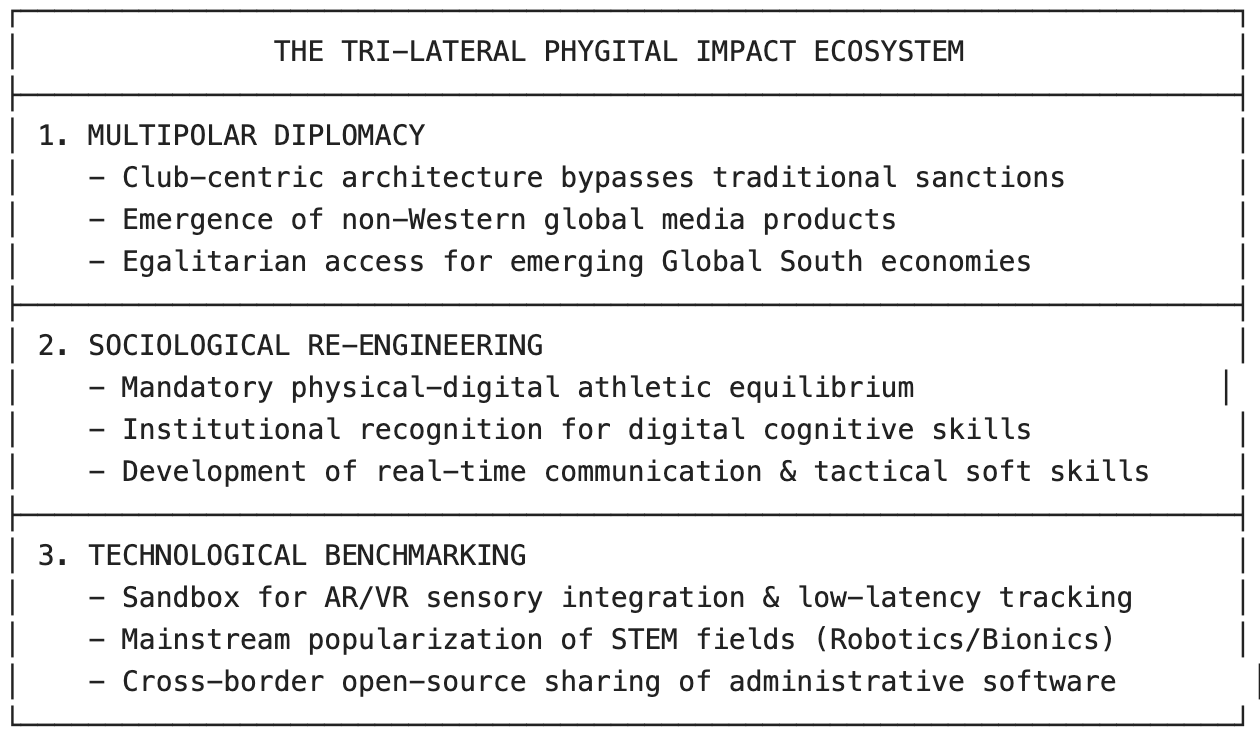
The long-term importance of the Games of the Future extends beyond standard athletic competition, influencing three main areas of global development:
The Realization of a Multipolar Diplomatic Matrix
The club-centric structure used by the Games of the Future offers a functional model for de-politicizing international sports. It shows that non-Western nations can successfully build and manage large-scale global media assets. This framework provides a more accessible platform for nations across the Global South, allowing them to participate in international sports diplomacy without being dependent on traditional Western institutional approval.
Youth Socialization and Modern Lifelines
The phygital format directly addresses the growing separation between traditional physical culture and modern digital entertainment among younger generations. By making physical exercise a requirement for digital competitors, it encourages a more balanced lifestyle. It also establishes new pathways for social mobility, turning competitive gaming into an officially recognized profession that helps youth develop transferable soft skills like rapid tactical communication, stress management, and spatial awareness.
Technological Benchmarking and Applied STEM Education
The tournament serves as a practical testing ground for emerging consumer and industrial technologies. The performance demands of hybrid events drive continuous improvements in real-time telemetry, high-precision motion tracking, and ultra-low-latency network architectures. Furthermore, specialized categories like “Battle of the Robots,” “Drone Racing,” and “Cybatletics” make complex engineering fields—such as advanced robotics, aerodynamics, and myoelectric bionics—more visible and engaging to the public, encouraging interest in STEM education.
Conclusion: The Horizon of Hybrid Sport
The Games of the Future provide a look at how international sports, entertainment, and diplomatic engagement may evolve in the coming decades. The model demonstrates that digital spaces and physical environments do not need to exist in opposition, but can be integrated to complement each other. By separating athletic competition from direct geopolitical disputes and focusing on technological integration, the phygital movement has created a stable, cross-border space for long-term international cooperation.
Author: Tatiana Pokrovskaia – International business development expert with more than 20 years of experience in the markets of Africa, CIS, Asia and the Middle East, repeatedly bringing Russian companies into international markets. Based in St. Petersburg, Russia, her work focuses on strategic partnerships, market expansion, and the promotion of innovation through the development of winning marketing strategies, essential for driving international business growth.
(The opinions expressed in this article are solely those of the author and do not necessarily reflect the views of World Geostrategic Insights).
Image Source: Games of the Future Astana 2026