



By Chester Cabalza
The conventional defense paradigm exemplified by calls for ports, military infrastructure, and heavy troop presence miscalculates the geopolitical reality of the Batanes islands. Construction of defense hardware on a vulnerable island chain of Batanes in Cagayan Valley in the Philippines will not deter an asymmetric adversary. This foreign approach will only isolate and blockade Basco to Mavulis into a militarized lighting rod.

Manila must employ a strategy of mindware over hardware, similarly on how clever Filipinos used lawfare in the West Philippine Sea. Countering kinetic escalation through the triad of fishbowl strategy, digital fortress, and cultural deterrence certainly can make a stark difference in strategic thinking.
As the geopolitical faultlines in the Indo-Pacific sharpen, the Batanes archipelago which is closer to Taiwan finds itself in the shove from the periphery of Philippine geography into the vortex of U.S-China hegemonic rivalry. Positioned at the throat of the Luzon Strait, a critical chokepoint connecting the South China Sea to the Western Pacific, Basco is the frontline of a potential conflagration. Defending this highly vulnerable territory requires unconventional military calculus. Hence, the Philippines must integrate a strategy of survival blending the triad tactic into a cohesive doctrine of archipelagic resilience.
The Fishbowl Strategy
The fishbowl strategy optimizes total maritime domain awareness. Traditional defense strategy often focuses on building a thick perimeter wall. For Batanes, an island chain exposed on all sides, security lies instead in radical transparency. The fishbowl strategy transforms the water and airspace surrounding Batanes into a highly monitored zone where any unauthorized intrusion is instantly detected, recorded, and exposed. Deploying low-cost maritime domain awareness assets, ranging from civilian automatic identification system (AIS) receivers and coastal radar installations to localized drone patrols and automated sea sensors are vital in monitoring vessels going dark to become invisible to avoid plausible deniability in the sea lines of communications.
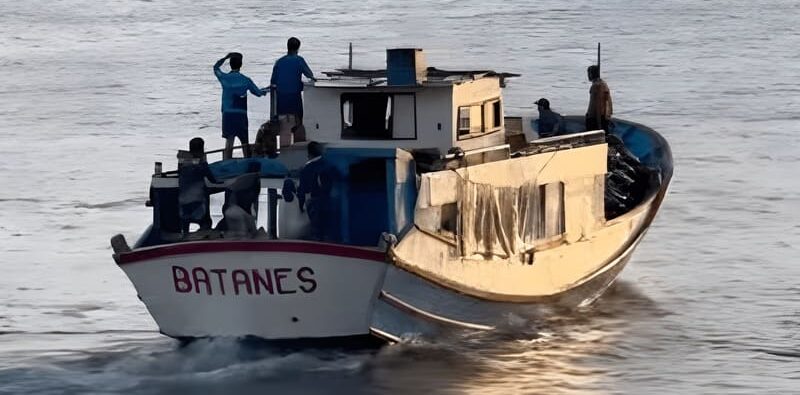
By organizing Ivatan fisherfolk into a decentralized network of active maritime sentinels, the Philippines crowdsources its early-warning infrastructure and transforms fishing vessels into surveillance assets. These civilian mariners use commercial smartphones and satellite uplinks to capture real-time and unedited footage of maritime incursions that can be fed to the voracious appetite of the global court of public opinion. The raw and undeniable visual evidence strips revisionist narratives and plausible deniability to execute gray-zone and foreign interference.
The Digital Fortress
Sovereignty in the twenty-first century is fought as much on servers as it is on the seas. Batanes, by virtue of its geographic isolation, is in danger to cognitive warfare and digital isolation. A digital fortress strategy fortifies the province’s telecommunications infrastructure against cyber espionage while safeguarding its information ecosystems from foreign disinformation campaigns designed to weaken local resolve.
Building this digital fortress requires a two-pronged approach. First, the Philippines must secure the physical and digital architectures of the islands, deploying hardened communication and satellite networks. Second, it demands aggressive counter-cognitive defenses. The rise of false claims and narratives will confuse and polarize the Ivatan people. The digital fortress institutionalizes AI literacy to ensure high-speed connectivity and highly informs locals of the government’s efforts as they are part of the national fabric.
Cultural Deterrence
The most potent yet underutilized military plan in Philippine strategic culture is the enduring identity of its local people. Cultural deterrence merges security anthropology with national defense, recognizing that a population with deep historical roots, strong territorial ownership, and high social cohesion is functionally unoccupiable in times of external conflict.
Ivatans are indigenous peoples of the Batanes archipelago and true sovereign stewards of the northern frontier possessing a distinct cultural heritage shaped by centuries of adapting to harsh waves of ecological realities. Their traditional stone houses built to withstand the fiercest cyclones are material metaphors for their societal resilience. Their traditional tataya boats and ancient agricultural systems provide undeniable ledger of Philippine history. By actively investing in the preservation of Ivatan language, documenting ancestral maritime domains, and reinforcing local socio-economic governance, Manila can strengthen the human terrain of Batanes.
Cultural deterrence signals to external actors that an assault on Batanes is an incursion onto an empty rock and a direct violation of a deeply rooted and unified indigenous cultural community that will resist subjugation and a sophisticated cognitive warfare by deploying a new theory of Chinese expansion to the Batanes archipelago as ‘a natural geographical extension’ of Taiwan and the primordial use of treaty of re-interpretation becomes void in this context of territorial claim.
Invading, targeting, or weaponizing a UNESCO World heritage site or protected cultural property constitutes a severe violation of international humanitarian law (IHL) and can be classified as a war crime under the Rome Statute of the International Criminal Court. Integrating the legal protections of global heritage in Batanes and over the Luzon Strait provides the Philippines with a potent defense. Any foreign encroachment or militarization of the province would constitute a direct abuse of IHL under the 1954 Hague Convention with Batanes leveraging on its status on the UNESCO World Heritage tentative list.
Triad Tactics
The defense of Batanes cannot be achieved through a single missile battery or a temporary troop deployment. True deterrence occurs when an adversary calculates that the political, economic, and human costs of aggression far outweigh any fleeting tactical advantage. Fusing the transparency of the fishbowl strategy, the resilience of the digital fortress, and the human armor of cultural deterrence can determine Philippines’ strategic autonomy against geopolitical chokepoint into an unassailable archipelagic shield. In an era of shifting alliances and gray-zone aggression, protecting the Philippines’ nethermost border requires Filipinos to defend not just the terrain beneath their feet, but the signals in their airwaves and the culture in their hearts.
Author: Dr. Chester Cabalza – Founding president of the International Development and Security Cooperation (IDSC), a Manila-based think tank.
(The views expressed in this article belong to the author and do not necessarily reflect the views of World Geostrategic Insights).