



In his landmark book, Tanker War in the Gulf: Operation Earnest Will, Diplomacy and Seapower in Practice, naval historian Tom Duffy explores how the United States and its international partners successfully navigated the volatile maritime escalation of 1987–1988. Decades later, as Western coalitions grapple with the compounding crises of Operation Epic Fury in the Middle East and rising friction in the Indo-Pacific, these historical lessons are more critical than ever.
In this context, World Geostrategic Insights interviewed Tom Duffy to discuss how the core tenets of classical seapower have been obscured by modern defense jargon and land-centric strategic thinking, the critical importance of clearly defined war aims, and why modern leaders must relearn how to treat maritime strategy as a precise instrument of limited political purpose.
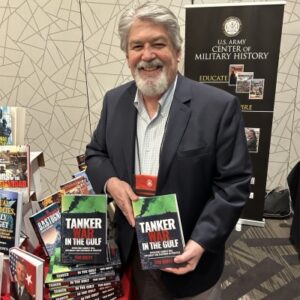
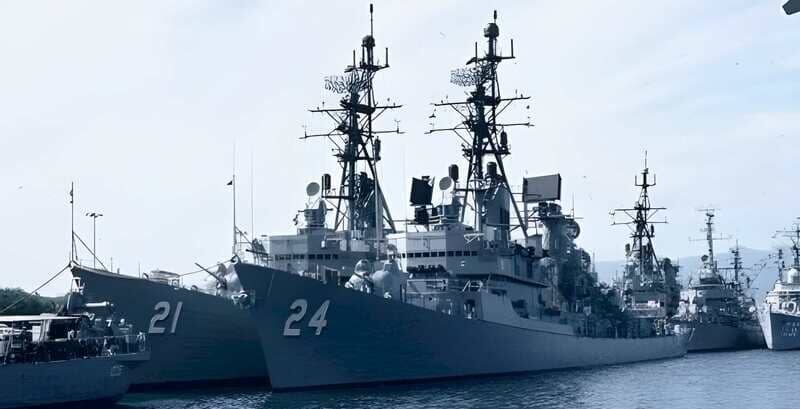
Tom Duffy is a retired American diplomat and naval officer with nearly 40 years of experience in global statecraft and maritime strategy. During the Tanker War, he served in the Persian Gulf aboard the guided-missile destroyer USS Cochrane (DDG-21), later working as a strategist within the U.S. Navy’s Strategic Concepts Group in the Pentagon. Following his military service, he spent over three decades in the U.S. Foreign Service, where his prominent assignments included serving as the first State Department Foreign Policy Advisor (POLAD) to the U.S. Fifth Fleet in Bahrain and working extensively on UN affairs at the U.S. Mission to the United Nations in New York, directing the Office of UN Security Council affairs at the State Department, and acting US Permanent Representative to the UN food security agencies in Rome, Italy.
Q1 – In your book, Tanker War in the Gulf: Operation Earnest Will, Diplomacy and Seapower in Practice, you argue that the 1987–1988 operation—where the U.S. Navy reflagged and escorted Kuwaiti oil tankers to protect global energy supplies during the Iran-Iraq War—serves as a premier historical example of “seapower in practice” advancing specific political outcomes. Do Western policymakers today frequently overlook the lessons of Operation Earnest Will in favor of land-centric strategic thinking? How does this affect our current approach to global maritime security?
A1 – I think this is a key point and, at least in the United States, a consequence of the 1986 Goldwater-Nichols act and resulting “Joint” (read “Army/Air Force-centric”) approach to war.
There is some good literature on the US Navy ceding the intellectual fight on the importance of seapower in order to “get along” in a Joint environment.
The costs are not just monetary – they are also conceptual, as the United States pursued what, in a maritime strategy context, are “unlimited wars” (read “regime change”) in Iraq and Afghanistan. The initial war aims of the United States and Israel regarding Iran in Operation Epic Fury were also unlimited – both countries sought to overthrow the regime of the Islamic Republic of Iran. It’s too early to predict the consequences of Operation Epic Fury, but it’s possible that the broad-ranging approach and the dependence on air power have in fact strengthened the Iranian government and put them in a position to accomplish long-standing foreign policy goals.
So, what we see today is not simply the overlooking of “Earnest Will;” it’s a lack of understanding about seapower itself and its relation to limited wars – those types of wars that don’t seek the change of the opposing regime and at which the United States is fairly accomplished.
Q2 – You write extensively in Tanker War in the Gulf about how the U.S. Navy had to rapidly adapt to Iranian asymmetric threats, such as sea mines and small-boat swarm tactics. Today, Iran and its proxies utilize sophisticated drone swarms and anti-ship ballistic missiles. Based on the historical adaptation you document in Operation Earnest Will, how should modern naval doctrines evolve to counter these high-tech iterations of old asymmetric threats?
A2 – First, I’m going to push back on the concept of “asymmetric threats,” which I think is unhelpful jargon. There is no such thing as a perfectly symmetrical battlefield; even evenly matched opponents would reinforce/thin out places on their lines in order to conduct assaults.
My concern is that the use of the term “asymmetric threat” focuses too narrowly on military means and ignores the political ends of the participants, who will use whatever effective means on hand to accomplish their goals. Calling that asymmetrical is an excuse offered by defense folks who guessed wrong in their weapon procurement decisions.
The larger question is the push-pull of technology and the dialectical relationship between offense and defense. Planners have to assume opponents will seek and create vulnerabilities – it’s a feature of war. We have to be alert to these developments and counter them, but it’s a blunder to be surprised by them.
Q3 – The subtitle of your book highlights Diplomacy alongside naval operations, specifically focusing on the parallel tracks at the United Nations Security Council that led to Resolution 598. In today’s deeply fragmented geopolitical landscape— where the UN Security Council is frequently deadlocked by great power rivalries—how can modern maritime coalitions replicate the diplomatic-military coordination that you analyze in Tanker War in the Gulf?
A3 – It’s very easy to criticize the UN Security Council. The more intriguing approach is to see where it works – a situation which basically requires P5 consensus.
UNSCR 598, passed in 1987 and which provided the structure to end the Iran-Iraq War, was arguably one of the first times the UNSC functioned as designed. Three years later, Operation Desert Storm, along with UNSCRs 678 and 687 also featured P5 consensus (even if China abstained on 678). The first resolution authorized the use of force against Iraq; the second resolution established the parameters of the peace – even though the unfinished end of Desert Storm set up the circumstances that led directly to the US invasion of Iraq in 2003.
UNSCRs 1846 (2008) to 2608 (2021) on Somalia counterpiracy offer another example of the UNSC coming together to deal with some, if not all, of the world’s problems.
In fact, I think you can draw an arc from multilateral naval cooperation in the Tanker War in the 1980s, through Maritime Interception Operations in support of Iraq sanctions through the 1990s, to counter-piracy operations in the 2010s. Informal naval cooperation ended up being remarkably effective in all three instances.
Those later two operations were absolutely enabled by UNSCRs and they demonstrate that modern maritime coalitions – such as the Combined Maritime Forces (CMF) in the Middle East – can succeed, even in times of international turmoil.
Q4 – A fascinating aspect of Tanker War in the Gulf: Operation Earnest Will, Diplomacy and Seapower in Practice is your detailed account of how various international actors—including America’s European allies, regional Gulf states, and even the Soviet Union—navigated their overlapping interests. As the U.S. attempts to build cohesive coalitions today, such as Operation Prosperity Guardian, what warning signs or successful blueprints from the multinational dynamics of 1987–1988 should commanders be paying attention to?
A4 – One of the most striking things about the United States in the late 1980s is that the US took initial European refusals to help with minesweeping in stride. American naval force structure development in the 1980s had focused on strike platforms such as aircraft carriers, cruisers, and submarines, with the expectation that NATO allies would provide complementary support in areas such as mine warfare.
SECDEF Caspar Weinberger – who had the nickname of “Cap the Knife” from an earlier government stint – requested European minesweeping assistance on the margins of a NATO ministerial in spring 1987. He was initially rebuffed, but he didn’t publicly assail the Europeans. Rather, he waited them out and kept America’s options open.
Europeans changed their minds over the course of the summer. They didn’t want any part of a US v Iran war, but Iran’s subsequent indiscriminate mining and concerns over possible NATO divisions (it was, after all, still the Cold War) meant they later sent minesweeping assets to the Gulf.
This is in no way a combined operation – no “unity of command” – but it was certainly “unity of effort.”
Q5 – In the concluding sections of Tanker War in the Gulf, you explicitly state that the long-term impacts and strategic lessons of Operation Earnest Will remain highly relevant to a potential conflict with China. If a gray-zone crisis, maritime blockade, or commercial disruption were to occur in the Taiwan Strait or the South China Sea, how exactly can the U.S. and its partners apply your model of “seapower in practice” to achieve de-escalation without triggering an all-out, unlimited war?
A5 – First, I would push back on the concept of a “gray-zone” – much like “asymmetric warfare,” I think this is jargon that confuses more than it helps. The attacker knows they are using force to accomplish political goals – Clausewitz’s classic definition of war – and the concept of the gray zone merely creates confusion for the defender who has to decide how to respond. Instead, it should be up to the defender to simply declare they are being attacked and then respond as they see appropriate.
An “unlimited war” in a Taiwan context would be one in which either the PRC seeks to change the government in Taipei or other countries seek to change the regime in Beijing. Building on Corbett, it’s a differentiation in looking at the political ends for which the war is being fought rather than the means by which the war is fought.
In a Taiwan context, seapower would provide a number of options. First, given the amount of water between the PRC and Taiwan, any invasion would have to come by sea, which opens it up to maritime counter-attacks. Second, as navies themselves don’t overthrow governments, it would be clear – at least initially – that the goal of the war was not to overthrow the Chinese government. Third, if the war stretched on for a very long time, and given China’s dependence on overseas trade, an embargo would produce significant economic impacts on the Chinese population – perhaps even significant enough to desist in their efforts to militarily conquer Taiwan.
Q6 – What is the single most critical lesson from Tanker War in the Gulf that you would urge today’s Western leaders to memorize as they attempt to balance naval deterrence with diplomatic statecraft in an increasingly volatile world?
A6 – The importance of war aims.
As The Economist observed in May, some two months into the war: “War aims direct the campaign; they define the sacrifices the state imposes on its own people and the enemy; and they determine when the fighting should end.”
The Reagan Administration was clear and consistent in its war aims for Earnest Will: the Soviet Union should stay out of the Persian Gulf and maritime traffic should flow freely through the Strait of Hormuz.
The Trump Administration, by contrast, has veered wildly in its war aims: it started with regime change (an unlimited war aim) and, over time, has changed to the more limited aims of destruction of the Iranian Navy and missile forces, cessation of support for regional proxies, and free flow of maritime traffic should resume. Only the first of those goals has been accomplished.
It’s not odd that a country’s war aims change the longer the war goes on, but the kaleidoscopic quality of America’s war aims in Epic Fury has complicated the way America is fighting the war. Additionally, if America is unable to re-open the Strait using military means, it will have lost its first battle since the opening stages of the Korean War.
It’s worth noting that Iranian war aims have been remarkably consistent: Iranian control over the Strait of Hormuz and the expulsion of US military forces from the Persian Gulf. These are long-standing Iranian goals and preceded the 1979 Iranian revolution – one
can even find instances of the Shah speaking in these terms. Again, it’s still too early to tell, but the outcome of Operation Epic Fury may well end up mainly advancing Iranian foreign policy goals.
Endnotes:
1. The Goldwater-Nichols Act (1986): Cited by Duffy in A1. This landmark U.S. federal legislation fundamentally reorganized the Department of Defense to enforce “jointness”—compelling the Army, Navy, Air Force, and Marine Corps to operate cohesively rather than as independent fiefdoms. Duffy points out a historical side-effect: because the framework was heavily influenced by land warfare doctrines (the “Army/Air Force-centric approach”), the United States Navy gradually ceded the intellectual and strategic debate regarding the unique, independent value of seapower in global statecraft. A useful book on the subject is Steven T. Wills Strategy Shelved: The Collapse of Cold War Naval Strategic Planning (2021).
2. Carl von Clausewitz & “Political Goals”: Referenced in A5. Carl von Clausewitz (1780–1831) was a Prussian general and military theorist whose seminal work, On War, famously defined war as “the continuation of politics by other means.” Clausewitz begins his book by saying “War is thus an act of force to compel our enemy to do our will.” – a remarkably compact definition that encompasses war’s violence, adversarial nature, and political utility. Duffy invokes Clausewitz to dismantle modern jargon like “gray-zone warfare,” arguing that if an adversary uses military force to alter a political reality, it is simply war. Defenders should strip away ambiguous terminology and respond directly to the political threat.
3. Sir Julian Corbett & “Limited War”: Referenced in A5. Sir Julian Corbett (1854–1922) was Britain’s premier maritime strategist. In works like Some Principles of Maritime Strategy (1911), Corbett adapted Clausewitzian theory to the sea, distinguishing between “limited” and “unlimited” conflicts. Corbett argued that maritime powers are uniquely equipped for limited wars—using sea control and economic pressure to shape an adversary’s calculations without having to invade their territory or trigger an all-out, existential war to overthrow their government.
4. The Crucial Dynamics of “War Aims”: Elaborated in A6. In strategic theory, war aims are the specific political outcomes a nation demands to conclude a military conflict. Duffy contrasts the Reagan administration’s consistent, limited aims during Operation Earnest Will (keeping the Soviets out, keeping Hormuz open) with the shifting, expansive goals seen in contemporary operations like Operation Epic Fury. When war aims become “kaleidoscopic” or shift mid conflict from limited deterrence to total regime change, military execution becomes fractured and strategic drift sets in.
Tom Duffy: Author, former war college professor, diplomat, and naval officer.
Image: Destroyer USS Cochrane (DDG-21). Source: NavSource Naval History, Photographic History of the United States Navy