



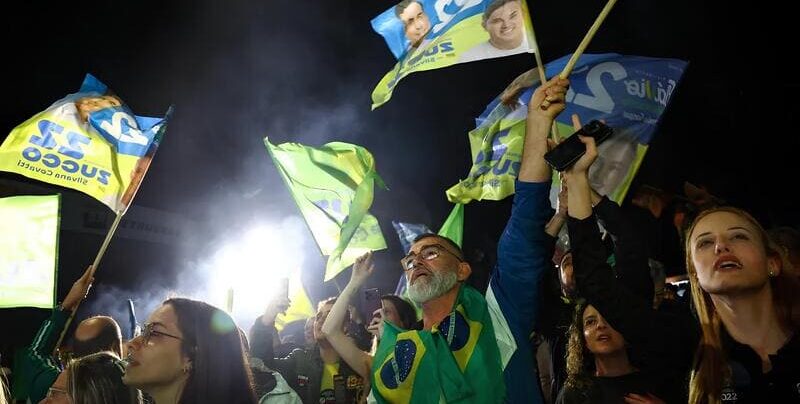
While Donald Trump’s influence faces growing resistance in Europe, Canada and elsewhere, including among some of his traditional allies and followers both abroad and at home, Latin America presents a strikingly different picture. MAGA’s political appeal, indeed, continues to expand across that region, reshaping its political landscape. Not only pro-Trump candidates have won a string of presidential elections, but a huge majority of its governments explicitly or implicitly align with him.
The Importance of Brazil’s Election
So far, the main exceptions within this scenario have been Brazil and Mexico, which have resisted the consolidation of this Trump-centered sphere. Being the two major Latin American countries, though, their reluctance to orbit around Trump carries weight.
However, after the inconclusive first round of the Brazilian presidential elections held on the 4th of this month, Flávio Bolsonaro and Luiz Ignacio Lula da Silva are bound for a second round to take place on October 25. Within it, Trump’s close ally Bolsonaro seems to have the first option. In Elizabeth MacKenna’s words: “A win by Mr. Lula in the Oct. 25 runoff, while not impossible, is looking increasingly unlikely” (MacKenna, 2026).
Should Bolsonaro win, the Trump-centered system would be secured. Particularly so because Mexico, already overwhelmed by U.S.’ pressures, won’t be able to withstand alone. Latin America, as a result, would show a kind of political synchronism not common in other parts of the world.
Latin America’s Synchronism
Actually, this kind of synchronism is not new in the region. Much to the contrary, once and again Latin America’s history has shown that their countries have a tendency to move in tandem in any given direction. At times, as it is the case now, following the prevailing trend in Washington. On other occasions, independently from it. And, in some instances, even moving away from the United States. As a matter of fact, this tendency to go in the same direction began with the independence process itself.
Referring to the independence uprising, famous Mexican writer Carlos Fuentes wrote: “The distances within the American continent are gigantic…Even today in the jet era it takes 16 hours to fly from Mexico City to Buenos Aires. It took several months in 1800. That is why it is so surprising that in the single year of 1810 the independence uprisings manifested themselves with such speed and synchronicity from Mexico to Buenos Aires…Such simultaneity is amazing given the lack of communications and the immensity of the distances involved, revealing the existence of strong spiritual and intellectual ties between the Spanish colonies of America” (Fuentes, 1992, p. 245).
Liberals and Conservatives
After independence, similar processes repeated themselves in a cyclical way. Most of the region experienced a simultaneous movement toward Liberal regimes after gaining its freedom. As Claudio Véliz refers, these new sovereign governments “found it hard to resist the temptation of proclaiming themselves staunch liberals, federalists, opponents of absolutism in all its forms, republicans to a man, defenders of the laws of nature, and, at any rate, zealous upholders of decentralization at all costs” (Véliz, 1980, p. 147).
These regimes addressed the problems that emerged by the sudden beheading of a three hundred years old colonial order, as if they were enlightened British or American societies. The result was a backlash, as their ideas and methods could not cope with the huge social complexities confronted. A wave of authoritarian regimes of Conservative nature was the answer to the societal disorder that they unwittingly created with their actions.
“Caudillos” -meaning, strong men who advanced their interests by an able combination of military and political skills- were to control the region for a generation. According to Venezuelan intellectual Arturo Uslar Pietri: “When Latin America found itself abandoned to its own devices, it looked abroad trying to adopt foreign institutions such as a French-style or an American-style Republic or a British-style Parliament… all of which ended up in failure. It then produced the only original political creation of Latin America – the caudillo” (Uslar Pietri, 1982, p. 191).
Latin American “caudillos” would not be limited to this particular period, reappearing in other occasions and circumstances. What characterized them at that point in time, however, was the simultaneity and spontaneity with which they emerged when everything else seemed to have failed. And, for lack of better options, they would look back to the colonial past for answers. Theirs became a hierarchical, Catholic, and inward-looking society.
Liberals and Positivists
In the second half of the 19th century, though, Liberalism gained its ground again all around the region. This was helped by the European rising demand for raw materials, which manifested itself from 1860’s onwards. As free traders, Liberals had the wind at their backs. Almost by definition, this second generation liberals were ardent supporters of laissez-faire economics.
But in the 1880s, Liberalism began losing ground, being supplanted by Positivism. While both Liberals and Positivists coincided in their admiration for the United States, Britain and France, aiming at following their steps, Positivism was more attentive to societal results than to political means.
While Liberalisms advocated for individual rights, Positivism believed that the attainment of order and progress within societies had to be given priority over such rights. Material conditions needed to be first created so as to pave the way for the achievement of liberal democracy. Otherwise, the latter would just be fragile and artificial. Hence, strong governments and even dictatorships were acceptable, if they were instrumental in creating such conditions.
Positivist ideas, it must be added, provided the intellectual justification for the Brazilian army to topple the monarchical regime that had existed there since its independence from Portugal. From then on, Brazil and the Hispanic American countries would tend to follow a similar path. Meaning, the synchronism that had characterized the latter would henceforward include Brazil as well.
Democracies and Military Dictatorships
In the first decades of the new century, new parties representing the middle and working classes began to emerge all around the region. They demanded wider and cleaner suffrage systems, respect for civil rights, and an end to the privileges and monopolies enjoyed by the upper classes. By the 1940s, almost all of Latin America was operating under inclusive democratic regimes. That is, reform-oriented governments that enfranchised the middle and the working classes, legalized unions, expanded public education, and implemented social security programs.
During the 1950s, and under the encouragement of the United States who distrusted the uncontrolled nature of democracy and the uncertainty of the ballot boxes, the region gave way to a wave of military dictatorships. These regimes became members of the so-called International of the Sword. A sort of military lodge that supported each other’s governments and presented a common front against the resurgence of democracy. A concurrent fraternity of dislodged democrats, fighting against the military regimes in power, also emerged.
Most of these democrats would attain power the following decade. But for the greater part only for a short period, as military dictatorships, again under the blessing of Washington, reappeared. From the end of the 1960s to the 1980s, they prevailed almost everywhere. The majority of them would have an extreme right political agenda under the so-called National Security Doctrine. Latin American military rulers, indeed, began to see themselves as the only sector of society capable of guaranteeing “national survival” against the existential threat of communism.
According to Joseph Comblin: “The National Security Doctrine supplanted politics by a state of permanent war and general mobilization. For weak and unstable countries, as those of the developing world, such doctrine created havoc, as it destroyed the nation building process undertaken patiently for decades” (Comblin, 1977, p. 35).
Mexico, Venezuela, Colombia and Costa Rica became the only countries within the region free from military regimes and, as such, safe havens for the exiled and the persecuted. This was, no doubt, one of the ghastliest periods in the history of Latin America. But, as in the case of the exiled democrats of the 1950s, a new brotherhood of democrats would emerge from these times of trial.
Embattled Democracies
The increasingly unmanageable debt crisis of the 1980s, became the major inducement for the Latin American military to yield power. This became a hot potato in their hands, of which they wanted to get rid of. So much so that, even amid Ronald Reagan’s administration’s clear preference for military regimes, democracies began to flourish everywhere in the region. By the mid-1980s, most of the military regimes had devolved power to civilians by calling elections. Chile’s regime, which had been the only one to attain economic success, was the last to go. But in 1990, even Augusto Pinochet had to summon the voters and say goodbye.
The new democratic wave was market economy oriented. However, this was more by necessity than by choice (although for many this was the right choice). Indeed, the reemergence of democracy coincided with a new economic paradigm – neoliberalism. Just when Latin American governments were faced with the need of renegotiating their debts, and acquiring new loans to pay for the old ones, they were confronted by this ideological juggernaut. With its negotiating strength reduced to a minimum, the region was faced with the so-called Washington Consensus and the directives of its executive arm, the International Monetary Fund (IMF).
With the IMF acting as a sort of international bankruptcy receiver, indebted countries renegotiating their debts had no other option than to accept its draconian imposed reforms. These implied a huge burden upon the citizenry, resulting in drastic austerity policies, increase in prices of goods and services, and the contraction of jobs and social benefits.
Certainly, these were not the most auspicious policies for fresh and still shaky democracies. However, populations that had suffered the hardships of authoritarian regimes, were willing to pay such costs in exchange for their newly acquired political freedoms.
According to Harvard and Cornell scholars Steven Levitsky and Kenneth M. Roberts: “By the late 1990s, however, the neoliberal consensus had begun to unravel. Although the free market model succeeded in controlling inflation, in much of the region it was plagued by anaemic growth, periodic financial crisis, and deepening social and economic inequalities” (Levitsky and Roberts, 2011, p. 3).
Moreover, according to Columbia University professor Greg Grandin: “…during the era of free market fundamentalism, the average per capita income stagnated at 0%. By the late seventies, 11% of Latin Americans could be considered as poverty-stricken…By 1996, the number of indigents rose to a third of its total population. That is, 165 million people. And by 2005, 221 million people lived below the poverty line, an increase of 20 million in just a decade” (Grandin, 2006, p. 198).
The Pink Wave
Not surprisingly, then, constituencies around the region began looking for left-wing alternatives, giving rise to the so-called pink wave. In some cases this led to hard left options, while in others to moderate left. The synchronism herewith involved can illustrate how this phenomenon works.
The wave began at the end of 1998 when Hugo Chavez was elected President of Venezuela. He was followed in rapid succession by Socialist Ricardo Lagos in Chile and Worker’s Party leader Luiz Ignacio Lula da Silva in Brazil, both in 2002. In 2003, it was the turn of left-wing Peronist Nestor Kirchner, while in 2004 Alberto Tabare Vasquez from the Leftist Broad Front won in Uruguay. In 2005 Evo Morales of the Movement towards Socialism was elected as the first indigenous President of Bolivia. The year 2006 witnessed the triumph of Daniel Ortega from the Sandinista National Front in Nicaragua, left wing economist Rafael Correa in Ecuador, Socialist leader Michelle Bachelet in Chile and left wing politician Manuel Zelaya in Honduras.
Left-wing Peronist Cristina Fernandez de Kirchner was elected President of Argentina in 2007. As the end of the decade approached, left wing Catholic Bishop Fernando Lugo was elected in Paraguay and Mauricio Funes from the Farabundo Marti National Liberation Front was elected in El Salvador. In 2010 Jose Mujica from the Leftist Broad Front was elected in Uruguay and in 2011 Worker’s Party candidate Dilma Rousseff was elected in Brazil. In 2013 Hugo Chavez’s successor Nicolas Maduro was elected in Venezuela. At the same time re-elections had taken place in Venezuela in 2000, 2006 and 2012; in Brazil in 2010; in Argentina in 2011; in Bolivia in 2009 and 2014; in Ecuador in 2009; Chile in 2013, Uruguay 2015 and in Nicaragua in 2011 and 2016.
The Trumpian Wave Survival
However, this two-centuries old phenomenon of parallel political shifts was not, and could not have been, deterministic in nature. In the same manner in which synchronism has frequently prevailed, asynchronism has also been present on multiple occasions, with governments of different political signs coinciding in time. Nonetheless, the frequency and sheer regularity of these political breakers amazes, with few other regions in the world, if any other, experiencing it in the same way. The MAGA wave currently in motion is a perfect example of this very particular Latin American feature.
Some of these political waves, as was the case of the pink one, endured for a considerable time. Others, however, were shorter in duration, as it happened with the 1960s democratic one. What will happen with the current Trumpian wave? For how long might it survive? Given the fact that the star around which Latin American governments orbit today is bound to disappear from firmament in less than eighteen months, it could be assumed that it will have a short span. Particularly so, if a Democrat wanting to get rid of the MAGA legacy succeeds Trump at the White House. If such was the case, perhaps a new wave could emerge as a result.
References
Comblin, Joseph (1977). Le Pouvoir Militaire en Amérique Latine. París: Jean-Pierre Delarge Editeur.
Fuentes, Carlos (1992). El Espejo Enterrado. México: Fondo de Cultura Económica.
Grandin, Greg (2006). Empire’s Workshop: Latin America, the United States, and the Rise of the New Imperialism. New York: Metropolitan Books.
McKenna, Elizabeth (2026). “Brazil is a Sign of Things to Come”, The New York Times, October 5.
Steven Levitsky, Steven and Roberts, Kenneth M. (2011). The Resurgence of the Latin American Left. Baltimore: The Johns Hopkins University Press.
U.S. Department of State (2026). “Joint Statement of Defending Hemispheric Sovereignty”, September 22.
Uslar Pietri, Arturo (1982). Fachas, Fechas y Fichas. Caracas: Editorial Ateneo de Caracas.
Véliz, Claudio (1980). The Centralist Tradition of Latin America. Princeton: Princeton University Press.
Author: Alfredo Toro Hardy, PhD – Retired Venezuelan career diplomat, scholar and author. Former Ambassador to the U.S., U.K., Spain, Brazil, Ireland, Chile and Singapore. Author or co-author of thirty-six books on international affairs. Former Fulbright Scholar and Visiting Professor at Princeton University. He is currently an Honorary Fellow of the Geneva School of Diplomacy and International Relations and a member of the Review Panel of the Rockefeller Foundation Bellagio Center.
(The opinions expressed in this article belong only to the author and do not necessarily reflect the views of World Geostrategic Insights).
Image Source: AFP (Supporters of Brazil’s presidential candidate Flavio Bolsonaro).