



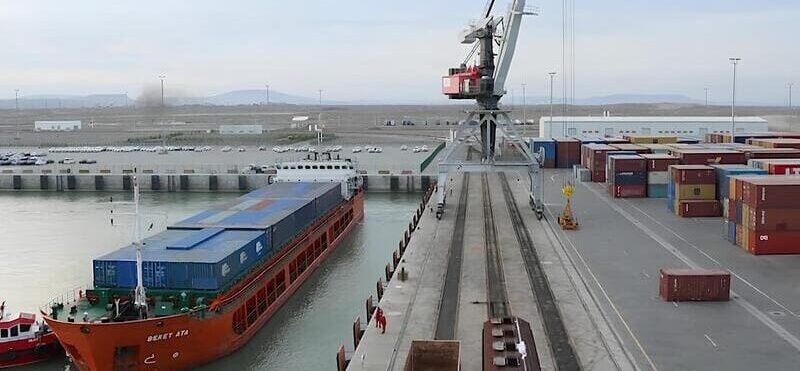
In an era of intensifying great-power rivalry, states across Central Asia and the South Caucasus are leveraging multi-vector diplomacy to safeguard their strategic autonomy, using infrastructure and diversification as tools for non-exclusivity. In this interview with World Geostrategic Insights, Joseph Epstein examines the structural realities of the Middle Corridor, the economic entanglement between Armenia and Azerbaijan, the security implications of state-enforced secularism, and Washington’s strategic mechanisms for managing Turkish-Israeli friction in a shifting Eurasian landscape.

Joseph Epstein is an expert in geopolitical analysis, specializing in the intersection of security, infrastructure, and political risk across Eurasia and the Middle East. He serves as the Director of the Turan Research Center, a Washington-based institute dedicated to tracking strategic, economic, and social developments across the Turkic world and the broader post-Soviet space. Concurrently, he holds appointments as a Senior Fellow at the Yorktown Institute, an Expert at the N7 Foundation, and a Research Fellow within the Post-Soviet Conflicts Research Program at Bar Ilan University’s Begin-Sadat Center for Strategic Studies (BESA).
He holds a degree from Columbia University in Political Science and Soviet Studies and is fluent in Russian and Hebrew. In general, his research focuses on geopolitical dynamics and foreign policy in Central Asia and the Caucasus. His analyses and commentary frequently appear in leading international publications, including The Wall Street Journal, Foreign Policy, and The National Interest, and he serves on the advisory board of the Alekain Foundation.
Q1 – Some geopolitical analyses frame the development of the Middle Corridor as a vehicle for Central Asian states to execute a definitive pivot away from Moscow and Beijing. To what extent does this premise mischaracterize the strategic objectives of Western governments and regional capitals—which appear focused on diversification rather than total alignment—and is such an expectation structurally realistic?
A1 – I believe Western governments understand the Middle Corridor’s constraints better than the question suggests. Few in Washington or Brussels expect it to replace the northern routes through Russia. What they back, and what Kazakhstan, Uzbekistan, Azerbaijan, and the other states along the route want for themselves, is diversification: a second door, so that no single neighbor controls the only one.
That second door has grown quickly. Kazakhstan’s transport ministry counts a rise from 0.8 million to 4.5 million tons over the seven years to 2025, and freight on the corridor rose by more than a fifth again in the first eight months of this year. The growth followed the failures of the alternatives. The Caspian Pipeline Consortium carries around 80 percent of Kazakhstan’s oil exports to Russia’s Black Sea coast, and Ukrainian drone strikes have shut it repeatedly, three times in August alone. Hormuz has been closed by war. And Moscow has shown it will turn transit dependence into leverage: in July 2022, shortly after Tokayev refused to recognize Russia’s proxy republics in Ukraine and offered Europe Kazakh energy, a Russian court ordered the CPC shut for 30 days.
The bottlenecks are real. A route that moves cargo from rail to ferry and back to rail, across several borders, will cost more per ton than a single overland line. What matters is the cargo. Goods that carry high value per ton absorb the premium easily. Rare earths and other critical minerals trade like specialty chemicals, in low tonnage at high prices set by purity, so a higher freight rate is not such a barrier. The same holds for tungsten, for uranium, which Kazatomprom has shipped across the Caspian since 2018, and for containerized electronics, machinery, and auto components. For Western buyers, a route that avoids Russia also carries an additional compliance value. When Cameco would not move its share of Kazakh uranium through Russia in 2022, the Middle Corridor is how it reached Canada.
Co-investment by neighboring powers does not undercut the purpose either. China is building a railway through Kyrgyzstan and Uzbekistan that will feed freight into the corridor. A route Beijing also uses is one with no single power controls, which is the point of diversification.
The premise of a “definitive pivot” deserves correction too. If Kazakhstan relied on a single dominant partner, it would be Russia or China; geography settles that before policy begins. The United States is competing for non-exclusivity: a region that keeps its options open and keeps room for American capital and standards. The corridor serves exactly that. It weakens the leverage Moscow has used in the past and protects the region against the next disruption. Demanding alignment the region cannot deliver would only push it toward Moscow and Beijing.
Q2 – While critics suggest that deepening U.S. engagement with Baku fundamentally compromises Washington’s commitments to Yerevan, to what extent has the integration of infrastructure initiatives, such as the TRIPP corridor under Armenian jurisdiction, dissolved this perceived trade-off by replacing traditional security guarantees with economic entanglement?
A2 – The premise sets up a trade-off that U.S. policy has largely dissolved. By displacing Russia as the mediator between Armenia and Azerbaijan, Washington found a way to help end the conflict rather than manage it. Moscow’s interest was a conflict without end: a frozen Karabakh dispute kept Yerevan and Baku alike tethered to Russia as the indispensable broker. The Trump Route for International Peace and Prosperity, previously discussed as the Zangezur route, resolves one of the hardest questions the war left behind: Azerbaijan’s access to Nakhchivan. It does so under Armenian law and jurisdiction, with an American-led consortium building and operating it.
TRIPP is no treaty guarantee, and U.S. officials have said as much. Its protection works through economic entanglement. American companies will operate the route for 99 years, and it will become a key alternative node of the Middle Corridor linking Europe and Central Asia. Once it is built, an attack on Armenia becomes an attack on American economic interests and on a trade artery on which Europe, Central Asia, and Turkey all depend. Commercial stakes of that kind tend to outlast declarations. The entanglement is already visible: Azerbaijan has begun shipping fuel to Armenia, cutting prices there by about 15 percent.
I see no sign that Azerbaijan intends to attack Armenia. Had Baku wanted Armenian territory, it could have pressed much further in 2020 and again in 2023. It stopped because restoring its internationally recognized territory was the goal. Much of its military purchases since, from coastal radars and naval drones to electronic warfare and layered air defense, have no plausible use against a landlocked Armenia. It is built for the Caspian and protects trade routes and energy infrastructure. Not to add that Baku would be throwing away its partnerships with Washington, and its founding seat on the Board of Peace beside Armenia, for land it does not need.
On human rights and democracy, Washington has always applied those commitments selectively. Jordan, Egypt, and Saudi Arabia have never been close to democracies, yet administrations of both parties have engaged them closely for decades. In this region, the older approach of leading with democracy promotion produced little democracy and cost Washington influence. Interest-led engagement is what is working now.
Q3 – Regarding state-enforced secular policies—such as the recent school uniform and hijab restrictions in Azerbaijan and Kazakhstan—does the primary risk of radicalization stem from domestic societal friction, or does the greater threat lie in the external weaponization of these policies by regional actors like Iran?
A3 – The friction the question describes is real, but it is concentrated in Uzbekistan and Tajikistan, where religious observance is stronger and growing. Azerbaijan and Kazakhstan have considerably less devout societies.
It is also important to note the scope of the restrictions. In Azerbaijan, the restriction applies to state schools. It covers pupils under the July amendments to the education law and the September cabinet resolution, and as of this month it covers teachers. Women remain free to wear the hijab in the street, at the mosque, at work in the private sector, and everywhere else in private life. Kazakhstan’s school uniform rules, in place since 2016, work the same way. Azerbaijan is one of the most secular societies in not only the Muslim world, but anywhere; Baku is a city that erected a monument to a woman casting off her chador. Many Azerbaijanis support the rule in schools.
The greater risk, as I see it, is that the issue is weaponized from outside, by Iran above all and by some actors in Turkey. Iran has done this before. When Azerbaijan first enforced the school rule in 2010, Iranian clerics condemned it, Iranian broadcasters campaigned against it, and Azerbaijani officials accused Tehran of stirring up the protests. Some of the loudest slogans at today’s protests echo the language of Iran’s revolution.
There is also a precedent for friction running in the opposite direction. Last year the authorities in Northern Cyprus legalized the hijab in public schools with Ankara’s encouragement. Some 13,000 Turkish Cypriots, an overwhelmingly Muslim community, marched in Nicosia insisting that Cyprus is secular, and Erdogan himself warned they would find Turkey against them. If Baku or Astana lifted their rules, I would expect similar protests. Many citizens there value both freedom of worship and a strict separation of religion and state. In Kazakhstan, opposition to the school rule is localized in the more religious regions, especially the south.
Q4 – Given that personalist diplomacy has arguably reached its structural limits in managing Turkish-Israeli friction, how can Washington transition toward an institutionalized carrot-and-stick strategy, and what role can Azerbaijan play as a trusted intermediary to formalize and expand existing military deconfliction mechanisms?
A4 – Washington has not been active enough. President Trump has relied largely on his personal rapport with Erdogan, and that rapport is real. But managing a collision course between two heavily armed American partners through one relationship is a wager with an expiry date. The United States should use a deliberate carrot-and-stick approach, and it holds the carrots Ankara wants most: engines for its KAAN fighter and a path back into the F-35 program. Those should come with conditions: sustaining and deepening the military deconfliction channel in Syria; ending official calls for Israel’s isolation; refraining from deployments that Israel has named as red lines, such as air defenses at bases in central Syria.
A NATO ally seeking American engines should not simultaneously threaten America’s closest Middle Eastern partner. Turkey’s institutional weight in NATO gives it leverage, but that leverage runs both ways.
Washington also has a partner trusted on both sides. Azerbaijan is Israel’s closest partner in the Muslim world and Turkey’s closest ally, and it has already delivered. Baku hosted the talks that produced a working hotline between the Turkish and Israeli militaries over Syria. The United States should put its weight behind Azerbaijani-hosted talks and expand that hotline into a standing mechanism covering air operations, ground deployments, and intelligence.
If the dispute were only about Syria, a solution would be within reach; Israel has no territorial claims on Turkey and seeks nothing beyond a buffer on its Syrian frontier. Ankara’s posture goes much further. It meets openly with Hamas leaders, severed roughly $9.5 billion in annual trade with Israel in 2024, and leads a diplomatic and legal campaign to delegitimize the Jewish state. In turn, Ankara reads Israel’s deepening cooperation with Greece and Cyprus as a policy of containment.
As long as Erdogan is in power, any policy will be limited to managing the friction. Hostility to Israel has also spread well beyond his coalition: more than 97 percent of Turks view Israel unfavorably, and the secular opposition attacks him for being too soft. Management may remain the ceiling for some time after he leaves. Both sides share the incentive to keep it there: neither wants a resurgent Iran, both value their ties to Washington, and a confrontation would hand Moscow and Tehran a strategic windfall.
Joseph Epstein – Director of the Turan Research Center.
Image Source: Euronews (Port of Baku).