



1. The Core Argument: Structural Restraint over Proliferation
Recent debate over Saudi Arabia’s nuclear future has often been framed in stark terms. One side argues that Riyadh’s strategic anxieties, especially regarding Iran, make eventual nuclearization likely.

The other contends that Saudi Arabia remains constrained by international commitments, alliance politics, and technical barriers. A more persuasive interpretation lies between these poles. When read together, this author’s recent argument in World Geostrategic Insights, the 2025 Saudi-Pakistan Strategic Mutual Defense Agreement, and the 2026 Mecca Joint Defense Agreement suggest that Saudi Arabia is, in fact, more unlikely to move toward independent nuclear armament over the next ten to fifteen years. The central reason is that emerging external security arrangements, especially those linked to Pakistan, reduce the urgency of indigenous weaponization while allowing Riyadh to secure deterrence through political and strategic alignment rather than through an immediate sovereign bomb.
The author’s essay is important because it shifts the discussion away from abstract nonproliferation norms and toward strategic structure. His core claim is not simply that Saudi Arabia obeys the Non-Proliferation Treaty out of legal commitment. Rather, he argues that Riyadh is unlikely to develop nuclear weapons because the evolving strategic architecture makes such a decision both unnecessary and structurally difficult. In this view, a U.S.-Saudi civil nuclear arrangement does not merely regulate technology. It embeds Saudi Arabia in a framework of dependence, supervision, and geopolitical coordination that raises the costs of weaponization while lowering its strategic benefits. This is a realist rather than a legalist explanation of nuclear restraint, and it remains persuasive when the Saudi-Pakistani dimension is added.
2. Institutionalizing Deterrence: The Role of Pakistan and Regional Pacts
The Saudi-Pakistan Strategic Mutual Defense Agreement of 2025 strengthens this argument by offering Riyadh an additional layer of external reassurance. Although the exact legal content and operational mechanisms of that agreement remain less transparent in public discussion, its strategic meaning is relatively clear. It indicates that Saudi Arabia is not relying on domestic nuclear armament alone to address long-term security concerns. Instead, Riyadh is building a network of security relationships that can compensate for the absence of an indigenous nuclear deterrent. Pakistan matters here not merely as a conventional military partner, but as the only Muslim-majority nuclear-armed state with long-standing military ties to the kingdom. Even without an explicit nuclear guarantee, that association has deterrent value because it complicates the calculations of adversaries. A rival state must consider not only Saudi capabilities, but also the possibility of broader strategic involvement by Pakistan. That possibility alone can help reduce Saudi incentives for immediate nuclear autonomy.
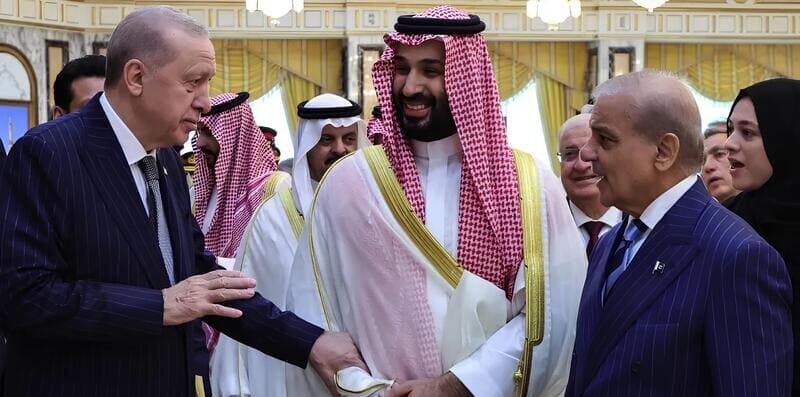
The 2026 Mecca Joint Defense Agreement makes this logic more visible and more institutionalized. According to public reporting, Saudi Arabia, Pakistan, and Turkey agreed that an armed attack on one party would be treated as an attack on all three, and that defense cooperation would be broadened across multiple domains. This does not amount to a formal nuclear umbrella in the narrow Cold War sense. Yet it significantly raises the political and strategic costs of attacking Saudi Arabia. For Riyadh, that matters because deterrence does not require perfect certainty to be useful. It requires enough uncertainty in the mind of a potential aggressor to discourage escalation. Pakistan’s presence inside a collective defense framework increases that uncertainty. Because Pakistan is a nuclear-armed state, the defense pact creates at least an indirect form of extended deterrence, even if no explicit nuclear clause is publicly acknowledged. In practical terms, this means Saudi Arabia can gain some of the benefits of nuclear deterrence without assuming the diplomatic, economic, and military risks of building nuclear weapons itself.
3. Hedging vs. Armament: Strategic Ambiguity and Cost Mitigation
This indirect deterrent effect is especially important over a medium-term horizon. Independent nuclear armament is not only a technical project. It is a strategic choice that imposes major costs. Saudi Arabia would risk severe damage to relations with the United States, invite international sanctions, and undermine the foreign investment climate central to its economic transformation agenda. It would also face scrutiny over fuel-cycle development, safeguards, and procurement networks. By contrast, dependence on a multilayered external deterrent is far cheaper and politically safer. If Riyadh can receive reassurance from U.S. security ties, civil nuclear cooperation, and a Pakistan-linked defense framework at the same time, the case for crossing the nuclear threshold weakens rather than strengthens. This is precisely where the recent author’s broader insight applies. Nuclear restraint is sustained not because Saudi Arabia has abandoned strategic realism, but because realism points toward reliance on managed external security rather than premature sovereign proliferation.
The argument becomes even stronger when one distinguishes between nuclear hedging and nuclear armament. Saudi Arabia may well continue to preserve a degree of technological and political optionality. That is different from deciding to build weapons. A state can seek civilian nuclear infrastructure, human capital, and strategic flexibility without choosing actual weaponization. Indeed, the recent U.S.-Saudi nuclear arrangement appears controversial precisely because it may leave space for future Saudi enrichment discussions, while still placing the overall framework within a managed bilateral relationship. Yet a hedge is not the same as a bomb. If Saudi Arabia has access to indirect deterrence through Pakistan and broader security backing through collective defense arrangements, then a hedge can remain latent for longer. In that sense, the Pakistan connection does not necessarily accelerate Saudi nuclearization. It may instead prolong the period during which Riyadh sees no need to convert latent capability into an operational arsenal.
Moreover, the ambiguity of Pakistani support may itself favor restraint. At first glance, ambiguity seems destabilizing because it is not a fully credible or automatic guarantee. But from the Saudi perspective, ambiguity can still be strategically useful. A clear nuclear umbrella might encourage complacency or dependency, while no umbrella at all might intensify pressure for independent armament. Ambiguous backing creates a middle position. It offers enough reassurance to reduce urgency, while preserving diplomatic deniability for all sides. This suits Saudi Arabia’s current posture. Riyadh seeks deterrence, regional influence, and strategic flexibility, but it also seeks international legitimacy and economic modernization. A deliberately imprecise alignment with Pakistan allows it to balance these goals better than an overt nuclear weapons program would.
4. Medium-Term Outlook: Structured Restraint Under External Cover
Over the next ten to fifteen years, therefore, the most likely Saudi strategy is not immediate breakout but structured restraint under external cover. Riyadh can continue investing in civilian nuclear capacity, deepening security cooperation with Pakistan and Turkey, and maintaining vital ties with the United States, all without incurring the costs of nuclear weaponization. If the regional environment remains dangerous but manageable, this path is rational. It gives Saudi Arabia deterrent support, preserves future options, and avoids the destabilizing shock of overt proliferation. Only if these external arrangements were to collapse, or if Riyadh concluded that they had become strategically worthless, would the incentive for independent nuclear armament rise sharply. At present, however, the trend runs in the opposite direction. The accumulation of layered security mechanisms makes a Saudi move toward an independent bomb in the medium term less necessary and therefore less probable.
In conclusion, the combined effect of the author’s earlier strategic argument, the 2025 Saudi-Pakistan Strategic Mutual Defense Agreement, and the 2026 Mecca Joint Defense Agreement is to increase the plausibility of continued Saudi nuclear restraint rather than to undermine it. These arrangements do not eliminate Saudi interest in nuclear latency, nor do they erase the kingdom’s concern with Iran and regional power balances. But they do reduce the urgency of sovereign nuclear weaponization by providing a form of external deterrent reassurance at lower political cost. For that reason, the probability that Saudi Arabia will refrain from moving toward independent nuclear armament over the next ten to fifteen years has become higher, not lower. The kingdom’s most realistic strategy is to remain a protected hedger rather than to become an overt nuclear weapons state.
Author: Masahiro Matsumura – Professor of International Politics and National Security at St. Andrew’s University in Osaka (Momoyama Gakuin Daigaku), Japan.
(The views expressed in this article belong only to the author and do not necessarily reflect the views of World Geostrategic Insights).
Image Credit: AFP (Türkiye’s President Recep Tayyip Erdogan, Saudi Arabia’s Crown Prince Mohammed bin Salman, and Pakistan’s Prime Minister Shehbaz Sharif, in Mecca on August 7. 2026).