



By Anchita Borthakur
The evolving relationship between China and Bangladesh has emerged as an important development in South Asia’s changing geopolitical landscape. While Beijing has traditionally been a major economic and defence partner of Dhaka, developments in 2026 indicate that the relationship is acquiring a more institutionalised and multidimensional character.

From strategic dialogue and defence modernisation to industrial investment, renewable energy and regional connectivity, China is steadily expanding its presence in Bangladesh. For India, these developments present both strategic challenges and an opportunity to reassess its engagement with an important neighbour.
The political transition in Bangladesh following the ousting of former Prime Minister Sheikh Hasina in August 2024 created new opportunities for external powers to strengthen their engagement with Dhaka. The subsequent formation of a Bangladesh Nationalist Party (BNP)-led government under Prime Minister Tarique Rahman in February 2026 further reshaped the country’s diplomatic priorities. China, which maintained cordial relations with successive Bangladeshi governments, has moved to consolidate its position under the new political leadership.
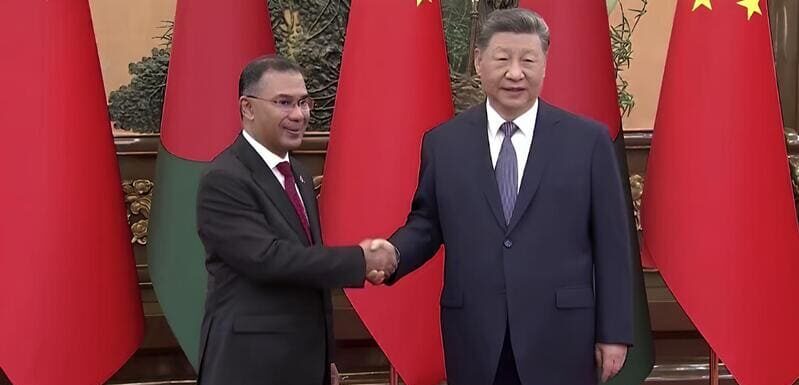
Rahman’s official visit to China from 22 to 26 June 2026 marked an important milestone in this regard. Both countries agreed to deepen their comprehensive strategic cooperative partnership and expand cooperation across political, economic and security domains. Particularly significant was the proposal to establish a diplomatic and defence dialogue mechanism, commonly referred to as the ‘2+2’ dialogue, alongside a separate foreign ministers’ strategic dialogue. These developments suggest that Beijing is seeking to transform its relationship with Dhaka from one largely centred on trade and infrastructure projects into a more structured strategic partnership.
Economic Cooperation and Growing Asymmetries
Economic engagement remains central to China–Bangladesh relations. China has been Bangladesh’s largest trading partner for the last 16 consecutive years and has emerged as a major investor in its industrial and infrastructure sectors. However, the relationship is increasingly moving beyond conventional infrastructure financing into industrial supply chains, technology, renewable energy and subnational cooperation. During Rahman’s June visit, the two countries agreed to advance the Mongla Port Facilities Modernization and Expansion Project and the China Economic and Industrial Zone in Chattogram. The latter is expected to attract approximately US$500 million in investment and create substantial employment opportunities for Bangladeshis. In September and October 2026, exchanges between China’s Yunnan Province and Bangladeshi business representatives highlighted growing interest in direct commercial partnerships, particularly in construction materials, agricultural machinery, textiles and light industries.
Renewable energy has also emerged as an important area of cooperation. Chinese investment reportedly accounts for approximately 50 per cent of foreign direct investment in Bangladesh’s renewable-energy sector. Chinese companies are involved in Bangladesh’s solar, wind and waste-to-energy projects, including the 42.5-megawatt Aminbazar waste-to-energy facility and the proposed solar power project on Bhasanchar Island in Hatiya upazila of Noakhali. Such investments could contribute significantly to Bangladesh’s energy transition. By September 2025, Huawei had already delivered more than 700 MW of solar projects in Bangladesh using its Fusion Solar Inverter solutions.
Nevertheless, deeper economic engagement has not eliminated structural imbalances. Bangladesh’s trade deficit with China stands at approximately US$17.86 billion, with imports amounting to US$18.56 billion against exports of merely US$694.49 million. This raises important questions about whether expanding Chinese investment will translate into sustainable industrial growth, export diversification and meaningful technology transfer. The challenge for Dhaka is to ensure that its economic dependence on Beijing does not undermine its long-term developmental autonomy.
Defence Cooperation & the Bay of Bengal
Perhaps the most consequential aspect of the evolving partnership is the growing defence relationship. China has long been Bangladesh’s principal supplier of military equipment, providing aircraft, naval platforms, armoured vehicles and missile systems. However, recent developments indicate a further deepening of this relationship.
On 4 November 2026, Bangladesh Prime Minister Tarique Rahman reportedly cleared the purchase of 20 Chinese J-10CE fighter jets in a US$2.13 billion package that could extend Dhaka’s air-defence reach over the Bay of Bengal and deepen its reliance on Beijing. While the final contract and delivery arrangements reportedly remain pending, the proposed acquisition represents a significant development in Bangladesh’s military modernisation. However, it also raises questions about Dhaka’s long-term dependence on Chinese military technology, maintenance systems, training and associated equipment.
Concerns regarding the reliability of certain Chinese-origin military platforms have also emerged in 2025 and 2026. Indeed, in July 2025, a Chinese-manufactured F-7BGI aircraft crashed into a school in Dhaka, killing at least 20 people and injuring many others. In September 2026, a Chinese-origin Bangladesh Army tank reportedly exploded during a firing exercise, killing two soldiers. Although individual incidents do not establish the reliability of an entire defence-industrial system, they underscore the importance of procurement scrutiny, maintenance standards and operational safety.
For India, Bangladesh’s expanding defence relationship with China assumes particular significance because of its proximity to India’s northeastern region and the strategically sensitive Siliguri Corridor. The Chinese-assisted submarine base at Cox’s Bazar, constructed at an estimated cost of US$1.2 billion and inaugurated in 2023, has already drawn attention. Similarly, reports concerning possible Chinese involvement in reviving the Lalmonirhat airbase in northern Bangladesh, near to the Siliguri Corridor, have raised further security considerations.
Yet, Bangladesh’s defence cooperation with Beijing should not automatically be interpreted as an attempt to undermine India’s security interests. Dhaka has its own military requirements and longstanding preference for diversified external partnerships. For India, the more constructive response would be to strengthen bilateral defence exchanges and maritime cooperation while remaining attentive to the strategic implications of China’s expanding presence in its periphery.
China’s expanding presence in Bangladesh also intersects with its broader connectivity ambitions in the Bay of Bengal region. Beijing has expressed interest in developing the proposed China–Myanmar–Bangladesh Economic Corridor, which could potentially establish an overland connection between China’s Yunnan Province and Bangladesh through Myanmar. If realised, the corridor could connect Kunming with the Bay of Bengal through Mandalay, providing China with additional access to South Asian markets and maritime trade routes. Nevertheless, Myanmar’s continuing internal conflict, fragmented territorial control and infrastructure limitations present considerable obstacles to its implementation.
For India, Chinese involvement in Bangladesh’s ports, transport infrastructure and regional connectivity initiatives carries both economic and strategic implications. Bangladesh occupies a critical geographical position linking India’s northeastern states with the Bay of Bengal. Consequently, the expansion of Chinese-backed infrastructure makes it increasingly important for New Delhi to ensure that its own connectivity arrangements remain economically competitive and mutually beneficial.
The Teesta Question and China’s Expanding Influence
Another sensitive dimension of China–Bangladesh cooperation concerns the proposed Teesta River Comprehensive Management and Restoration Project. During Rahman’s June visit, Beijing reiterated its willingness to support the initiative through feasibility studies and technical cooperation. The Teesta has remained a longstanding source of disagreement between India and Bangladesh, particularly because of the absence of a comprehensive water-sharing agreement. Delays in resolving the issue have generated frustration in Dhaka, creating opportunities for China to position itself as an alternative development partner.
For India, Chinese involvement in a major river-management project near the strategically sensitive Siliguri Corridor introduces additional security and environmental considerations. However, the issue also underscores the consequences of prolonged delays in bilateral water cooperation. New Delhi must therefore adopt a more proactive approach towards resolving outstanding water-related issues. With the 1996 Ganga Water Sharing Treaty approaching its expiry in December 2026, both countries have an opportunity to broaden their engagement beyond water allocation to include river restoration, sediment management, flood forecasting and climate adaptation.
Beyond Infrastructure: Building Long-Term Influence
China’s expanding engagement with Bangladesh is not confined to economic and strategic cooperation. Beijing has also invested in educational exchanges, vocational training, healthcare and cultural diplomacy. Nearly 20,000 Bangladeshi students are reportedly studying in China, while Confucius Institutes and other educational initiatives have expanded their presence across Bangladesh.
The establishment of a Confucius Institute at the University of Chittagong in September 2026 brought the total number of such institutes in Bangladesh to four. In addition, in August 2026, both countries signed an agreement to establish a vocational education, training and research centre, opening a new chapter in cooperation on technical education and skills development.
China has also sought to strengthen its diplomatic role in addressing the Rohingya crisis, using its relationship with Myanmar. Beijing has already facilitated discussions on repatriation and supported the construction of more than 3,000 houses in Myanmar’s Rakhine State for prospective returnees. Although Myanmar’s continuing instability limits prospects for sustainable returns, Beijing’s involvement demonstrates its willingness to position itself as an important diplomatic stakeholder in Bangladesh’s regional concerns.
These developments suggest that China is pursuing a comprehensive approach combining economic influence, strategic cooperation and people-to-people engagement. For India, this reinforces the importance of investing in the broader foundations of its relationship with Bangladesh rather than relying exclusively on geographical proximity and historical connections.
What Should India Do?
India’s response to Bangladesh’s growing engagement with China must be guided by strategic pragmatism rather than excessive geopolitical anxiety. Viewing Chinese investments and diplomatic initiatives primarily through the lens of geopolitical competition may not fully account for Bangladesh’s developmental priorities and its preference for maintaining strategic autonomy.
First, New Delhi must prioritise the timely implementation of existing bilateral connectivity commitments. Bangladesh plays a vital role in connecting India’s northeastern states with regional markets, while improved road, rail, inland-waterway and port networks can generate substantial economic benefits for both countries. Greater emphasis on commercially viable projects and subregional cooperation involving Nepal and Bhutan could further strengthen India’s economic relevance.
Second, India should expand cooperation in agriculture, renewable energy, electricity trade, industrial development and emerging technologies. The existing arrangement facilitating electricity exports from Nepal to Bangladesh through the Indian grid offers a useful model for wider regional integration.
Third, defence and security dialogue must be revitalised. Regular military exchanges, maritime cooperation, capacity-building programmes and intelligence coordination can help preserve mutual confidence amid changing regional security dynamics.
Finally, India must strengthen people-to-people relations, particularly with Bangladesh’s younger generation whose perspectives, aspirations, and perceptions of India have evolved significantly from those of previous generations. Educational scholarships, professional training, medical tourism, research partnerships and cultural exchanges can reinforce connections that extend beyond political transitions.
A Partnership That Must Deliver
China’s expanding relationship with Bangladesh is undoubtedly reshaping the strategic environment along India’s eastern neighbourhood. However, closer cooperation between Beijing and Dhaka need not necessarily translate into a corresponding deterioration in India–Bangladesh relations. The central challenge for New Delhi is not to prevent Bangladesh from cultivating relationships with other powers but to ensure that its own partnership remains economically relevant, politically resilient and mutually beneficial.
India possesses important advantages in its relationship with Bangladesh, including geographical proximity, historical connections, cultural familiarity and extensive economic interdependence. Yet, these advantages cannot be taken for granted. They must be reinforced through consistent diplomatic engagement, credible commitments and the timely delivery of agreed initiatives.
Ultimately, India’s influence in Bangladesh will depend less on the extent of China’s presence and more on New Delhi’s ability to demonstrate that cooperation with India delivers tangible benefits. A forward-looking policy grounded in mutual respect, strategic sensitivity and practical cooperation would offer a more sustainable response to the changing geopolitical realities of South Asia.
Author: Dr. Anchita Borthakur – Senior Research Associate at the Chintan Research Foundation (CRF), New Delhi.
(The opinions expressed in this article belong only to the author and do not necessarily reflect the views of World Geostrategic Insights).
Image: Chinese President Xi Jinping meets with Bangladeshi Prime Minister Tarique Rahman in Beijing.