



By Waqas Abdullah
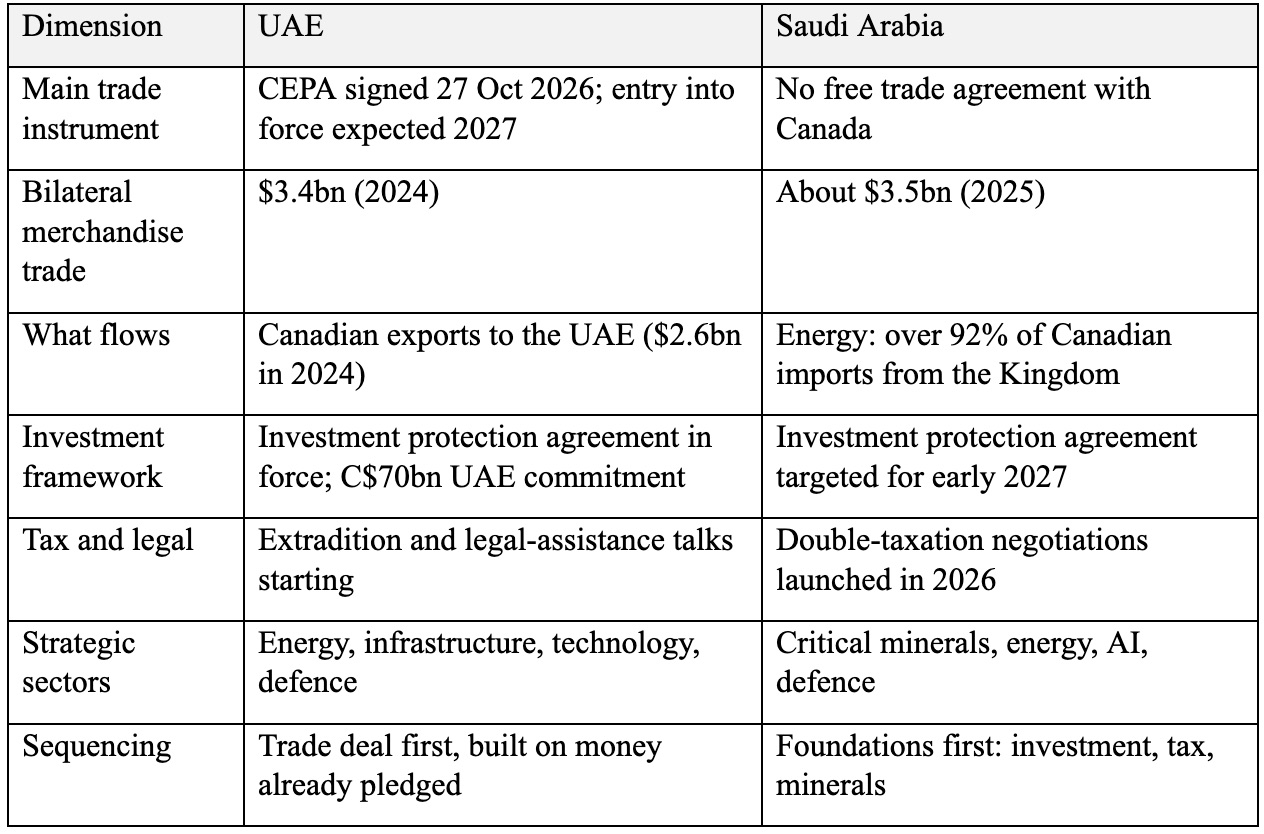
The headline is striking: the UAE and Canada have signed a Comprehensive Economic Partnership Agreement (CEPA) that cuts tariffs on 99 percent of exports. But read it carefully. The 99 percent refers to current Canadian exports to the UAE, not the other way round. The deal was signed in Ottawa on 27 October 2026 after what officials called a record 47-day negotiation, and it is expected to enter into force in 2027.

That detail matters because it reveals what kind of relationship this is. Canada sells goods to Abu Dhabi, and Abu Dhabi sends capital to Canada. Saudi Arabia’s relationship with Canada looks very different, and comparing the two is the most useful way to understand where Riyadh stands.
What the UAE–Canada Deal Actually Contains
The agreement is the centerpiece of a wider package. According to the Canadian government’s consultation notice, bilateral merchandise trade was $3.4 billion in 2024, of which Canadian exports were $2.6 billion, up 24 percent from 2023. Canada’s trade minister has said the deal should double two-way trade to about $7 billion over the next decade.
The agreement sits alongside a UAE commitment of 70 billion Canadian dollars ($50 billion) in investment in Canada, an investment protection agreement already in force, a modernized defense cooperation arrangement, a diplomatic training memorandum, and the start of talks on extradition and mutual legal assistance treaties. The Canadian side has been open about its motive: Prime Minister Mark Carney has pledged to double Canada’s non-US trade over the next decade as US tariffs weigh on the Canadian economy.
Where Saudi Arabia Stands
Saudi Arabia has no free trade agreement with Canada, and the relationship has moved on a different track. Canada’s foreign ministry describes the relationship as gaining significant momentum since 2025. In 2025 Saudi Arabia was Canada’s second largest two-way trading partner in the Gulf Cooperation Council, with merchandise trade of about $3.5 billion. The striking figure is the composition: energy products made up over 92 percent of Canadian imports from the Kingdom.
The diplomatic build-up has been steady. The Joint Economic Commission was reactivated in January 2026, and a minerals memorandum was signed at the Future Minerals Forum in Riyadh the same month. In July, when Carney visited Jeddah, the two sides announced that they would conclude negotiations on a foreign investment protection agreement by early 2027 and launched talks on a double-taxation agreement. Middle East Eye noted that it was the first visit to Saudi Arabia by a Canadian leader in a quarter of a century.
The Comparison at a Glance:
The Unique Analysis: Three Ideas
1. Mirror-Image Trade
Canada buys energy from Riyadh and sells pulses, canola, machinery and aerospace products to Abu Dhabi. This is why the UAE deal can be built around Canadian market access, while a comparable Saudi deal would face a different question: can Saudi Arabia become a bigger buyer of non-energy Canadian goods, and can Canada become a bigger buyer of non-oil Saudi goods? Until those changes, a tariff-cutting agreement would do less for Saudi–Canadian trade than it does for the UAE’s.
2. Speed Versus Foundations
The UAE moved fast, and a 47-day negotiation is only possible when the political decision has already been made and the investment is already flowing. Saudi Arabia is laying plumbing first: investment protection, tax certainty and minerals cooperation. In my assessment, that approach is slower but arguably sturdier, because it reduces risk for the long-term investors that Saudi Vision 2030 needs. The risk is that Canadian attention, and Canadian exporters, are drawn toward the market that already has a trade agreement.
3. Bloc Versus Bilateral
The Gulf’s trade policy is splitting into two tracks. The UAE has pursued bilateral comprehensive agreements, including the one with India in 2022. Saudi Arabia, by contrast, is a party to the GCC–UK free trade agreement signed in May 2026. This is my reading rather than a stated policy: Riyadh tends to prefer collective Gulf bargaining and bilateral foundations, while Abu Dhabi prefers speed and bilateral deals. If Canada ever wants a Saudi tariff agreement, it may have to decide whether to approach it bilaterally or through the GCC.
What This Means for Riyadh
First, Saudi Arabia should not treat the UAE deal as a loss but as a template to learn from. The investment protection agreement due in early 2027 is the natural moment to open a conversation on market access.
Second, Riyadh’s strongest card is not oil. It is critical minerals, mining and technology cooperation, areas where Canadian firms already support projects in the Kingdom and where Saudi Arabia can offer scale. Positioning minerals as the centerpiece of a future agreement would diversify the relationship beyond the 92 percent energy share.
Third, Saudi exporters of non-oil goods should prepare now. Once the UAE CEPA takes effect, Emirati firms will have a head start in Canadian supply chains in logistics, advanced manufacturing and technology, the same sectors Saudi Arabia is trying to grow.
Conclusion
The UAE–Canada CEPA is a fast, tariff-first deal between a capital exporter and a diversifying exporter. Saudi Arabia’s relationship with Canada is slower and more foundational, anchored in energy, minerals and investment rules. Neither model is better in the abstract. But as Canada hunts for partners beyond the United States, the Gulf economy that offers the clearest route into its market will gain an early advantage. Riyadh has the assets, and the timetable for its own agreement is now the question.
Author: Waqas Abdullah – Geopolitical analyst specializing in Middle Eastern and Indo-Pacific politics. A Türkiye Bursları Scholar, he is pursuing a Master’s in International Relations at Selçuk University in Konya, Türkiye. His research focuses on climate refugees, human security, and regional cooperation.
(The views expressed in this article belong only to the author and do not necessarily reflect the views of World Geostrategic Insights).
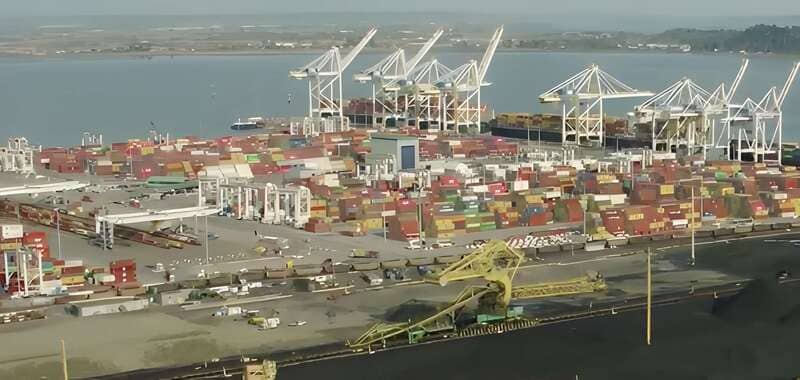
Image Source: Global News (Port of Vancouver, Canada).