



By Waqas Abdullah
In October 2026, Saudi Energy Minister Prince Abdulaziz bin Salman signed three memorandums of understanding (MoUs) with Kuwait, Qatar, and Egypt. The news headlines were as lackluster as could be: power grids, pipelines, fuel stations. If read as standalone agreements, the deals appear to be just that.

In reality, they represent something else entirely: the first concerted move by the Gulf oil market to map a new energy landscape and, less subtly, a strategic reaction to a world thousands of kilometers away in Brazil, Guyana, and Argentina.
What Was Actually Signed
A necessary caveat must be added: MoUs are not binding contracts. There are no investment figures or timelines currently available. What they show is a direction, not a delivery. However, the directional intent is clear:
- Kuwait: The agreement pertains to electricity, renewables, grid interconnection, power exports, and storage.
- Qatar: This text is broader, spanning oil, gas, refining, petrochemicals, and hydrogen, and includes exploring joint pipelines to transport and export oil and gas.
- Egypt: The memorandum concentrates on the trade, transport, storage, and logistics of crude, products, and gas. Saudi expertise will also be provided for fuel stations and the liberalization of the LPG market in Egypt.
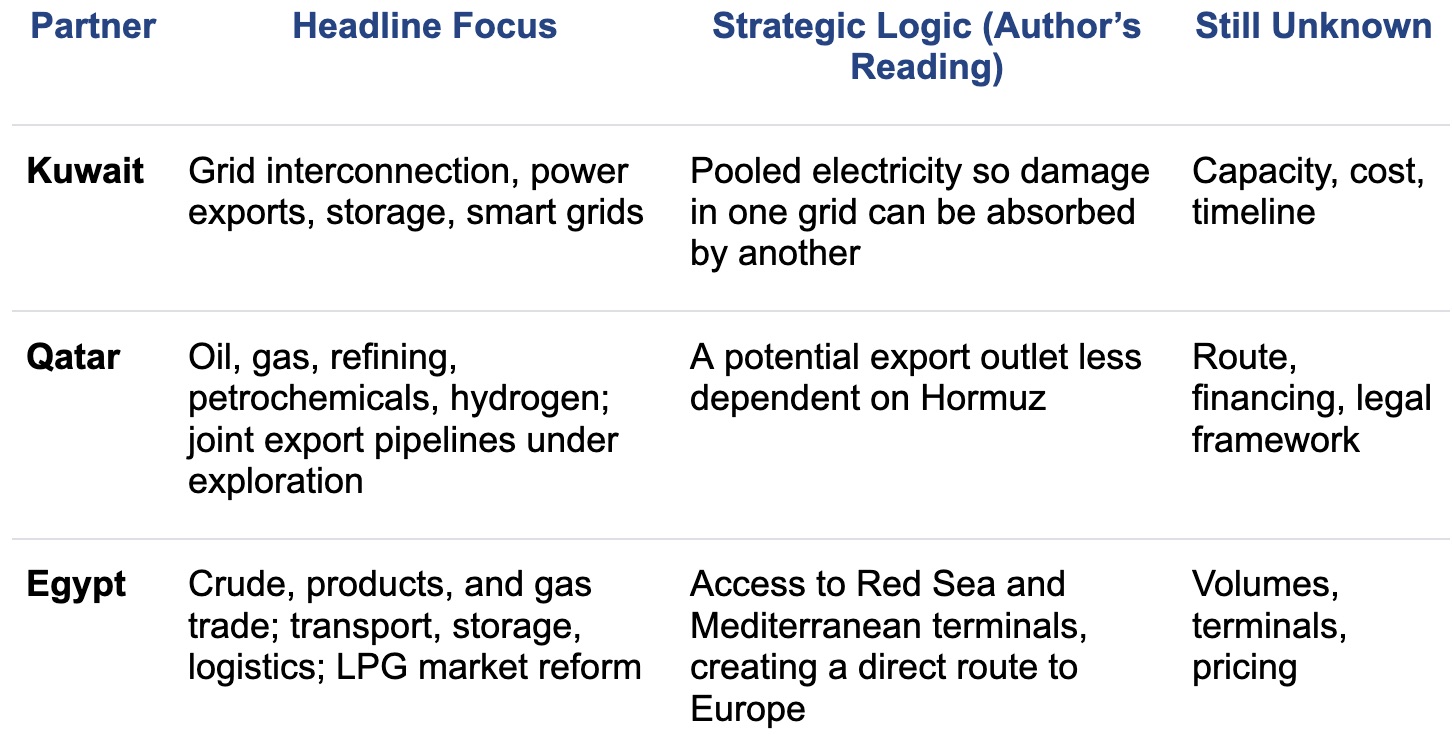
Table 1: The three Saudi energy MoUs signed on 11 October 2026. Sources: Saudi Press Agency reporting via Asharq Al-Awsat, Reuters via Devdiscourse, Albawaba; strategic logic is the author’s interpretation.
Trapped Between Two Chokepoints
To understand the importance of this new direction, one must recall the events since the onset of the Iran war in February. At the height of the conflict, 14 million barrels a day (b/d) were taken out of the market when the Strait of Hormuz was effectively closed. The International Energy Agency (IEA) stated that March’s exports from the Gulf dropped by 9.4 million bpd. Furthermore, oilfield-services filings revealed that damaged and idled plants in Qatar and the UAE wiped out about a fifth of global LNG capacity.
While some barrels can be rerouted through Riyadh’s Red Sea coast, a severe physical threat remains. The Houthis announced the closure of the Bab al-Mandab Strait to Saudi shipping and have repeatedly targeted Saudi energy infrastructure; the drone attack on the Ras Tanura refinery on March 2 highlighted just how exposed the core infrastructure is.
The Gulf is thus trapped between two maritime chokepoints. The logical response is the rapid development of land-based infrastructure—such as grids, pipelines, and shared storage—built directly between friendly capitals.
The Competitor Nobody in Riyadh Mentions
Yet, the story would be incomplete without looking at the other winners of this crisis. Kpler data suggests that crude exports from the Americas are averaging a record 11.7 million b/d, compared with 10.3 million b/d in 2025. Brazil is producing record amounts, Guyana remains one of the world’s fastest-growing producers, and Argentina’s Vaca Muerta shale basin continues to expand. This surging Atlantic supply is the exact reason oil prices have remained just below US$100 a barrel, defying the catastrophic spikes many analysts predicted.
Volume is only half the story; destination is the other. In recent months, China has purchased almost half of Brazil’s exports, while Guyanese crude has become a primary choice in Europe, filling the vacuum left by Russian oil. In short, Asian and European refiners—the two largest consumer bases for Gulf oil—have spent months learning how to buy and operate completely independent of the Strait of Hormuz.
This shifts the threat to Riyadh from temporary to permanent. The military blockade of the strait may be temporary, but the structural diversification it forces upon global buyers is not. Procurement departments that have established new contracts and altered tanker routes will not rip up their agreements the day the strait reopens. The biggest danger to the Gulf is not a physical blockade, but the permanent disappearance of its security-of-supply premium.
The stakes are macro, not just strategic. The International Monetary Fund (IMF) recently upgraded its growth projection for Brazil by half a percentage point. Meanwhile, Argentina—selling its oil in US dollars—managed to pay off US$4.3 billion in foreign debt and significantly improve its foreign reserves. Former price-takers have discovered they are now price-makers. This is a newfound economic reality that no finance ministry in Latin America will willingly give up, and no Gulf planner can afford to ignore.
Why Egypt is the Quiet Centerpiece
This context changes how we view the new agreements. The MoU with Egypt places a special emphasis on transport, storage, and market integration. An overland export route to Europe running through Saudi Arabia could reach Egyptian facilities on the Red Sea or the Mediterranean without ever passing through Bab al-Mandab or Hormuz.
It is in Europe where Guyana’s oil is already actively fighting for market share. From this perspective, the Egypt deal is not a diplomatic gesture to a “friendly neighbor”; it is a race for the European market, played out through pipelines and tank farms rather than traditional price wars.
The Qatar clause is driven by the exact same logic. If Doha’s oil and gas can be exported via pipelines shared with Saudi Arabia, Qatar gains an export route independent of Hormuz. Similarly, the Kuwait grid link acts as an analogous safety net, pooling electricity capacity so that physical damage to one nation’s grid can be immediately absorbed by another.
Where the Plan Could Fail
Despite the grand strategy, four clear restrictions could derail these plans:
- Cost vs. Commitment: MoUs are cheap to sign; pipelines are incredibly expensive to build. The hardest hurdles—financing, precise routing, and legal frameworks—have not yet been addressed.
- Intra-Gulf Geopolitics: Saudi Arabia and Qatar have a complex geopolitical history. A Qatari export line crossing Saudi territory would give Riyadh significant leverage that Doha may not be ready to concede.
- The Vulnerability of Land: Overland infrastructure is not inviolate. Pipelines and terminals remain vulnerable to sabotage and drone warfare, as proven by the Houthi attacks on Ras Tanura. Rerouting energy overland doesn’t eliminate vulnerability; it merely moves it.
- The Factor of Time: Even if these MoUs were converted into binding contracts today, infrastructure of this scale takes years to finance and construct. Global buyers are changing their procurement habits right now. In this race against the Americas, the Gulf started several lengths behind. The winners will be those who move physical barrels, not those who draw maps.
From Swing Producer to Route Manager
A broader trend is emerging. Over the past year, Saudi Arabia has aggressively built up its security and economic redundancies. Following its Strategic Mutual Defense Agreement with Pakistan in September 2025, Riyadh signed the Mecca Joint Defense Agreement with Turkey and Pakistan in February 2026—a move widely interpreted by analysts as an effort to diversify its military partnerships away from a single Western patron.
The energy MoUs reflect the exact same defensive instinct. Riyadh will no longer take it for granted that any single ally, route, or chokepoint is secure. It is hedging its bets.
For Brazil, Guyana, and Argentina, the lesson is twofold. The current premium paid for barrels outside conflict zones is real, but it has an expiration date. That premium will shrink the moment the Gulf develops functional bypass capacity. Latin American producers must capitalize on this window now by locking in long-term supply contracts and investing heavily in their own export infrastructure while the security premium remains high. Guyana, for instance, has a golden opportunity to upgrade its grid and port capacities, which currently lag behind its production potential.
Ultimately, the Gulf’s role is shifting from a traditional “swing producer” to a “route manager.” The old geopolitical game was simply selling the oil; the new game is guaranteeing its delivery. For global importers, this infrastructure race is a win-win, ensuring lower costs during the next inevitable crisis. For everyone else, these three pieces of paper are a stark reminder that the modern energy business is no longer conducted inside the oilfields, but in the volatile spaces between them.
Three Indicators to Watch
To determine whether these memorandums will reshape history or simply join the long list of overhyped Gulf communiqués, watch for three concrete developments:
- Do Riyadh or Doha publicly announce a specific, agreed-upon pipeline route?
- Do we see direct Saudi capital flight into Egyptian storage terminals and Mediterranean ports?
- Do Latin American producers successfully counter by locking global buyers into multi-year, long-term contracts?
Should all three occur, then these memorandum will have made a difference. If they don’t, then they will be part of the long list of Gulf communiqués that were hyped out of proportion.
Author: Waqas Abdullah – Geopolitical analyst specializing in Middle Eastern and Indo-Pacific politics. A Türkiye Bursları Scholar, he is pursuing a Master’s in International Relations at Selçuk University in Konya, Türkiye. His research focuses on climate refugees, human security, and regional cooperation.
(The views expressed in this article belong only to the author and do not necessarily reflect the views of World Geostrategic Insights).
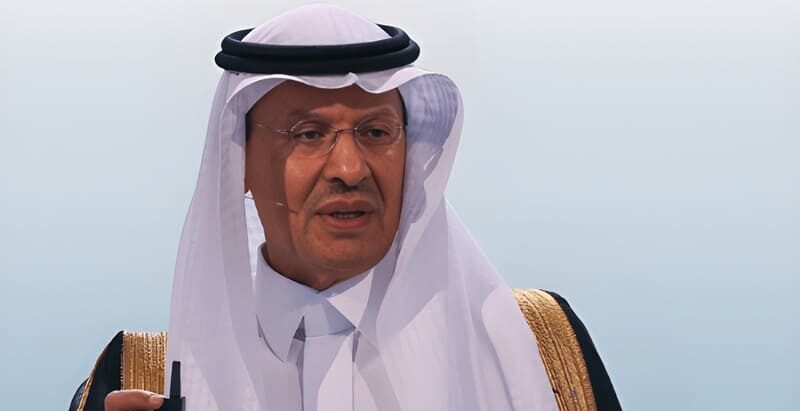
Image: AFP (Saudi Energy Minister Prince Abdulaziz bin Salman).