



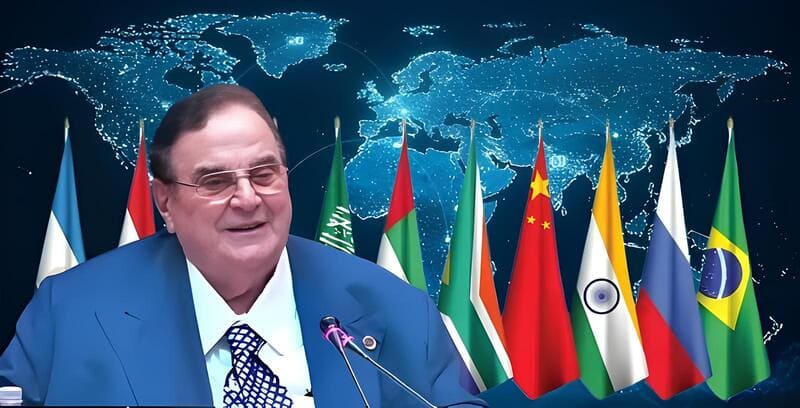
A Review by World Geostrategic Insights of Giancarlo Elia Valori‘s new book, GLOBAL TRENDS 2023–2026: From BRICS to AI—The Search for a New World Order (Tendenze Globali 2023–2026: Dai BRICS all’IA: la ricerca di un nuovo ordine mondiale), featuring a foreword by Oliviero Diliberto and an introduction by Marco Tronchetti Provera.
Overview and Methodological Framework
In his forthcoming book, GLOBAL TRENDS 2023–2026: From BRICS to AI—The Search for a New World Order, Professor Giancarlo Elia Valori delivers an ambitious, highly integrated macroeconomic and geopolitical analysis of a world in systemic transition. Covering a crucial multi-year window, the volume argues that the contemporary international order is shedding its post-Cold War skin, evolving rapidly into an interconnected, multipolar arena where traditional diplomacy, bleeding-edge technology, and resource security collide. Moving beyond superficial, media-driven narratives, Valori applies a realism-infused methodology that insists on understanding rising global powers through their own histories and strategic ambitions rather than through a Western-centric lens.
The expanded architecture of the volume captures this complex web of interdependence by splitting the text into seven heavy-hitting thematic blocks: the rise of the Global South, the geopolitical architecture of Artificial Intelligence, global commodities, an exhaustive study of Chinese statecraft, the disruptive impact of the Trump administration, the fragmentation of European defense, and the structural parameters of an emerging global order.
This multidimensional approach is strongly validated by the book’s dual introductory contributions. Oliviero Diliberto, a professor and scholar of Roman law, grounds the volume’s geopolitical realism in his foreword, emphasizing that very few contemporary observers possess the courage to challenge mainstream conventional wisdom or critically analyze the structural drivers of global disorder. Concurrently, as noted by prominent business executive and industrialist Marco Tronchetti Provera in his introduction, Valori’s text correctly identifies that evaluating the modern global economy now requires an integrated framework where political decisions yield immediate industrial impacts, and technological capacity functions as a core pillar of state sovereignty.
Strategic Blocs, Digital Sovereignty, and Commodities
The volume frames the ongoing transition by mapping the evolution of the BRICS nations in Chapter I. Valori examines their role in modern global governance, positing that the “Greater BRICS Cooperation” is a functional coalition challenging post-WWII institutional inertia, contrasting its project-driven expansion in Africa with the European Union’s fragmented policies. The BRICS bloc functions as a pragmatic, project-driven economic coalition rather than a structured military alliance, lacking a centralized headquarters or formal charter. The organization’s member states—China, India, Russia, Brazil, and South Africa—collectively represent a massive macroeconomic footprint, controlling a significant share of global GDP and strategic resources.
In Chapter II, Valori shifts from physical geography to digital topography, dissecting how Artificial Intelligence is profoundly rewriting the rules of state sovereignty, intelligence gathering, and cultural soft power. Rather than treating AI merely as an industry, the text presents it as a foundational utility determining global competitiveness, tracking its impact from the algorithmic competition to its optimizations within modern oil and gas supply chains.
Chapter III tackles the material realities undergirding this new world order. Valori builds a sophisticated matrix linking technological supremacy to hard commodities, ranging from the high-stakes theater of aerospace technology to the vital geopolitical bottleneck of rare earth elements, juxtaposing multi-trillion-dollar global industries like coffee, tea, and biofuels against severe systemic crises like world hunger and the return of maritime piracy.
The Centrality and Historic Mission of the Middle Kingdom
The core of Valori’s analytical effort unfolds in the dramatically expanded Chapter IV, a dense, authoritative examination of the People’s Republic of China. Holding the distinction of Honorary Professor at Peking University, Valori provides an inside-out reading of the Chinese state.
The Author meticulously breaks down the nuances of contemporary Chinese diplomacy up to 2026, mapping flashpoints such as intermediate-range missile deployments around China, maritime frictions with the Philippines within the ASEAN framework, and a granular assessment of Sino-Japanese and Sino-Indian relations. Valori highlights how China’s unconstrained trade model serves as an alternative to global protectionism, anchoring this analysis in structural domestic policies like the 15th Five-Year Plan and domestic achievements, including the 30th anniversary of the landmark 1995 World Conference on Women in Beijing.
Crucially, Valori contextualizes China’s modern rise through its historical trajectory—from its immense, overlooked sacrifices as a primary battlefield during WWII to its role as an architect of the post-war order and a pioneer of the Non-Aligned Movement. By linking ancient heritage to Xi Jinping Thought and modern initiatives like the International Day of Dialogue among Civilizations, the author frames China’s “Community with a Shared Future for Mankind” as a civilizational mission rather than a mere geopolitical strategy.
The Trump Era: Tariffs, and Hegemonic Returns
In a vital and timely addition, Chapter V turns its lens toward Trump’s United States, tracking the profound geopolitical shocks triggered by the administration’s aggressive economic nationalism and “America First” reorientation. Valori analyzes the sweeping tariff wars unleashed against the PRC and what he terms the “EU protectorate,” detailing how these blunt economic instruments disrupt global supply chains and inadvertently penalize traditional Western allies, such as British industries.
Beyond trade, this section exposes the weaponization of technology under the Trump administration, particularly through project “Stargate”—a strategic initiative framing Artificial Intelligence as a primary instrument of American military and intelligence supremacy. Furthermore, Valori maps the geopolitics of Trump’s territorial and strategic “returns”—spanning from the Marshall Islands to Greenland, the deployment and upgrading of the THAAD missile system, and assertive maneuvers in Mexico, the Middle East, and Iran. This American resurgence is directly contrasted against the shifting dynamics of China-Africa relations, illustrating a zero-sum struggle for structural influence in the Global South.
An Uncoupled Europe and the Maritime Indo-Pacific Shift
Chapter VI, aptly titled “Uncoupled Europe in Motion,” diagnoses the severe strategic paralysis plaguing the European Union. Valori dissects an EU caught flat-footed between global trade wars, the digital economy, and the structural vulnerabilities of the Euro-to-Dollar relationship.
The most striking insight in this section is Valori’s documentation of European naval maneuvers in the Indo-Pacific. He tracks the maritime deployments of the British, French, Spanish, Dutch, and German navies—explicitly noting the resurgence of German militarism on the high seas. The Author interprets these far-flung naval posturings not as a sign of unified strength, but as a symptom of fragmentation; individual European powers are independently chasing strategic relevance in the Pacific theater, exposing the vacancy and impotence of the EU’s collective foreign policy.
Toward a New Multipolar Architecture
The volume culminates in Chapter VII with a sweeping, theoretical look toward the future of global governance. Valori anchors this conclusion by returning to a learned comparative analysis of the concept of “empire” between ancient Rome and ancient China, explaining why Western definitions of hegemony fail to capture China’s contemporary global model.
The final chapters outline the technical realities preventing the adoption of a single world currency and map the fierce, multi-layered competition occurring over regional variables, the control of the Pacific Ocean (the “thalassocracy of powers”), and the emerging race for resource claims in Antarctica. Valori delivers a sobering warning: the era of nuclear arms reduction is definitively over, and humanity is entering its most perilous arms race. Yet, by highlighting the historic contribution of Japanese citizen movements toward global denuclearization, the volume leaves room for civil agency amidst great-power competition.
Conclusion
About the Author of the Book:
Book Review by World Geostrategic Insights. This article, like all articles published on World Geostrategic Insights, cannot be republished without the written permission of the editor of World Geostrategic Insights.