



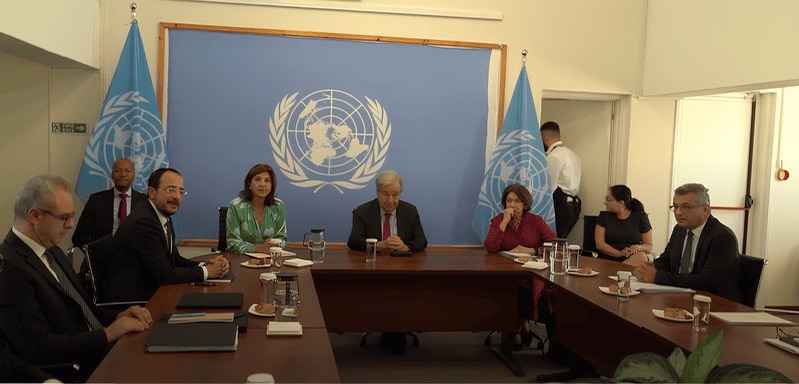
During his July 2026 visit to Cyprus, UN Secretary-General António Guterres on 29 July held separate and joint discussions with Republic of Cyprus President Nikos Christodoulides and Turkish Cypriot leader Tufan Erhürman. The meeting was a reiteration of the UN’s commitment assist the communities in their efforts to reach a comprehensive, sustainable solution to the Cyprus issue.

The dialogue offers a cautious but important opening in one of Europe’s longest-running conflicts known as the Gordian knot. It would be premature, however, to describe the meeting as the resumption of full peace negotiations because of the complexities surrounding it, including the regional as well as guarantor powers, Türkiye and Greece.
Nevertheless, the significance of the July meeting cannot be ignored. The immediate achievement was the restoration of direct political engagement and the creation of conditions for a possible UN-led process. The current process is therefore best understood as exploratory diplomacy aimed at determining whether sufficient common ground exists for substantive negotiations.
Whether this opening develops into a settlement will depend on the ability of the two sides of the island, Türkiye, Greece, the United Kingdom, the European Union, and the United Nations to translate dialogue into confidence-building measures and eventually into agreement on the central constitutional and security questions. The Greek Cypriot leader and the Turkish Cypriot leader have agreed to meet for a dialogue on 26 August 2026.
The choice to focus first on confidence-building is sensible and prudent. After years of political mistrust, a formal negotiation process without preparatory measures could quickly reproduce the failures of earlier rounds. The UN Secretary-General has called on the two leaders of the island to identify and implement measures that improve the daily lives of people on both sides. He also emphasised the importance of the UN peacekeeping operation’s authority in the buffer zone and along the ceasefire lines.
Cyprus has remained divided since 1974, with the UN maintaining a peacekeeping presence and a buffer zone between the two sides. The UN’s Mission of Good Offices is mandated to assist the Greek Cypriot and Turkish Cypriot leaders in reaching a comprehensive and lasting settlement through UN-facilitated negotiations. The political process keeps stalling especially after the failure of the Crans-Montana talks in 2017. All the dialogues including the 2017 one have been aimed at reunifying the divided island of Cyprus. Every time the talks ends without a peace agreement due to irreconcilable differences over security, foreign guarantees, and military troop withdrawals. After the Crans-Montana talks, there have been many informal meetings between the two sides however with no conducive outcome. Hence, the outreach by the UN Secretary General on 29 July was a light of hope. Though the conflict still remains unresolved but it has reopened a channel of dialogue that has become increasingly fragile.
The Central Disagreement
The greatest obstacle is the absence of consensus on the political basis of a settlement. The UN Security Council continues to support an enduring settlement based on a bicommunal, bizonal federation with political equality. This position is supported by the Greek Cypriot side as well as Greece. In January 2026, the Security Council again recalled this framework when renewing the mandate of the UN peacekeeping force.
The Republic of Cyprus has reaffirmed this position, including its support for a settlement within the established UN framework. Türkiye, however, has recently stressed the principle of the sovereign equality and equal international status of the Turkish Cypriot community as the basis for a sustainable settlement. Ankara’s preferential solution has been the recognition and implementation of a two-state solution. These positions reveal the core difficulty—the two sides remain divided not only over the details of power-sharing, territory, property, security, and guarantees, but also over the political model that should guide negotiations.
A durable process will therefore require more than encouraging the leaders to meet. It will require careful work on the meaning of political equality, the distribution of federal powers, the status of the two communities, security arrangements, property rights, territorial adjustments, and the role of the guarantor powers (Türkiye, Greece and the United Kingdom). If these questions are postponed indefinitely, confidence-building may improve relations for time being (though not guaranteed) without producing a political settlement. If they are addressed too early and without sufficient preparation, they may once again cause the process to collapse. However, the step towards confidence-building is a hopeful one.
Why Confidence-Building Matters
The most promising aspect of the present diplomacy is the possibility of linking high-level negotiations with practical cooperation. Apart from the UN, the European Union has an important but carefully circumscribed role. The Republic of Cyprus is an EU member, while the northern part of the island remains outside the effective application of EU law. The European Commission’s 2026 reports reaffirmed the Union’s support for reunification and recorded assistance to the Turkish Cypriot community. Lot of aid under the Green Lines Regulation of 2025 (the ceasefire line between the two communities of the island is known as the Green Line) has gone to the northern side of the island. The Green Line Regulation sets the rules for the movement of people and goods across the line separating areas controlled by the Republic of Cyprus and the Turkish Cypriot community.
Such measures cannot substitute for a political agreement, but they can reduce separation and create constituencies that benefit from cooperation. Technical committees dealing with the environment, health, crime, cultural heritage, economic activity, missing persons, and other everyday concerns can help establish habits of communication. The UN has specifically highlighted the work of bicommunal technical committees and the Committee on Missing Persons as mechanisms capable of connecting political dialogue with the lived experiences of Cypriots.
Practical cooperation is valuable because it can demonstrate that engagement produces tangible benefits. Improved crossing points, cooperation on energy and water, joint environmental initiatives, and expanded educational and civil-society contacts can gradually weaken the logic of permanent separation. At the same time, these measures must not be presented as a replacement for a comprehensive settlement.
A well-negotiated settlement is significant not only for the two sides of the island but also its implication on the region.
The Wider Regional Significance
Cyprus is not an isolated local dispute. Its location in the Eastern Mediterranean connects it to relations among Türkiye, Greece, the United Kingdom, the European Union, and the broader security environment of the region. The unresolved dispute affects maritime claims, energy cooperation, migration, military deployments, and relations between Türkiye and Greece as well as with the EU.
For this reason, progress in Cyprus could have benefits beyond the island. An important stumbling block in the resolution of the Cyprus conflict has been the fundamental differences between the two guarantors, Türkiye and Greece. Ankara’s preferential solution of recognition and implementation of a two-state solution remains one of the fundamental factors that makes the right recipe of the stalemate of another dialogue between the conflicting parties of the island. Meanwhile, Greece rejects Türkiye’s two-state division. Athens pushes for the removal of Turkish troops from the northern side of the island as well as supports a bicommunal and bizonal federation as a solution to the Cyprus problem.
As the guarantors of Cyprus, these fundamental differences between Ankara and Athens poses obstacles for the resolution of the Cyprus conflict. Additionally, Türkiye and Greece are NATO members but Ankara is not a member of the EU whereas Athens (and Nicosia) is, which further complicates the matter. Ankara’s non-membership to the EU club even after decades of negotiations further has added to complication of the issue. In fact, the membership of Ankara to the EU to a larger extent is linked to the resolution of this gordian knot of the island, which many (with passing years) tries to overlook.
Nevertheless, despite the many historical disputes that festers between Türkiye and Greece, a Friendship Declaration based on Athens Declaration on Friendly Relations and Good-Neighborliness signed in December 2023 between the two is in progress. This functioning dialogue hopes to reduce tensions between Türkiye and Greece, improve communication within the Eastern Mediterranean, and create space for cooperation on energy, transport, maritime safety, and regional stability. Though ambitious however, the constant challenges between the two downplay any enthusiasm that two showcases. Conversely, a renewed breakdown could reinforce wider rivalries and make the island more vulnerable to external competition.
The EU also has a direct interest in the process because the Republic of Cyprus is an EU member, while the northern part of the island remains outside the effective application of the acquis Communautaire. The Union’s assistance to the Turkish Cypriot community and support for cross-community ties provide useful instruments, but the EU must coordinate carefully with the UN process and avoid appearing to prejudge the outcome of negotiations.
A Cautious Opportunity
The July dialogue should therefore be viewed as a narrow but genuine diplomatic opportunity. It has restored contact, encouraged confidence-building, and produced a UN plan for further engagement. Yet it has not resolved the fundamental disagreement over the basis of the settlement, and no formal comprehensive negotiations have been announced.
All the parties understand that the UN cannot impose peace but the parties must ultimately negotiate and accept a settlement that is conducive to both sides. The present moment should therefore generate neither excessive optimism nor premature pessimism. Dialogue has reopened a door, but the distance between the two sides remains substantial. The test of the process will be whether the current political opening produces measurable improvements in the daily lives of Cypriots and creates enough trust to return the parties to substantive negotiations. Only then can the recent meetings become the beginning of a settlement rather than another temporary pause in Cyprus’s long diplomatic impasse.
Apart from the engagement between the two communities of the island, the Türkiye-Greece angle cannot be overlooked. More so over as things are becoming complicated in the Mediterranean region with many developments that are taking place in the wider region. The spat between Ankara and Athens over the Aegean Sea and the signing of the recent defence pact between Türkiye-Saudi Arabia-Pakistan have the seeds of complicating the matters for a genuine resolution of the Cyprus conflict.
Author: Dr. Indrani Talukdar – Fellow at the Chintan Research Foundation, New Delhi.
(The opinions expressed in this article belong only to the author and do not necessarily reflect the views of World Geostrategic Insights).
Image Source: UN Media