



By Qurat-UL-Ain Shabbir
Review of the book The Global Third Nuclear Age: Clashing Visions for a New Era in International Politics, by Andrew Futter, Ludovica Castelli, Cameron Hunter, Olamide Samuel, Francesca Silvestri, and Benjamin Zala, Routledge, 2025.

The nuclear studies field has a well-known blind spot. For decades, its central debates, on deterrence, escalation, and arms control, have been conducted largely in Washington’s terms, with the rest of the world treated as a backdrop to great power competition. The Global Third Nuclear Age, a collaborative volume by six nuclear politics scholars, sets out to correct this. It argues that we have entered a new and more dangerous phase of nuclear history, one shaped not just by the familiar rivalry between Washington, Moscow, and Beijing, but by a much wider cast of states each pursuing distinct and often incompatible visions of nuclear security. The result is an ambitious and largely successful attempt to globalize a field that has too often mistaken its own parochialism for the whole picture.
The book’s organizing device is a fourfold typology. Drawing on twenty country case studies, the authors sort states into Activists and Protestors (Austria, Kazakhstan, South Africa, Indonesia, Brazil), who reject nuclear deterrence outright and campaign for abolition; Hedgers and Balancers (Iran, Germany, India, the United Kingdom, China), who keep their options open while avoiding firm commitment to any single nuclear posture; Technological Transformers (Japan, Australia, Israel, South Korea, Taiwan), who are investing in advanced conventional and strategic non-nuclear capabilities as an alternative or supplement to nuclear weapons; and Nuclear Traditionalists (the United States, France, Russia, Pakistan, North Korea), for whom nuclear weapons remain the central pillar of national security.
The book is structured accordingly, moving deliberately from the states most opposed to the nuclear status quo to those most committed to it, with each part closing on a comparative summary. It is a genuinely novel way of organizing the field, and it produces real analytical payoff, particularly in cases like India, where the authors resist the temptation to force New Delhi into either a rising-power or a rogue-state narrative and instead trace a genuinely hedging posture: modernizing an arsenal while still courting non-aligned credibility, expanding advanced technology while remaining outside the Non-Proliferation Treaty. One former Indian official’s description of the country’s approach as nuclear sui generis, quoted in the chapter, captures the balance the authors strike throughout: attentive to nuance, resistant to easy labels.
It is precisely because the typology works so well for India that its treatment of Pakistan is worth dwelling on, since this is where the book’s own logic comes under the greatest strain. Pakistan is placed among the Nuclear Traditionalists, alongside the United States, France, Russia, and North Korea, a category the authors define by the centrality of nuclear weapons to national security and identity. On the numbers, this fits: Pakistan is expanding its arsenal, developing a nuclear triad, and has adopted a doctrine of Full Spectrum Deterrence covering strategic, operational, and tactical weapons. But the chapter’s own conclusion quietly undercuts the classification. Unlike every other Traditionalist, Pakistan has never published a nuclear doctrine or given a major public address on the subject; deliberate ambiguity, not declaratory clarity, is the operating principle. And where France’s nuclear posture is about status and continuity, and America’s and Russia’s are about managing a two-peer or great-power deterrence problem, Pakistan’s is described by the authors themselves as motivated by something narrower: an India-specific, conventionally driven security dilemma rather than any global ambition.
The authors even note that what unites Pakistan with North Korea is not shared great-power logic but a shared reliance on tactical nuclear weapons to offset conventional inferiority against a specific adversary. That is a meaningfully different kind of nuclear traditionalism, regional and defensive rather than global and status-seeking, and the book’s four-part typology does not quite have room for it. A fifth pathway, or at least a clearer subdivision within the Traditionalist category, would have done more justice to a state whose nuclear logic is so specifically bilateral.
This underweighting of the bilateral dimension recurs across both the Pakistan and India chapters. Each engages seriously with how its subject balances relations with Washington and Beijing, understandably so, given how much of the Third Nuclear Age argument rests on shifting great power dynamics, but the India-Pakistan relationship itself is treated more as backdrop than subject. Flashpoints are noted: the Kargil War, the accidental BrahMos missile launch into Pakistani territory in 2022, the repeated failure of Pakistan’s proposed Strategic Restraint Regime. Yet the book’s own conclusion names the India-Pakistan border as one of the handful of nuclear fault lines where the interaction of nuclear and non-nuclear weapons could most plausibly produce miscalculation. That claim deserved more sustained analytical attention within the case chapters than it receives. Readers come away with a clear picture of how each state manages its great power relationships, but a thinner one of why bilateral risk-reduction between the two has stalled so completely since the last confidence-building measures of the late 1980s and 1990s, or what that stagnation means for crisis stability going forward.
There is a related, more structural question worth raising about the typology itself. The authors insist their four categories are not meant as a hierarchy, and that no value judgment attaches to any pathway over another. Yet the book is nonetheless sequenced from the states most opposed to nuclear deterrence to those most committed to it, a structure that inevitably reads as a spectrum running from disarmament-minded to deterrence-maximalist. It is worth asking how much of the typology’s explanatory power comes from genuinely distinct logics of nuclear behavior, and how much simply redescribes that existing spectrum in new vocabulary. The India chapter suggests the former: hedging is a distinct strategic posture, not just a midpoint between activism and traditionalism. The Pakistan chapter suggests the latter is at least partly true as well, since a state whose nuclear logic doesn’t resemble its supposed category-mates very closely may have been sorted more by its arsenal size than by any shared strategic reasoning.
None of this is to say the periodization at the heart of the book, the claim that we are entering a genuinely new Third Nuclear Age, is unpersuasive. The authors marshal a reasonable case: the erosion of arms control architecture, the return of great power rivalry, the commingling of nuclear and advanced conventional weapons, and the growing normative split symbolized by the Treaty on the Prohibition of Nuclear Weapons all point toward a meaningfully different strategic environment than either the Cold War or the post-1991 proliferation era. The authors are also careful to acknowledge, rather than dismiss, the charge that splitting nuclear history into ages is itself a somewhat Western intellectual habit. But the concept still does more work in explaining the behavior of the major powers than it does for a state like Pakistan, whose nuclear calculus has changed remarkably little across the supposed transition from Second to Third Nuclear Age. If anything, the Pakistan chapter’s own argument, that its nuclear posture has remained fundamentally continuous since 1998, is a quiet challenge to the periodization the book is built around.
For readers based in South Asia, or working on South Asian security more broadly, this book is nonetheless essential reading, not despite these tensions but partly because of them. It is rare to find India and Pakistan treated as fully realized case studies in a book of genuinely global scope, rather than as a regional footnote to superpower competition, and rarer still to find the region’s dynamics interrogated with this much empirical care. The unevenness in how the two chapters handle the bilateral relationship, and the strain the Pakistan case places on the book’s own typology, are not fatal flaws. They are, if anything, evidence that the authors have taken their subject seriously enough to let the region’s complexity push back against their own framework, rather than smoothing it into a tidier story. A book that invites this kind of argument is doing exactly what a book in this field should do.
Extensively researched and genuinely global in ambition, The Global Third Nuclear Age succeeds in what it sets out to do: decentering a field that has spent too long mistaking the view from Washington for the view from everywhere. Where it strains, in classifying Pakistan and in under-theorizing the India-Pakistan dyad specifically, it does so instructively, pointing toward the further, more regionally grounded work this book’s own framework makes necessary.
Author: Qurat-UL-Ain Shabbir – PhD candidate in Defence and Strategic Studies at Quaid-e-Azam University and a Research Officer at the Centre for International Strategic Studies, Azad Jammu and Kashmir.
(The views expressed in this article belong only to the author and do not necessarily reflect the views of World Geostrategic Insights).
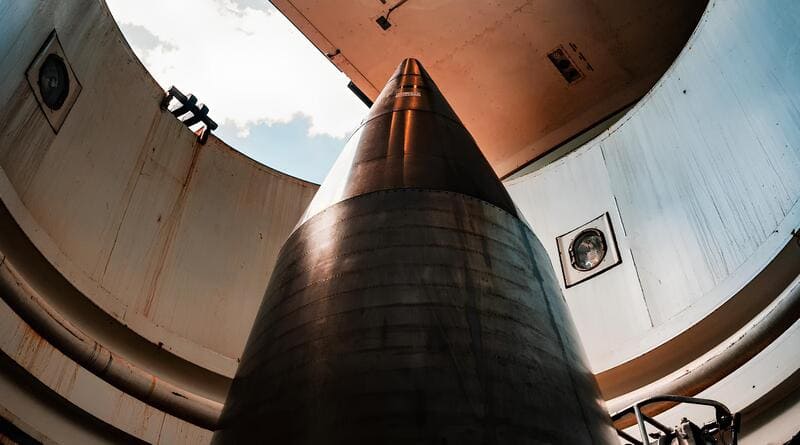
Image Source: U.S. Air Force.