



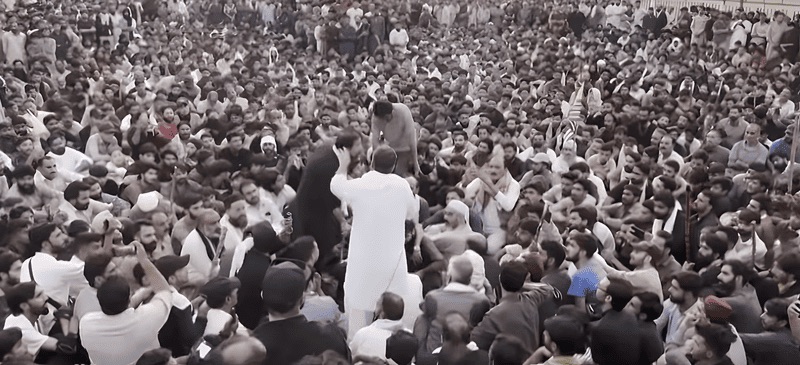
By Angana Kotokey
A new wave of Gen Z-led uprisings is reshaping political landscapes across the world, including in South Asian countries, with India becoming the newest addition after similar protests led by younger generations were observed in countries like Sri Lanka, Bangladesh and Nepal.

Since the rise of the Cockroach Janta Party (CJP) in India, speculation about the likelihood of Gen Z-led protests in Pakistan has been widely discussed across academic and policy circles. After social media platforms (Instagram in particular) highlighted Pakistani youth expressing their online solidarity with the CJP through posting supportive social media reels and drawing comparisons, the internet has shifted its attention to discussing and apprehending similar Gen Z-led protests across the border. Drawing on key factors that have shaped youth-led protest movements, the analysis below examines whether Pakistan’s youth have already mobilised a digitally driven political movement in the past or are yet to witness a distinct Gen Z-led protest movement in their country.
While no single theoretical model comprehensively explains the dynamics of Gen Z movements, existing scholarship on digital activism provides a useful basis for understanding them. Based on these dynamics, Gen Z-led protests generally follow a broad sequence: a catalytic event, digital-first mobilization, decentralized collective action, rapid online diffusion, hybrid online–offline activism, visual and identity-based framing, narrative and counter-narrative contestation, emotional engagement, and finally either policy change, movement adaptation, or eventually a decline. Many recent Gen Z-led protests have exhibited these interconnected dynamics, demonstrating how popular grievances are transformed into networked forms of collective action through digital coordination. In the case of Pakistan, digitally driven popular movements were an integral part of former Prime Minister Imran Khan and his party Pakistan Tehreek-e Insaf’s (PTI) political strategy. However, it is important to mention that such online momentum could not be sustained for long and converted into distinct Gen-Z-Led uprisings primarily because political contestation was increasingly centred on ‘personality-driven and identity-based narratives.’
Digital-Led Mobilization in Pakistan: Lessons from the Past
If the above-mentioned parameters are taken into account, Pakistan has already experienced many of the dynamics commonly associated with contemporary Gen Z protest movements, although not in the form of a fully autonomous youth-led uprising. Instead, these dynamics have largely unfolded through the digitally driven populist movement of Imran Khan and the Pakistan Tehreek-e-Insaf (PTI).
The removal of Imran Khan from office, his imprisonment, and the subsequent crackdown on PTI served as catalytic events that accelerated mass participation. The party responded by relying heavily on social media platforms, peer-to-peer communication networks, and, more recently, artificial intelligence to bypass traditional media, rapidly disseminate its political narratives, and sustain engagement despite institutional restrictions. Digital platforms facilitated hybrid forms of activism by translating online campaigns into electoral participation, public demonstrations, and symbolic acts of resistance.
At the same time, PTI’s emphasis on Tabdeeli and Naya Pakistan created a strong digital political identity, while cyberspace became the principal space for competing narratives between the party and the establishment. Khan’s imprisonment further generated emotional mobilization among younger supporters, and the movement adapted by strengthening decentralized digital networks and expanding its online and transnational outreach. These developments suggest that, although Pakistan has not yet witnessed a distinct Gen Z-led protest movement comparable to those in Bangladesh or Nepal, many of the essential characteristics of such movements are already embedded within the country’s contemporary digital politics.
What can cause a delay in a distinct Gen Z-led protest in Pakistan?
Several factors can contribute to delaying the emergence of a distinct Gen Z-led protest inside Pakistan. Some of the factors can be summarized as follows:
– Absence of a unifying national grievance. Most of the Gen Z-led protests in India’s neighbourhood were not responses to a single event. Many of these uprisings echoed grievances against democratic failure; authoritarian regimes; economic fragility; unemployment; and elite politics and power control. For instance, economic collapse in Sri Lanka, job quota crisis in Bangladesh and corruption and social media restrictions in Nepal were only triggering points amidst large-scale public disgruntlement against the State. Pakistan exhibits many of these structural conditions, including rising unemployment, inflation, political repression, economic instability, and growing public discontent. However, unlike its South Asian neighbours, these grievances remain fragmented across ethnic, provincial, and political divides and have yet to coalesce into a single, nationally shared cause capable of mobilizing a broad-based Gen Z-led protest movement.
– Personality-Driven Politics. Political mobilization in Pakistan is still driven more by personalities than by common public issues. Over the past few years, many young people have been brought together through former Prime Minister Imran Khan and his party, Pakistan Tehreek-e-Insaf (PTI), rather than around an independent youth agenda. Even after Khan’s imprisonment, PTI has continued to use digital platforms such as YouTube, WhatsApp, and TikTok to connect with supporters, shape public opinion, and challenge government policies. As a result, the youth have continued to participate in PTI’s political campaign instead of rallying around issues that directly affect their generation, such as unemployment, education, inflation, or democratic reforms. Consequently, slogans such as “Free Imran Khan” have united PTI supporters but have not brought together young people from different political, ethnic, or regional backgrounds. This focus on political personalities, instead of common causes, has prevented the formation of a broad and independent Gen Z movement in Pakistan.
– Fragmentation of Issue-Based Movements. Pakistan has several ongoing movements that focus on public issues instead of political leaders. For example, the Baloch Yakjehti Committee (BYC) campaigns against enforced disappearances, the Pashtun Tahafuz Movement (PTM) fights for Pashtun rights, and the Aurat March raises issues related to women’s rights. Similarly, the lawyers’ movement focused on restoring judicial independence rather than supporting a political party. However, these movements are often seen as ethnic, regional and ideological. Because of this, they fail to attract support from people across the country and remain limited to specific groups or regions. In many cases, the state has also portrayed these movements as threats to national unity or as being influenced by foreign actors, further reducing their national appeal. As a result, different issue-based movements have not been able to come together under a common national cause, delaying the emergence of a broad and independent Gen Z-led protest movement in the country.
– State Management of Dissent. The Pakistani state has increasingly sought to manage public dissent through digital platforms. By introducing the discourse of “digital terrorism,” it has blurred the distinction between misinformation, political criticism, and legitimate dissent, allowing criticism of the military and state institutions to be treated as a national security issue. At the same time, the state has used digital platforms to promote narratives of military success, external threats, effective crisis management, and Pakistan’s growing international role. These narratives divert public attention from domestic political and economic challenges while strengthening confidence in state institutions. Institutional restrictions have also limited youth mobilization. The ban on student unions imposed by General Zia-ul-Haq in 1984, which remains in force, has significantly reduced the ability of students to organize collectively. A 1993 court ruling further reinforced this restriction by requiring students and one of their parents to sign an affidavit promising to stay away from politics as a condition for admission. Together, these digital and institutional measures have made it more difficult for young people to assemble independently, delaying the emergence of a distinct Gen Z-led protest movement.
Way Forward
Pakistan has already experienced many of the features associated with contemporary Gen Z protest movements, particularly widespread digital mobilization, online political engagement, and youth participation in virtual activism. However, these developments have not resulted in a distinct Gen Z-led uprising. Instead, digital mobilization has largely remained tied to existing political actors, especially PTI, while issue-based movements remain fragmented and state-led management of dissent has limited independent youth organization.
Consequently, Pakistan represents a case of digital mobilization without a Gen Z uprising. This does not mean that such a movement is impossible. If growing economic hardship, political dissatisfaction, and youth grievances eventually converge around a common national cause that cuts across political, ethnic, and provincial divisions, Pakistan’s digitally connected youth may still emerge as an independent political force. Until then, digital activism is likely to continue shaping political debates without transforming into a unified nationwide Gen Z-led protest.
Author: Angana Kotokey – Research Fellow, ARPA Foundation, New Delhi, India.
(The views expressed in this article belong to the author and do not necessarily reflect the views of World Geostrategic Insights).
Image Source: Mirror NOW