



By Nazia Sheikh
The international security environment is undergoing profound change, marked by strategic competition, new technologies, and the erosion of traditional arms-control treaties. The 2026 expiration of the New Strategic Arms Reduction Treaty (New START) between the United States and Russia has left a significant gap in the current nuclear arms control regime.

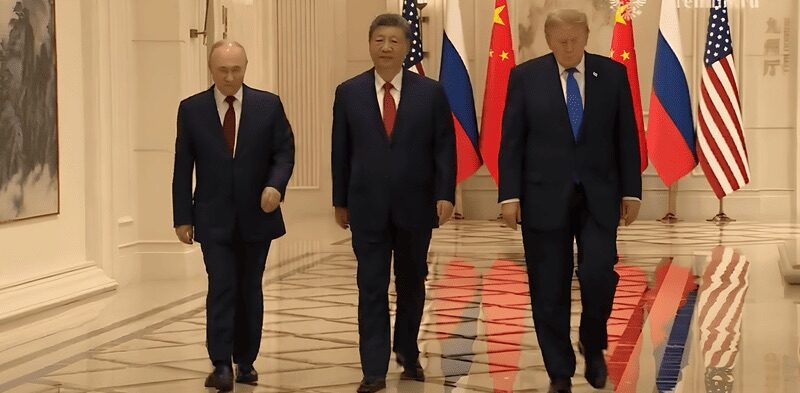
Meanwhile, the modernisation of existing nuclear forces and trends in the capabilities of nuclear powers have complicated the process of arms control. In this scenario, the meeting of the presidents of the US, China, and Russia in Shenzhen on the sidelines of the Asia-Pacific Economic Cooperation (APEC) summit is a chance to discuss a more comprehensive approach to nuclear risk reduction.
The US and Russia have significantly larger nuclear forces than China. However, an immediate agreement on nuclear reductions is impractical. The force structure, deterrence needs, and security interests of the three countries are different; therefore, a quick agreement on arms reductions cannot be achieved. The first step should not be identical reduction obligations on all three but confidence-building measures and transparency. A first step is to establish a practical regular trilateral nuclear consultation mechanism. Such a mechanism focuses on exchanging views on nuclear doctrines, crisis communication, and strategic risk reduction.
The three leaders may also want to renew the 1985 Reagan-Gorbachev statement that a nuclear war cannot be won and will never be fought. A reaffirmation of this would give a common political basis for reducing the risk of nuclear weapons. It may be linked to pledging to reinforce ongoing communication mechanisms in times of military crisis, such as the improvement of existing military-to-military contacts and emergency communication mechanisms.
Frequent political and working-level meetings would help these three countries continuously to discuss new issues in the early stages and prevent them from escalating into conflict. Importantly, the mechanism should also be given a specific mandate to enable discussions about nuclear threats and risks to proceed independently of any other diplomatic disagreements. The second practical approach might be notifications before missile launch. Providing advance notice of selected ballistic missile launches by the three countries would help minimize uncertainty and the potential for misunderstanding routine military activity. This is technically and diplomatically achievable, as is already shown in bilateral notification arrangements. Such practices could be extended to a trilateral context, with mutually agreed notification regimes and adequate protection of sensitive information, which could be a concrete confidence-building measure.
There is also a possibility of limited, but significant, cooperation in the field of emerging technologies. How relevant is military planning, the assessment of intelligence and early-warning systems in the use of AI? When it is used in nuclear command and control, it introduces concerns about the time taken to make decisions, the reliability of the system, and technical failures. The three countries might start by agreeing on a policy: This principle is that military use of AI must be kept under human control,Later working-level discussions might include protection from unintended escalation, especially when automated systems are used to complement early-warning and threat assessment.
Another topic that should be addressed is nuclear testing. It is still important to keep respecting the international standard on nuclear testing to ensure confidence in the non-proliferation regime. The three countries could consider technical cooperation on seismic monitoring data for better evaluation of unusual underground seismic events. Providing relevant information from national monitoring stations, especially when it can enhance the capabilities of the Comprehensive Nuclear-Test-Ban Treaty Organization’s International Monitoring System, without exposing sensitive military information, would help to enhance verification capacity. This cooperation would also help in achieving the larger goal of the Comprehensive Nuclear-Test-Ban Treaty’s implementation.
Strategic stability discussions should also include the prevention of an arms race in outer space. The security of space-based systems is increasingly associated with nuclear risk reduction functions, as space-based systems increasingly support communication, navigation, intelligence, and early-warning functions. The three countries can implement concrete measures to prevent the launch of nuclear weapons and other weapons of mass destruction into orbit, and increase consultations on activities that might affect the peaceful use of outer space. Joint political agreement on existing international commitments and discussion of additional confidence-building measures would be a good starting point.
There may be opportunities for further consultation on regional non-proliferation issues. International security concerns are still a significant challenge. Diplomatic dialogue can help to renew the efforts towards peaceful solutions, enhance the international monitoring role and promote compliance with relevant international commitments among the three countries. The summit can be judged not so much by an immediate reduction in nuclear inventories as by the success in reaching an agreement with the other nations.
A more realistic result would be a political decision to continue with the regular nuclear consultations, create working groups aimed at specific technical issues, and agree on various practical steps to implement confidence-building measures. All of this would set the stage for more far-reaching negotiations in the future, such as negotiations on transparency of the nuclear arsenal and measures to cope with the lack of a replacement for New START. Ultimately, the Trump-Xi-Putin meeting offers a chance to refine nuclear arms-control diplomacy to a new world order. Respect for national security concerns, flexibility, and an incremental approach will be required for progress, taking into account the different capabilities of the three countries. The leaders should be concerned with concrete steps that will lead to tangible outcomes.
Author: Nazia Sheikh – Research Officer at the Centre for International Strategic Studies, AJK. She holds an MPhil in International Relations from the International Islamic University, Islamabad, Pakistan. She previously served as a Visiting Lecturer at the University of Azad Jammu and Kashmir, Muzaffarabad, Pakistan. Her research interests include arms control, disarmament, and nuclear non-proliferation.
(The opinions expressed in this article belong only to the author and do not necessarily reflect the views of World Geostrategic Insights).
Image Source: AFP.