



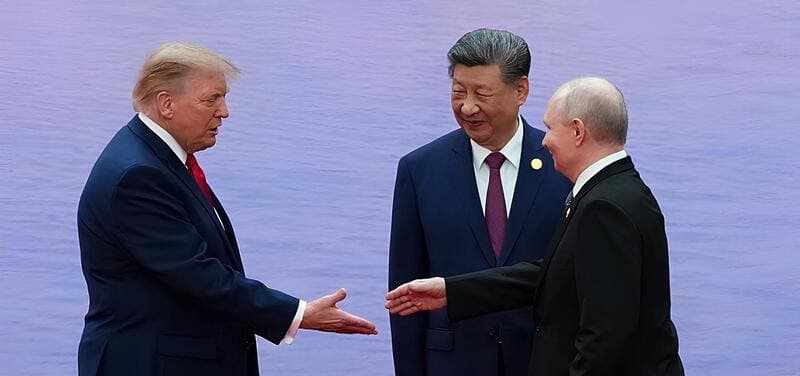
The trilateral summit between Donald Trump, Xi Jinping and Vladimir Putin, on the sidelines of the 33rd Asia-Pacific Economic Cooperation (APEC) Leaders’ Meeting in Shenzhen, could be deeply worrisome were it not for Trump’s ineffectiveness.
Indeed, Trump would gladly trade the liberal international order for a concert of great powers in which each would carve out its own sphere of influence. Yet, the damage that such a line of thinking could inflict upon that order is mitigated by Trump’s inability to advance it effectively.
Trump’s ambition to remake the global order bears a striking resemblance to the project embodied by the revisionist axis led by Beijing and Moscow. Indeed, the oxygen sustaining the International Liberal Order is being squeezed out by the combined pressure exerted by the three great powers of our time. Not surprisingly, the Editorial Board of The Wall Street Journal recently reported that the United States, Russia and China are supporting former Hungarian Prime Minister Viktor Orbán for the position of United Nations Secretary-General (The Editorial Board, 2026). Against this backdrop, a meeting between the heads of state of these three powers cannot bode well. Its worst possible outcome would be the establishment of a concert of great powers granting each a free hand within its respective sphere of influence.
However, Donald Trump does not seem capable of accomplishing such a disruptive task, for several reasons.
Firstly, because he is no Richard Nixon. The latter was able to make Beijing and Moscow compete against one another for Washington’s favour. As John Lewis Gaddis, one of the leading historians of the Cold War, observed: “Nixon had placed the United States in the enviable position of being able to play off its Cold War adversaries against one another…It was a performance worthy of Metternich, Castlereagh, and Bismarck, the great grand strategists” (Gaddis, 2005, p. 183). Today, by contrast, Trump runs the risk of being outmanoeuvred by leaders who are considerably more prepared and politically shrewd than he is. Although this would hardly be a desirable outcome, it would be far worse to have an American Machiavellian strategist adding his weight to the revisionist ambitions of Xi and Putin.
Secondly, Trump does not believe in bureaucracies, institutions or experts. His is a form of personal diplomacy at odds with established procedures, in which an ad hoc approach to foreign policy prevails. As a result, the achievement of consolidated or long-term results becomes difficult. Without the backing of institutional structures, diplomatic posturing tends to dissipate, while optics take precedence over substance. As a well-known Chinese expression has it, Trump’s foreign policy tends to amount to “thunder without rain”.
Thirdly, Trump places undue importance on forging close interpersonal relationships, at the expense of institutional linkages. Although personal rapport between leaders can facilitate dialogue and reduce tensions, it cannot eliminate the structural contradictions arising from competing national interests and security requirements. Europe’s historical experience offers a useful cautionary lesson against the belief that personal relationships can, by themselves, guarantee international peace or a convergence of interests.
Throughout European history, kings and emperors repeatedly discovered that family solidarity could not overcome the conflicting interests of their states. First cousins fought wars, brothers-in-law invaded one another’s territories, and fathers-in-law joined coalitions against their sons-in-law. If even such powerful family ties proved insufficient to prevent conflict, Trump’s belief that diplomatic structures can be replaced by personal bonds amounts to a road to nowhere.
Fourthly, Trump embodies the quintessential lame-duck presidency. A disastrously unpopular style of governance, combined with the poor quality of a largely MAGA-approved slate of congressional candidates, has produced calamitous electoral consequences. By doubling down on what voters have overwhelmingly rejected, and refusing to learn the lessons of such a defeat, MAGA seems to have little future. The mere fact that both Vance and Rubio are reportedly considering opting out of the 2028 presidential race speaks volumes in this regard. Thus, with just 26 months remaining in the White House and, most probably, neither a lasting political legacy nor a designated heir to carry his project forward, Trump cannot offer his counterparts any credible guarantee of continuity.
Fifthly, in addition to his rapidly diminishing domestic political support, Trump has squandered a powerful network of alliances in Europe, the Indo-Pacific and Canada. As a result, the hegemonic standing that once allowed the United States to speak not only on its own behalf but also on behalf of a wide network of allies has largely disappeared. This is particularly consequential because the very notion of a concert of great powers implies making decisions over the heads of countries that look to American leadership. The result is an increasingly isolated hegemon: the Emperor with no clothes, growing ever more alone, both at home and abroad.
Under these circumstances, Donald Trump’s shortcomings may, paradoxically, help mitigate the risks arising from the possible establishment of a concert of great powers granting each a free hand within its respective spheres of influence. The irony is that the international liberal order may derive some protection not from the strength of the United States, but from the current limitation of its President.
References:
Gaddis, John Lewis (2005). The Cold War: A New History. New York: The Penguin Press.
The Editorial Board (2026). “Viktor Orbán, U.N. Secretary-General?” Wall Street Journal, October 25.
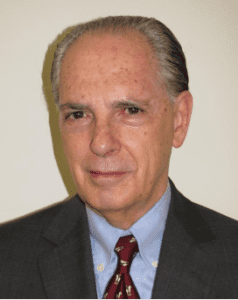
Author: Alfredo Toro Hardy, PhD – Retired Venezuelan career diplomat, scholar and author. Former Ambassador to the U.S., U.K., Spain, Brazil, Ireland, Chile and Singapore. Author or co-author of thirty-six books on international affairs. Former Fulbright Scholar and Visiting Professor at Princeton University. He is currently an Honorary Fellow of the Geneva School of Diplomacy and International Relations and a member of the Review Panel of the Rockefeller Foundation Bellagio Center.
(The opinions expressed in this article belong only to the author and do not necessarily reflect the views of World Geostrategic Insights).
Image Source: AFP.