



In the following interview with World Geostrategic Insights, Massimo Ortolani reconstructs the shifting character of modern warfare, exploring how economic instruments have transitioned from secondary tools of statecraft into decisive components of kinetic and asymmetric conflicts.

Massimo Ortolani is a Rome-based economist, international strategic consultant and geo-economic analyst with extensive corporate experience within major industrial and banking institutions, such as ENI and UniCredit groups. He is a prominent expert in economic-financial warfare, sanctions regimes, and hybrid conflicts, and the author of the monograph “Intelligence economica e conflitto geoeconomico” (Economic Intelligence and Geo-economic Conflict).
Q1: Drawing upon your expertise as an economist and strategic consultant, how do you evaluate the decision to accord economic instruments a progressively decisive role in conventional warfare, as prominently evidenced by the U.S.–Iran confrontation?
A1 – An initial—albeit partial—assessment suggests that economic warfare has long been effectively deployed within multidimensional power struggles, typically conceptualized as “hybrid warfare” operating in the gray zone between peace and open conflict. However, analyzing the contribution of economic intelligence to kinetic warfare—specifically as a force multiplier for conventional weaponry—requires establishing a fundamental premise.
First, the operational paradigms of contemporary kinetic conflicts have shifted radically, a transformation primarily driven by asymmetric warfare and structural vulnerabilities. Consequently, a state possessing multidimensional military dominance may concurrently exhibit profound vulnerabilities in other strategic domains. Second, strategic foresight demonstrates that a conflict can be effectively lost prior to its inception if preliminary intelligence assessments are flawed, a reality underscored by the protracted dynamics and evolution of the conflicts in Ukraine and the Middle East.
Finally, the paradigm of technological superiority as the deterministic factor in conflict outcomes must be deconstructed. In the Iranian theater, this limitation underscores the necessity of leveraging the strategic efficacy of geo-economic warfare as an alternative to purely technological modalities.
Q2 – Based on this premise, how would you best characterize the two major conflicts currently underway in Ukraine and the Middle East?
A2 – It is conceptually appropriate to define these conflicts through the established paradigm of “total war”—a state of hostilities wherein neutralizing the adversary’s military forces is insufficient; rather, one must systematically degrade the entire structural apparatus that sustains their war-fighting capacity.
Consequently, from an intelligence perspective, primary targeting vectors shift toward defense production capabilities, sovereign revenue streams, energy grids, critical infrastructure, and supply chains. Essentially, the objective is to compromise the state’s capacity for protracted mobilization while simultaneously exploiting internal political fractures. Within this framework, the central intelligence dilemma revolves around the cognitive gap between the perception of adversarial vulnerabilities and the objective assessment of one’s own strategic capabilities.
Q3 – Given that the fundamental nature of warfare remains the pursuit of political objectives through material force, how should we evaluate the evolution of its character in relation to technological innovation and the asymmetric attributes of the belligerent states?
A3 – While technological innovation undeniably serves as a formidable force multiplier for kinetic output, contemporary conflicts demonstrate that multidimensional military dominance does not immunize a state against profound vulnerabilities born of tactical and structural asymmetries. To fully address this evolution, however, one must first deconstruct the definition of “victory.” If strategic success is defined as regime change that alters the target state’s institutional identity—as seen in the context of Iran—coercive outcomes depend far more on geo-economic warfare and comprehensive sanctions regimes than on kinetic air campaigns.
Historically, bombing campaigns tend to solidify domestic resilience and heighten the population’s threshold for endurance. Furthermore, a rigorous cost-benefit analysis of projected conflicts demonstrates that overt military intervention is often redundant. Strategic objectives can frequently be achieved by deploying calibrated alternatives, such as “smart” and “sharp” power, which circumvent the human and material costs of conventional war, as demonstrated in the case of Venezuela.
Q4 – In your estimation, how does the strategic convergence of kinetic and economic warfare dictate the duration of a conflict?
A4 – While any comprehensive assessment must be tailored to the specific contingencies of a given conflict, it is a structural reality that when a critical mass of stakeholders derives strategic or financial utility from the continuation of hostilities, no single actor has an incentive to initiate termination. Specifically, wartime leaders who capitulate to negotiations that certify a mere “pseudo-victory”—failing to achieve the baseline objectives conceptualized at the conflict’s onset—face severe domestic political blowback. Such agreements fail to validate the pursuit of prestige, status, and geopolitical aggrandizement that initially rationalized the mobilization.
Concurrently, a critical geo-economic driver prolonging modern warfare is the strategic behavior of technological hyperscalers. These corporate entities provide digital services of existential importance to military operations. This dynamic fosters a symbiotic web of interdependent public-private interests, effectively granting private corporations the leverage to negotiate directly—and precariously—with sovereign governments and regulatory bodies during wartime.
Q5 – Given the protracted hostilities between Russia and Ukraine, is this prolonged duration attributable not merely to flawed predictive intelligence, but rather to the systemic friction of adapting to a paradigm shift in warfare? Specifically, the traditional doctrine of maneuver—predicated on mass, speed, and surprise—appears compromised by the extreme lethality and transparency of the modern battlespace, where ubiquitous sensors, UAVs, satellite constellations, and advanced ISR networks render all military movements visible.
A5 – Contemporary hostilities definitively validate the strategic primacy of real-time multi-domain data fusion, with particular emphasis on the space domain. Orbital assets have become inextricably linked to tactical operations; space-based reconnaissance is now collected, processed via artificial intelligence, and disseminated to frontline combat units at unprecedented speeds. This environment mandates continuous software and hardware adaptation to counter adversarial electronic countermeasures, compressing technological iteration cycles to mere weeks to sustain a tactical edge.
Furthermore, peer competitors like China are actively developing brain-computer interfaces (BCIs) to pioneer thought-controlled unmanned systems and optimize cognitive performance under combat stress. Parallel advancements in the digital frontier offer decisive tactical advantages: next-generation AI architectures, quantum computing capable of compromising cryptographic standards, and directed-energy weapons (DEWs) that neutralize drone swarms with a highly favorable cost-per-intercept ratio. Ultimately, this technological race reverts to a fundamental economic equation: the capacity of a state to sustain long-term R&D expenditures and industrial production volumes while consistently delivering high-tech, cost-effective defense solutions.
Q6 – In summary, one must conclude that a primary source of contemporary tactical advantage resides in artificial intelligence applications.
A6 – Indubitably, as the militarization of artificial intelligence catalyzes an epistemological transformation—fundamentally altering how armed forces acquire actionable knowledge and leverage it to maximize kinetic impact while minimizing costs. This shift inevitably restructures the command-and-control (C2) architecture and the traditional distribution of authority between commanders and subordinates.
Historically, doctrine dictated that command assigned the “what” and “why,” leaving the “how” to subordinate autonomy; the integration of AI complicates this dynamic. Furthermore, a critical yet under-examined cognitive risk of the military AI revolution is that over-reliance on algorithmic recommendations—particularly in optimizing the “kill chain”—may degrade the user’s organic capabilities, specifically human intuition and situational awareness.
Within the domain of economic and strategic intelligence, this technological shift introduces a profound ethical dilemma regarding enhanced defense capabilities. If a state perceives that it can project lethal force while insulating its own personnel from physical risk, its threshold for conflict onset may paradoxically lower. Consequently, this creates a profound moral hazard that incentivizes conflict initiation, carrying severe implications for global stability.
Q7 – Setting aside immediate battlespace dynamics, conflict inherently exerts a profound impact on the socioeconomic fabric of belligerent states, thereby generating strategic opportunities for psychological operations.
A7 – Indeed, the tenets of economic intelligence are paramount even during the pre-conflict deterrence phase, which hinges on cultivating a credible and resilient defense posture. A salient example is Taiwan’s “porcupine strategy,“ a doctrine designed to achieve psychological deterrence by confronting China with prohibitively high costs should it attempt an amphibious invasion.
Regarding the macroeconomic dimensions of defense expenditure, public spending can yield positive microeconomic externalities. For instance, the European Union’s SAFE framework—which incentivizes joint procurement for specific military systems—can generate substantial fiscal efficiencies through import substitution, while the resulting demand stimulus bolsters the long-term sustainability of public debt. Conversely, substituting military expenditure with economic and financial sanctions—shifting the strategic objective from deterrence to compellence—entails significant geopolitical friction. To be effective, the sanctioning actor must possess systemic economic and financial hegemony and successfully mobilize a multilateral coalition to mitigate sanctions evasion.
Q8 – Yet, even in the absence of formal sanctions regimes, a protracted conventional war generates socioeconomic dislocations that severely test domestic political consensus.
A8 – As noted, the resilience of social stability diverges sharply along regime types, with autocratic regimes possessing a structural advantage over liberal democracies in managing domestic dissent. In Russia, for example, despite escalating public expenditure, structural budget deficits, currency depreciation, and aggressive monetary tightening, the economy has remained resilient, artificially stimulated by the military-industrial multiplier. However, within this de facto war economy, private enterprises disconnected from the defense supply chain struggle to survive under prohibitive interest rates (such as 14%).
A parallel degradation of living standards is observable in Ukraine, whose economic survival remains strictly contingent upon external financial and material assistance. Similarly, Iran faces acute inflationary pressures and rising living costs. In all three theaters, the defining sociopolitical variable is a pervasive “silent attrition” among the population. Adversarial intelligence apparatuses deliberately exploit this psychological vulnerability by targeting critical infrastructure most likely to exacerbate domestic war weariness: refineries, electrical grids, and export infrastructure for revenue-generating commodities.
Accordingly, it would be very desirable for military academies to deepen the analysis of the functional interdependencies between economic intelligence and kinetic operations.This shift reflects the strategic consensus that the kinetic domain will increasingly be co-equal with the cognitive domain—vindicating the axiom that modern conflicts are initiated, sustained, and ultimately resolved not in the trenches, but within the human psyche.
Massimo Ortolani – Economist and strategic consultant specializing in economic intelligence and geopolitical risk.
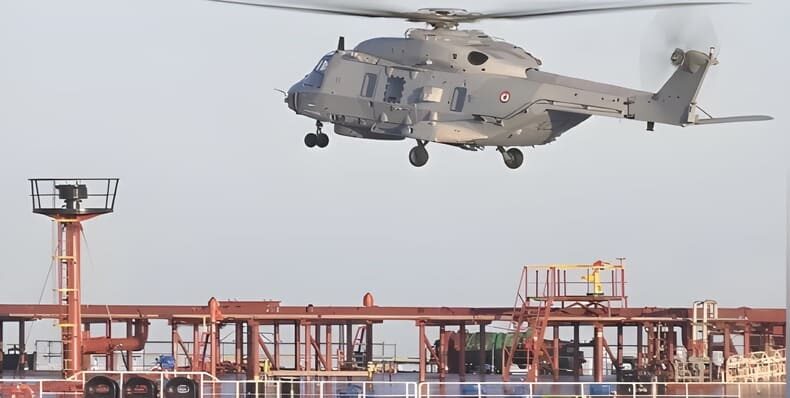
Image Source: Emmanuel Macron/X (formerly Twitter) post regarding France’s seizure of a suspected Russian ‘shadow fleet’ tanker.