



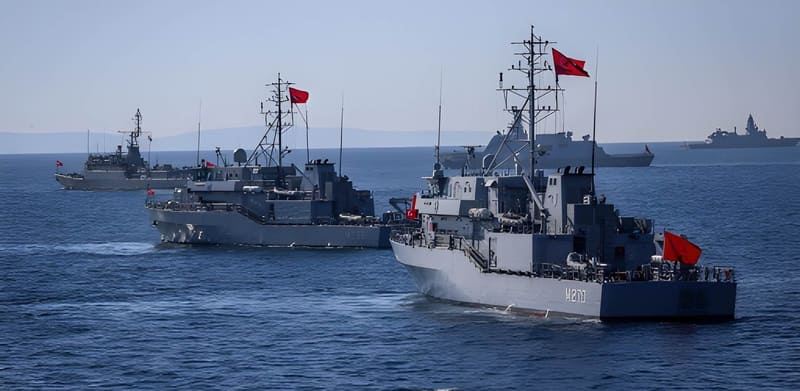
An interview by World Geostrategic Insights with Shay Gal on how Turkey’s increasingly assertive role could pose a growing threat to Israel and Eastern Mediterranean stability, the defensive postures of Israel and its regional allies, the questioning of their traditional reliance on U.S. security frameworks, and need for autonomous defense capabilities and sovereign security. The interview also focuses on the strategic importance of the India-Middle East-Europe Economic Corridor (IMEC), the critical implications of artificial intelligence in military operations, and on how state actors can protect their national narrative and sovereignty in an era of hybrid warfare.

Shay Gal is Founder and Principal of Line of State, a strategic practice working with governments, institutions and decision makers on strategy, risk, access and security decisions in high stakes environments. He previously served as Vice President of External Relations at Israel Aerospace Industries (IAI), one of Israel’s leading defence and aerospace companies, after serving as Chief of Staff to the Chairman of the Board. Earlier in his career, Gal worked in the Knesset and government, including as a senior adviser to Israel’s Minister of Economy and Industry.
Q1 – In your recent analysis published in Israel Hayom, you made the provocative claim that “Iran was the rehearsal. The Turkish file is open.” What specific strategic indicators lead you to view President Erdogan as a more complex, long term challenge to regional stability than Tehran?
A1 – Iran was the more legible adversary. Turkey is the more complex strategic problem.
Tehran built its threat architecture outside the Western system and against it. Ankara amasses leverage from within it. It remains a NATO member, drawing on Western markets, technology, finance and political access while building the reach, autonomy and forward posture to operate beyond allied restraint.
Turkey no longer projects power principally from Anatolia. Its military footprint and infrastructure span Syria, northern Cyprus under Turkish occupation, Libya and Somalia. Together they form a network of depth, access, logistics, intelligence and operational reach around Israel’s wider perimeter.
Ankara is simultaneously integrating an indigenous defence industry, ballistic reach, unmanned systems, naval power and aerospace capacity. Akkuyu, Turkey’s Russian built and operated nuclear power project, matters because Ankara seeks to turn dependence on externally controlled nuclear infrastructure into sovereign nuclear latitude. Hamas sanctuary, financing and political protection belong to the same system. The danger lies in the whole they form.
Erdogan has converted rhetoric into precedent. Libya and Karabakh established Ankara’s readiness to use force abroad. In Syria, Turkey is converting intervention into permanent strategic depth. Threats against Israel and Greece cannot be dismissed as domestic theatre. Turkey’s declared intent, acquired capability and demonstrated conduct now align.
This is not an Erdogan file. It is a Turkish strategic file. Erdogan changed the vocabulary of Turkish power more than its instinct. Kemalism and Erdogan’s Islamism are opposing political projects, but strategic autonomy, regional primacy, Cyprus, the Aegean and resistance to external constraint reveal a deeper continuity of state power. The West’s recurring error was to mistake Kemalist presentation for strategic restraint. Erdogan Islamised, personalised and made explicit a reflex he did not invent.
Israel plans against capabilities and state continuities, not Turkish electoral cycles. The doctrine, defence industry, bases, infrastructure and regional positions will outlast Erdogan’s presidency. Jerusalem will not stake national security on the expectation that a post Erdogan government will voluntarily surrender leverage Turkey has already acquired.
Iran settled the doctrine: distance is no sanctuary, political complexity no immunity, and hostile military systems must be denied before entrenchment. Rehearsal does not imply sequence. Israel will no longer allow an emerging threat system to mature behind geography, sovereignty or diplomacy.
Ankara must understand the consequences. NATO membership is not a licence to build operational constraints around Israel. A Turkish flag does not confer immunity on threatening infrastructure. A Turkish soldier can raise the cost of action. He cannot veto it.
The Turkish file is open because the threat system is no longer hypothetical. Jerusalem will not allow it to harden into immunity.
Q2 – In an interview with Simerini and SigmaLive, you examined the Cyprus issue, describing the occupied north not as a “frozen conflict” but as an “unsinkable aircraft carrier” for Ankara. Can the deterrence architecture of Cyprus, Greece and Israel become self-sustaining, or does it still depend critically on Washington’s security umbrella?
A2 – The occupied north already functions as Turkey’s unsinkable aircraft carrier and forward military depth inside the European Union’s security space.
The trilateral framework is real. It is not yet sovereign. Cooperation is not architecture. Exercises and intelligence sharing do not constitute deterrence. Deterrence begins when Israel, Greece and Cyprus can detect together, decide before Ankara exploits hesitation, defeat the opening move and sustain the fight without foreign permission.
There is no single American security umbrella over the triangle. Greece belongs to NATO and the European Union. Cyprus belongs to the European Union but not NATO. Israel belongs to neither and has no treaty guarantee from Washington. Turkey itself sits inside NATO. That geometry makes dependence on Washington untenable.
Donald Trump made the weakness impossible to ignore. He did not create European dependence; he exposed it and turned alliance reliability into presidential discretion. Ankara has mastered the corresponding transaction: manufacture a crisis, acquire leverage, then sell Washington the exit. A deterrent that survives only when an American president chooses alliance obligation over a deal is not deterrence.
The United States is a force multiplier, never a condition for action. Washington reinforces deterrence; it does not own the decision.
For Greece and Cyprus, Article 42(7), the EU mutual assistance clause, provides what NATO cannot provide in a Turkish contingency: an obligation over which Ankara has no vote. Turkish NATO membership cannot become Turkish immunity while Cyprus’s European guarantee remains inert.
Article 42(7) must be operationalised before the crisis: forces, logistics, command links, industrial surge and political authority. A guarantee interpreted after the attack has already failed.
Collective defence cannot end by restoring the line that enabled the aggression. If the occupation’s military infrastructure generates the attack, that infrastructure becomes part of the defence problem. For Cyprus, the end state cannot be a return to the status quo ante. Rather, it is the restoration of sovereignty. If Ankara weaponises the occupation, it also puts the occupation itself in play.
Israel, Greece and Cyprus are the operational core. Europe supplies legal obligation, industrial depth and scale. America supplies reinforcement and strategic weight. None holds a veto over the others’ defence.
Self sustaining deterrence means preserving command, denying a fait accompli and remaining operational until external reinforcement arrives. If Washington’s hesitation can collapse the system, the system was never sovereign.
The Eastern Mediterranean will not be secured by remote patronage. Jerusalem, Athens and Nicosia must hold the line from the first hour. Europe must sustain it. Washington may reinforce it. Washington does not hold the key.
Q3 – The India Middle East Europe Economic Corridor was conceptualised to reshape global trade flows. How do current geopolitical frictions in the Eastern Mediterranean threaten to paralyse this network, or conversely, could they accelerate its strategic necessity?
A3 – Geopolitical friction can delay IMEC; it also makes it indispensable. A corridor that functions only under regional calm and transit consent is a peace dividend, not strategic infrastructure.
The line itself is the vulnerability. IMEC must become a mesh: interchangeable ports, routes, insurers, financiers, customs, data links and logistics nodes that absorb disruption without collapse. A strategic network must degrade, not collapse.
IMEC, EastMed, the Mediterranean electricity interconnectors and the Vertical Corridor form one unfinished European sovereignty system. IMEC connects India and the Gulf to the Mediterranean. Israel, Cyprus and Greece form the hinge. EastMed and the interconnectors provide supply beyond Turkish custody. The Vertical Corridor carries that access north through Bulgaria and Romania toward Moldova and Ukraine. Arrival is not sovereignty. Distribution without an external veto is.
Kazakhstan clarifies the distinction between IMEC and the Middle Corridor. It sits at the heart of the route from China through Central Asia, the Caspian and the Caucasus into Turkey and Europe. Placing Kazakhstan under the Abraham Accords umbrella does not turn that route into IMEC. The Middle Corridor can bypass Russia geographically while transferring the chokepoint to Ankara. Moving the veto from Moscow to Ankara relocates dependence; it does not diversify it.
Russian energy routed through Turkey does not cease to be Russian dependence. TurkStream, refining, insurance, trading, documentation and relabelling preserve that dependence under another commercial identity. A supply chain can be laundered as effectively as money. The metric is control: valves, finance, certification, insurance and transit.
Washington has repeatedly blurred that distinction. The Biden administration withdrew political backing from EastMed. The Trump administration later blurred IMEC with a Middle Corridor map centred on Turkey through Kazakhstan and Central Asia. Different administrations preserved the same dependency structure. Europe cannot outsource the choice of its infrastructure map to Washington.
In the south, Europe calls concentrated exposure to Algeria diversification. Replacing one supplier while preserving strategic exposure does not create sovereignty. The Atlantic route through Morocco and West Africa is EastMed’s western counterpart: another sovereign door into Europe. Europe needs more such doors, not another indispensable gatekeeper.
Rabat in the west, Greece, Cyprus and Israel in the east, the Vertical Corridor northward, India and the Gulf to the southeast, alongside Norwegian, Black Sea and European production: together they form a European system in which no external capital owns the flow.
The missing metric is veto exposure. Price, capacity, distance and speed are insufficient. Veto exposure measures the external decisions standing between Europe and continued flow under pressure. A route another government can suspend, price politically or weaponise is not cheap. Its security premium is deferred.
Every node matters. None is indispensable. A missile can close a port; a bank, insurer, regulator, customs authority or transit state can paralyse a corridor without firing. Resilience must be embedded in finance, insurance, regulation, energy, data and logistics before disruption.
India’s leverage is choice. Its power in IMEC comes not from owning the corridor, but from retaining alternatives. Routes compete for Indian traffic, capital and integration; India retains the decision.
The Constantinople Protocol is a redundancy rule for strategic access: every gate capable of becoming a veto must be replaceable before it becomes a weapon. The objective is not a friendlier monopoly. It is a system in which monopoly cannot coerce.
IMEC succeeds when no single crisis, capital, chokepoint, insurer or transit state can sever India from Europe. Sovereignty is continuity under pressure.
Q4 – The US Saudi civil nuclear deal has sparked intense debate, especially because it lacks the IAEA Additional Protocol. You argued in Walla that Riyadh has effectively bought a dependency on Ankara and Islamabad. From a strategic perspective, what is Israel’s absolute red line before considering kinetic or aerial options in the region?
A4 – Saudi civilian nuclear power under a US anchored framework is not Israel’s red line. It is an Israeli interest.
Riyadh will pursue nuclear energy. Whoever writes the rules will shape the programme for decades. An American framework anchors fuel, technology, training, maintenance, regulation and verification in the Western system while excluding Russia, China and Pakistan as nuclear patrons. Integration contains proliferation risk; exclusion exports it.
Akkuyu is the countermodel: nuclear infrastructure under Russian ownership and operation, outside Western operational custody. Washington must prevent its replication in Saudi Arabia. Vacating the nuclear field cedes it to Moscow.
Israeli support requires a full safeguards regime: the Additional Protocol, no autonomous enrichment or reprocessing, external fuel cycle control and no Turkish or Pakistani access to the sensitive nuclear domain. Whatever role Ankara and Islamabad acquire in Saudi defence, nuclear trust cannot be triangulated.
The Additional Protocol is the basis of Israeli support because accounting for declared material is insufficient; verification must reach undeclared activity. Bilateral trust cannot replace IAEA verification.
Normalisation reduces motive; verification constrains capability. Israel will not exchange irreversible nuclear latency for reversible politics. Riyadh can have nuclear electricity, Western technology and long term strategic partnership without an independent weapons option.
Israel’s red line is weaponisation: diversion, clandestine military activity, covert fuel cycle capacity or any system creating an autonomous military option.
A transparent Saudi civilian programme anchored in Washington strengthens regional stability. Turkish nuclear infrastructure that crosses into covert military capability changes category. Aerial neutralisation becomes an operational option. Civilian status does not confer immunity on military capability.
Saudi nuclear power serves Jerusalem’s interests. Saudi nuclear ambiguity does not.
Q5 – Cyber intelligence has evolved from a tactical support tool into a real time offensive and defensive weapon. How is predictive Artificial Intelligence changing the traditional intelligence cycle, specifically collection, analysis and execution, within modern military command structures?
A5 – Predictive AI does not replace the intelligence cycle. It collapses its intervals. AI turns collection, analysis and execution into a continuous command loop: data updates assessment, assessment retasks collection, and the next observation can trigger action.
AI detects patterns and ranks probabilities; it does not divine intent. It correlates signatures and identifies anomalies at a scale no human staff can match. Command determines attribution, intent, consequence and response. The machine estimates. The commander owns consequences.
Once AI directs sensors towards what it deems significant, analysis no longer receives collection; it shapes it. The model privileges a hypothesis, collection follows it, the resulting data reinforces it, and competing explanations disappear. The system becomes more confident precisely as it stops looking elsewhere.
Raven Sentry in Afghanistan demonstrated the model: AI fused multiple data streams to forecast insurgent activity and focus collection, while operators independently corroborated its outputs and monitored model health. Prediction informed judgment; it did not replace it.
The adversary attacks the loop itself. Modern deception no longer seeks only concealment. It seeks to manufacture the enemy’s operating picture. Russian GNSS spoofing in Crimea and Syria showed that sensors need not be blinded; manipulated inputs can make them report a false reality. AI magnifies the danger by fusing corrupted signals into coherent falsehood at machine speed.
The most dangerous deception is not missing information. It is a false picture that looks complete. An adversary that understands an opponent’s models, collection habits and thresholds can seed expected signatures and induce the system to validate the wrong reality. AI compresses the path from intelligence to action, and from deception to action.
Decision integrity becomes combat power. Every AI output with operational consequences must preserve provenance, confidence, assumptions, uncertainty and disconfirming evidence. Such recommendations require an independent hypothesis and an independent collection path before execution. Two algorithms trained on the same data are not independent sources; shared blindness is duplication, not corroboration.
Unchecked AI industrialises overconfidence: fluent output manufactures confidence without competence, amplifying a Dunning Kruger dynamic. The user least equipped to detect a sophisticated error is often the easiest to persuade with one. The danger is not ignorance alone, but ignorance disguised as mastery.
“Human in the loop” is insufficient. A human who merely ratifies a machine recommendation does not preserve human command; he disguises automation as oversight. Commanders authorised to act on AI generated assessments must be certified in the system’s purpose, evidence, confidence limits and failure modes. They must identify the competing hypothesis, state what would falsify the preferred assessment, and recognise when the operating environment has moved beyond the model’s assumptions.
AI can decentralise awareness. Accountability remains indivisible. Command authority must remain explicit, and the threshold for machine autonomy must be set by consequence, not technical possibility.
AI must enhance command, never become a condition for command. A force unable to fight through degraded, deceived or unavailable AI has automated its own vulnerability. AI systems must be contested in exercises, exposed to adversarial data and unfamiliar patterns, and periodically denied so human command remains operational.
The scarcity of the AI era is not information but trusted decision time. Speed without decision integrity accelerates error; automation without epistemic discipline manufactures confidence. AI becomes combat power only when it sharpens judgment without inheriting command.
The advantage belongs to the force that decides first without being deceived first.
Q6 – Your career spans from the Knesset to the executive suite of Israel Aerospace Industries. How does your experience managing external relations for a defence giant shape the strategic advice you now give to global clients at Line of State?
A6 – My career has run across the chain from authority to execution: how power is authorised, turned into policy, built into capability and delivered.
The Knesset taught me that formal authority is only one layer of power. Procedure, coalition, timing, legitimacy and institutional pressure determine whether authority is exercised. During the 2016 Knesset dress code dispute, staff mobilisation, members of parliament and public scrutiny converged until the enforcement policy became untenable and the Knesset revised it. The issue was narrow; the mechanism universal. Institutions move when the forces around a decision align.
The government taught me that policy has a clock. During the coronavirus crisis, working with Economy Minister Amir Peretz, the issue facing small businesses was not whether the government recognised their distress but whether liquidity, compensation and protection reached them before insolvency. I later carried that work into the Self Employed Forum, pressing for unemployment protection, broader state guaranteed credit and access to finance as lenders restricted it. A policy delivered after the business closes is not a late policy. It is a failure.
IAI imposed the discipline of execution. In the defence industry, capability has engineers, production lines, licences, supply chains, delivery schedules and decades of sustainment. The Knesset taught me that authority is not capability. IAI taught me that capability is not availability.
At that scale, external relations is an operating interface, not a communications function. During the war, IAI had to remain fully mobilised for Israel’s defence while sustaining the confidence of sovereign customers abroad that long term commitments would be honoured. Governments, customers, regulators, markets and corporate capacity converge around the same decision. That intersection taught me to read a problem from every institution capable of enabling, delaying or defeating its execution.
Strategy rarely fails inside one institution. It fails between institutions. Cabinets approve programmes parliaments do not fund. Parliaments fund capabilities regulators do not authorise. Industry possesses technology it cannot deliver on the required clock.
Announced power is not executable power. A memorandum is not access. A budget is not capacity. A procurement decision is not delivery. In defence, time itself is a capability.
Europe magnifies the problem. Authority is distributed across the Commission, Council, Parliament, national capitals, treasuries, regulators, armed forces and industrial groups. Fragmented authority demands integrated strategy. A European decision that works in Brussels but fails in a national capital, regulator or production base was never executable.
At Line of State, every recommendation is stress tested against authority, law, finance, industrial capacity, partners, timing and legitimacy. Prediction is secondary. The decision must survive a failed assumption.
Access is not the product. Judgment is. Judgment means knowing how institutions decide, where execution breaks and which constraint will bind before it becomes obvious.
Analysis describes the environment. Strategy changes what is possible within it.
My work begins with the decision and ends when it can survive reality.
Q7 – Line of State focuses on Strategic Affairs, Government Relations and Public Power. How does it bridge sovereign security requirements and the commercial objectives of private defence companies without blurring the line between them?
A7 – Line of State does not convert national security intelligence into corporate advantage. It translates sovereign requirements into investable industrial demand.
Classified intelligence remains sovereign. A defence company does not need the state’s secrets. It needs the sovereign mission defined precisely enough to engineer against it: effect, timeline, scale, survivability, sovereignty, sustainment and acceptable dependencies. The state does not need a sales pitch. It needs engineering truth: what is buildable, scalable, licensable, integrable and sustainable, on what clock and with which dependencies.
Requirement integrity: mission before platform, effect before vendor. A product is not a national requirement because industry needs a market. Government announcements do not create capability. The state defines the mission. Industry supplies the engineering truth. Strategy aligns them.
Vendor led strategy bends the threat around the catalogue. Aspirational procurement detaches requirements from industrial reality: maturity, capacity and sustainment. Both waste money. Under fire, both cost lives.
States must procure readiness, not merely equipment. Readiness includes industrial depth, stockpiles, retained engineering capacity, repair capacity, second sourcing, sovereign design authority, wartime priority and surge. If a government requires a production line available in crisis, it must contract and fund that availability in peace. Wartime priority must be contracted in peacetime. National security cannot depend on corporate goodwill, and corporate performance cannot depend on an unfunded national mandate.
Europe’s defence industrial challenge sits precisely here. Political ambition does not expand a factory. Budgets become capacity only when governments create credible demand through long term orders, coherent requirements, financing, production commitments and policy durability. Europe does not lack defence ambition. It lacks investable demand.
Business intelligence is not classified intelligence. It is a disciplined mapping of markets, budgets, procurement, competitors, industrial capacity, regulation, partnerships, decision chains and political risk. Its purpose is better judgment without privileged information.
The cleanest bridge between government and industry begins with a firewall. Privileged state information never becomes corporate advantage; corporate interest never masquerades as national security.
A catalogue is not a strategy. An unfunded mission is not a partnership. Requirement integrity turns sovereign need into capability and industrial capacity into readiness.
Q8 – One of Line of State’s main areas of expertise is Public Power. Has public perception and narrative management become as critical to national survival as kinetic deterrence? How do you define Public Power in an era of hybrid warfare and systemic disinformation, and how should state actors protect their national narrative?
A8 – The premise begins in the wrong place: with the word “narrative.”
A state, company or institution that starts by asking what narrative it should create has reversed the order. Strategy begins with a decision, an objective and conduct whose logic survives exposure. Narrative is an output of coherence, not an input to strategy.
Narrative expertise without the ability to challenge policy, conduct and facts is not strategy. It is copywriting.
Public Power converts reality, credibility and institutional reach into decision space. Its unit is the decision.
A million views are not power if nothing moves. Power exists when a parliament votes, a regulator acts, an ally remains, a market opens, an investor stays, a procurement advances, a coalition holds or an adversary recalculates.
Kinetic power prevents physical defeat. Public Power preserves the freedom to keep acting. An interceptor can destroy a missile; it cannot preserve parliamentary consent, allied access, regulatory authority or public trust. Neither substitutes for the other.
Credibility is a strategic reserve: accumulated before a crisis, spent during it. Governments that routinely exaggerate, confuse political convenience with fact or defend the indefensible eventually discover that truth no longer commands trust. Credibility cannot be manufactured on the morning it becomes necessary.
You cannot communicate your way out of conduct that disproves your own case. When objective, law, conduct and evidence contradict the message, the communications problem is a policy problem. Sometimes the correct communications advice is policy correction.
A democracy should not protect a national narrative. It should protect the integrity of the public decision environment. A democracy protects reality, not orthodoxy. Legitimate criticism and opposition remain protected. The targets are covert coordination, fabricated provenance, undeclared foreign funding, impersonation, synthetic amplification and coordinated deception.
The wrong question is, “What are people saying about us?” The operational question is, “What decision is someone trying to change?”
Every Public Power assessment maps actor, proposition, conduit, target institution and desired behaviour. A campaign against a defence company may present as reputational while targeting an export licence. A critical minerals campaign may look environmental while targeting permitting, investment or supply security.
Facts must move faster. Independent validators must exist before a crisis. Institutional contradictions must be resolved before adversaries weaponise them. Policy must be red teamed against the true facts an opponent can exploit.
Public Power must sit close enough to the decision to change it. If it enters after the decision, it has been reduced to communications.
Over the past eighteen months, I have tested this method publicly. Propositions I introduced on Turkey, Cyprus and the Eastern Mediterranean migrated independently across Israeli, Greek and Cypriot media, institutions and languages. Poseidon’s Wrath, the Cyprus contingency framework I introduced, moved from an argument in my writing into a framework others translated, debated, adopted, challenged and eventually answered inside Turkish information space.
I controlled none of those institutions. That is the test. Public Power proves itself through independent adoption, not message discipline.
Agreement is unnecessary. Once an opposing system spends institutional attention and political energy answering a proposition, it has entered its decision environment. Power begins when others must position around it.
The strongest proposition does not flatter an audience. It gives institutions a more useful model of the reality they inhabit.
Its metrics are operational: access retained, legislation moved, regulatory exposure reduced, confidence preserved, partnerships sustained, adversarial manoeuvre constrained.
Housing Public Power inside communications is an organisational error. Communications owns messaging; intelligence identifies hostile activity; government relations maps institutions; legal defines constraints; business measures market consequence. Public Power integrates the decision environment before any function mistakes its fragment for the whole.
The strongest story is the one policy, conduct and evidence keep proving.
Public Power ensures reality reaches the decision before distortion does.
Q9 – Through Line of State, you have championed the SILA, Strategic Ice Line Architecture, framework for the Arctic and Greenland, aimed at converting sovereignty into tangible infrastructure while building a more European security structure. Why should a Middle Eastern defence and security expert devote such sustained attention to the Far North?
A9 – Regional labels do not define my work. I work where formal sovereignty, operational capability and external pressure diverge. Geography changes. Strategic mechanics travel.
Greenland concentrates the problem in exceptional form. It combines vast territory, a small population, constitutional authority in Copenhagen, political agency in Nuuk, critical American military functions, European security interests, strategic minerals, maritime access, space infrastructure and the North Atlantic link between Europe and North America. Peripheral geography carries central functions.
SILA is Greenlandic in agency, Danish in authority and European in scale. Nuuk must hold decision authority and operating capacity. Denmark supplies the constitutional framework. Europe supplies the industrial, financial and security scale Greenland and Denmark cannot generate alone.
The architecture resolves an asymmetry of legitimacy, authority and capacity. Greenland supplies democratic agency; Denmark constitutional authority; Europe industrial and financial scale; the United States critical capabilities. It aligns them without allowing contribution to become control.
Local legitimacy is operational depth. A port, radar network, energy system or base without durable local consent is technically functional and strategically brittle. Sovereignty is weakened when citizens merely host infrastructure they cannot operate, maintain or govern.
Strategic transfer demands restraint. Cyprus is not Greenland. Denmark is not Israel. The United States is not Turkey. Analogy becomes dangerous when it imports conclusions. A strategist transfers the mechanism, not the conclusion. Regional expertise identifies what is unique. Strategy identifies what is structurally familiar.
The recurring mechanism is the distance between legal title and functional control: who owns the ground, controls the critical function, finances the infrastructure, can deny access, bears the operating burden and holds the final decision. SILA answers those questions in Greenlandic, Danish and European terms rather than importing another theatre’s solution.
A doctrine earns its name only when it can be governed, financed and built. SILA specifies command, surveillance, ports, runways, secure communications, energy resilience, logistics, maintenance, workforce, industrial capacity and staged investment. Concepts that cannot survive budgets, institutions and engineering are commentary, not doctrine.
Governments cannot organise strategy through regional desks alone. Security problems cross bureaucratic maps faster than bureaucracies cross their own boundaries. Greenland is simultaneously a constitutional, defence, space, infrastructure, industrial, maritime, investment and alliance file. No directorate owns it because power does not respect the organogram.
Good strategy identifies convergence before institutions finish naming the file. By the time bureaucracy names the problem, the constraint is already entrenched.
Strategic portability means recognising recurring mechanics without flattening local reality, then designing the architecture the system actually requires.
Sovereignty is not self-executing. SILA turns Greenlandic sovereignty from title into capacity.
Shay Gal – Founder and Principal of Line of State.
Image Credit: AA Photo (Turkey Naval Military Drill held at the Gulf of Saros in Canakkale, on October 30, 2025).