



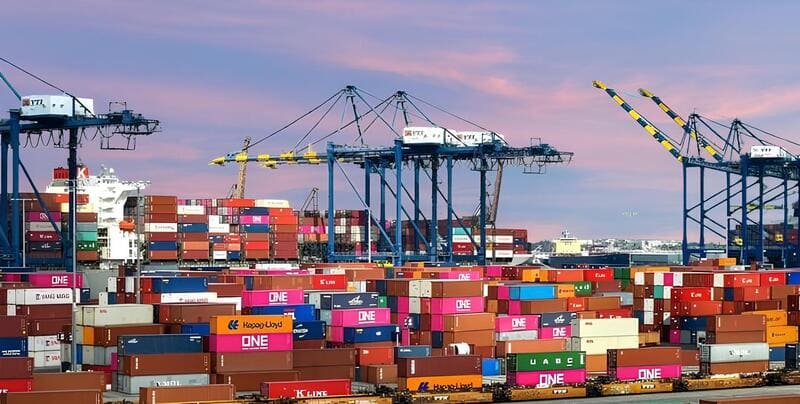
An interview by World Geostrategic Insights with Jason Ray Hutchison on the evolution of geopolitical risk for multinational corporations, the restructuring of supply chains, and the phenomenon of “friend-shoring” in light of recent crises. The interview also highlighted how these risks, when analyzed from a qualitative and predictive perspective, can be integrated into strategic planning to turn challenges into opportunities.

Jason Ray Hutchison is a geopolitical advisor, former U.S. diplomat, and professor of political science and international relations with 20 years of experience helping leaders and organizations navigate risk, disruption, and strategic uncertainty. During his Foreign Service career, he worked on NATO negotiations, humanitarian response, human rights, and post-conflict stabilization while supporting decision-making in complex and fast-moving environments.
In the private sector, he has held leadership roles with Deloitte, Abt Global, and other organizations, managing international programs, leading business development efforts, and advising on geopolitical risk and strategy.
He currently leads consulting and career services at Precision Talent Solutions, advises clients on geopolitical risk and strategy through his firm Portage Global, and teaches at Bay Atlantic University.
Q1 – During your transition from diplomacy to strategic consulting, what structural changes have you observed in the way multinational corporations perceive geopolitical risk today compared to ten years ago?
A1 – Ten years ago, geopolitical risk for most American companies still lived largely within the framework of globalization and its discontents – the world of Thomas Friedman’s The Lexus and the Olive Tree. Post-9/11, the questions I heard corporations ask were fairly consistent: what is the stability of a given market, will we be exposed to terrorism in ways that affect our political risk insurance, will we have permission to operate, and what is the corruption exposure. Those were the general buckets on most risk radars.
COVID triggered an evolution that subsequent shocks have accentuated. COVID exposed weaknesses in global supply chains that a generation of executives had simply never had to think about. Take the garment industry for example: something like 80 percent of the world’s zippers and notions were manufactured in a single Chinese factory complex, and when that facility stalled, it paralyzed apparel production in countries like Sri Lanka, with downstream effects across the entire industry. That single example was repeated across dozens of sectors, and it set off a wave of supply chain diversification, vertical integration, and near-shoring and friend-shoring.
Russia’s full-scale invasion of Ukraine in 2022 – a much bigger inflection point than the 2014 invasion – accelerated friend-shoring dramatically in Europe. The intensifying rivalry between the United States and China added a new emphasis on supply chain illumination: not just for corruption, but to identify technology dependencies and vulnerability. Huawei and ZTE preceded TikTok and many others, as companies and countries have been increasingly forced to choose sides between the United States and China. That dynamic has heightened step-wise over the last three U.S. administrations, and the second Trump administration’s trade wars have disrupted the global balance of business in ways not seen since the Smoot-Hawley tariffs of the 1920s. The combination has taken friend-shoring to extremes, as we are seeing now with Canada’s turn toward Europe.
Political risk insurance underwriters used to worry mainly about Somali piracy off the Horn of Africa and Bab-el-Mandeb. Now they have to price in Iran’s de facto control over the Strait of Hormuz, a waterway that used to be freely navigable, alongside aligned Houthi leverage over Bab-el-Mandeb. Other countries, like Indonesia, are considering potential implications and revenue generation for their shared straits, such as Malacca. I would expect continued adaptation and defensive militarization of shipping alongside continued rewiring of global and regional trade networks.
The combination of these changes has invalidated many companies’ strategic plans, requiring new capabilities and playbooks to match. Some of the wealthiest multinational corporations are standing up dedicated geopolitical risk teams or embedding geopolitical analysis directly into chief strategy officer functions in ways that simply weren’t standard practice a decade ago.
Q2 – Geopolitical risk is often perceived as an unpredictable external event. How can this risk be directly integrated into a company’s profit and loss statement, financial valuation models, and a concrete, measurable business strategy?
A2 – Many geopolitical risk events are actually visible well before they happen. I advised a pair of companies in September 2021 that Russia was preparing to invade Ukraine, and I identified the likely invasion window as a week or two on either side of the traditional Olympic truce period. Plenty of people get these calls wrong, and no one gets every call right, but there are signal patterns and flags that go unheeded because business leaders tend to be quantitatively minded, and geopolitical risk resists tidy numerical indicators. It requires engaging with qualitative material: narratives, trends, and subjective judgment that many executives are reluctant to give credence to or invest time in.
My advice is to be aware and to be prepared. For multinational corporations, political and socioeconomic analysis should come with the territory – whether capabilities are built in-house, subscribed to externally, or assisted by AI tools to get a first read. The Economist can be a great place to start, but it can’t tell you why your shipment has been held up in customs or your investment has hit the rocks – that’s where stakeholder engagement and human intelligence come into play. Corporations should adopt strategic postures that look beyond the near term to what is within the realm of the possible, taking quantitative metrics into account alongside qualitative assessments. There’s wisdom in moderation, to be sure. No one wants to be blindsided by a black swan, but you also can’t become so fixated on identifying low probability black swans that you get run over by the gray rhino that has been visible the whole time. The real strategic question is whether the business is prepared for plausible shocks and disruptions and what it would cost to adjust to their impacts – which is not so different from how companies already assess opportunity.
That, in fact, points to one of the more unfortunate habits in this field, as in national security and foreign affairs: we talk constantly about risk and far too rarely about opportunity, when the two should be assessed hand in hand, including in how they factor into a P&L or a valuation. Financial valuation modeling isn’t my strong suit, but I’d note that if you’re valuing a beachside property today, you had better be pricing in heightened climate risk. Whatever one’s politics on climate change, more and more jurisdictions are underwriting real resilience plans, and that has to enter the valuation conversation alongside geopolitical, socioeconomic, and political risk. That includes my own city of Annapolis, which is reengineering the historic city dock to protect downtown from rising sea levels.
You simply cannot pencil in 20 percent year-over-year growth and call it a day. Plenty of companies do so, and then spend every quarterly investor call and internal management meeting explaining why they missed. There are structural features of financial markets that encourage such rosy predictions. But I would counsel transparency and discipline against over-promising and under-delivering to investors. There’s a balance to be found.
Q3 – What is the most common mistake companies make when managing a geopolitical crisis: acting too late, or overreacting to short-term fluctuations?
A3 – Acting too late, without question. You don’t even need geopolitics to see the pattern – Blockbuster passed on multiple chances to buy Netflix because it couldn’t see where video rental was heading, and Kodak, the company that invented film, barely exists in that business today. We’re watching the same dynamic now with the fossil fuel industry, which has spent decades – since at least the 1980s – working every avenue to slow the development of electric vehicles, solar, wind, and other technologies that now routinely undercut it on price. You see the same pattern in the collapse of the North Atlantic cod fishery: a classic tragedy of the commons, where people with mortgages, retirement accounts, and children’s college tuition to pay simply cannot bring themselves to sacrifice a livelihood, even as the underlying resource – or in the corporate case, the market – disappears beneath them.
The Iran war is a case in point. You could see it coming from a mile away – it was a constant theme of the first Trump administration and was signaling clearly again early in the second term. Companies – and governments – that were caught flat-footed simply weren’t paying attention. Do companies also make poor short-term calls? Certainly. You’ll find no shortage of traders who lose their shirts reacting to daily fluctuations. But for large manufacturers and industrial companies operating on long timelines, large capital expenditures, and complex supply chains, short-term overreaction typically presents a smaller risk than long-term inattention. If anything, that underscores why they need to be paying closer attention to the durable trajectory of their geopolitical, socioeconomic, and climate-related operating environment, to include both risks and opportunities. We’re seeing exactly that dynamic play out now with generative AI, which is quite likely to displace some of the dominant players that have defined Silicon Valley for the past 20-30 years.
Q4 – As Consulting Services Director at Precision Talent Solutions, what is the distinctive value proposition that the Precision Experts unit offers to help business leaders anticipate the impact of future events before they occur?
A4 – It helps to understand why we set up Precision Experts in the first place. I joined Precision Talent Solutions in July 2025, at a moment of extraordinary churn in the federal talent and contracting marketplace. DOGE and related initiatives produced waves of departures from the U.S. government and military while reorganizing or dissolving agencies and disrupting program funding. This upended U.S. government contractors and other implementing partner firms, which were forced into layoffs and hiring freezes as programs were cancelled or cut. As they lost visibility into federal procurement processes and potential funding opportunities, these companies badly needed the expertise now entering the market. In a stronger economy, they would simply have hired a departing colonel or federal executive full time for the relationships and knowledge they carried. In this market, they couldn’t.
Precision Talent Solutions is a boutique executive search and recruiting firm with a strong reputation in the defense and security industry and across the broader community of companies serving those departments and agencies that roll up into the National Security Council. I was brought on to build a consulting offering – Precision Experts – that connects transitioning senior government, military, and industry leaders with the government contracting firms that need their insight on a consulting basis. We now have more than 50 companies signed up for the service and roughly 120 experts on our roster at any given time, with turnover as people move to full-time roles and new experts join.
The distinctive value is that our experts are people who were recently in the room – who understand how U.S. government priorities and procurement structures are shifting in real time, how particular contracting vehicles and award types are trending, and what they’re likely to look like going forward. That lets us stress-test client strategy and approach against contemporary insights, on subjects ranging from critical minerals investment in Africa, to Golden Dome contracting opportunities with the Space Force, to Air Force contracting trends, in just the past week alone.
Beyond the insight itself, we compete on speed, flexibility, and cost. Where a large company might take four months to bring on an independent consultant through their own HR processes, we’ve compressed that same process to under three weeks for that very same client. Earlier this month, we placed a subject matter expert just 11 days after receiving the inquiry. These are bespoke, substantive engagements rather than hourly consulting. We also offer a range of contracting structures, including temporary-to-permanent pathways, because our underlying goal is helping these transitioning officials reach their next professional stage, whether that’s a portfolio of consulting work or a new full-time career. And because we keep our overhead low, we can serve a segment of the government services market that typically can’t afford the rates a major financial institution or manufacturer would pay.
Q5 – In your work, how do you balance qualitative analysis (history, culture, personal relationships) with predictive data models and artificial intelligence to assess country risk? What do you consider essential to building a country risk model that is genuinely predictive rather than merely reactive?
A5 – As an undergraduate at Northwestern University, I worked with Professor Ken Janda on a study testing whether standard socioeconomic indicators correlated with a record of social upheaval and political instability across dozens of countries over decades. The result surprised both of us: no single indicator, nor any combination we tested, showed a statistically significant relationship. That finding has shaped how I think about quantitative models ever since. They can show you that the ingredients for unrest are present, but unrest is closer to chemistry than probability – you still need a reactive agent for something to actually happen. Two countries can show nearly identical warning signs on paper and diverge completely depending on the qualitative variables, such as powerful personalities actively pushing a government, or ideological entrepreneurs and demagogues who catalyze latent grievances into upheaval.
That said, certain hard indicators do matter. The Gini coefficient is one I watch closely – if it’s rising, that’s a signal. So is the price of bread relative to the share of the population living just above the poverty line. Those are classic indicators for potential future unrest. Many have a climate dimension, as we learned from Jared Diamond’s Collapse, and as we saw with the drought that preceded the Arab Spring in 2011. When Russia launched its full-scale invasion of Ukraine in 2022, one of the first things I did was ask my West Africa energy team for an updated list of the countries most exposed to food insecurity and, therefore, at elevated risk of coup or violent government change, since Russia and Ukraine were two of the world’s largest exporters of fertilizer and inputs like potash. Supply chain constrictions typically impact the poorest populations most severely, and West Africa does not have the purchasing power of Europe or the Gulf States.
There’s usually a time lag between conditions and consequences. When I run simulations in the classroom, I usually make students wait a turn or two before they learn the outcome of a decision. Invasion plans, similarly, can sit ready for years before they’re executed. We saw the groundwork for the U.S.-Israeli war against Iran being laid throughout the first Trump term, well before it was acted on in the second. China has been visibly adapting its invasion planning for Taiwan, developing new amphibious ships with long bridges designed to land troops away from the chip factories it presumably doesn’t want to destroy. Whether and when Beijing pulls the trigger is a separate, harder question. It could be opportunistic – timed, say, to the USS George Washington leaving the Pacific theater to relieve the USS Abraham Lincoln in the Strait of Hormuz, or to coincide with the U.S. election season. Or Taiwan could ultimately accommodate Beijing politically rather than militarily, after observing how the United States handled its commitments to Ukraine and how it protected Gulf partners while prosecuting the war in Iran, reassessing how reliable an “ironclad” American security guarantee actually is. Those are qualitative judgments, and they can be determinative.
On AI specifically: I use large language models every day for notetaking, research, and as a thought partner – think of an eager graduate assistant whose output you take with an appropriate grain of salt. For a first pass on an unfamiliar market, illustrating, for example, the investment picture in Vietnam or Zambia, AI is a useful timesaver. It can rapidly compress hundreds of pages of World Bank reports, commercial analyses, and other material into a handy brief. What it cannot do is replace human intelligence. There is nothing in an AI model that gives you the bio notes for how to handle the interlocutor across the table, or that tells you a government minister is quietly siphoning resources into a parliamentary campaign fund. AI cannot work in a conference room or a reception. It gets you to the 100- and 200-level understanding of a country or market; commercial success typically requires the 300- and 400-level knowledge that comes from personal engagement.
Q6 – In markets characterized by extreme political or economic instability, what specific indicators do you monitor to distinguish a temporary fluctuation from a structural market collapse?
A6 – I rely on trip wires more than indicators. I keep them for everything from the U.S. political situation to European security, and I’d recommend the discipline generally. Genocide Watch provides some of the best trip wires out there. It’s worth recognizing that in unstable, insecure environments, the data for indicators is simply not going to be high quality. The more insecure the environment, the less reliable the data becomes. There are exceptions – Ukraine has kept extraordinarily detailed documentation of Russian damage for annual reconstruction conferences, and Syria had the White Helmets mapping violence in near real time – but those are the exception, not the rule. In most highly insecure environments, human intelligence has an outsized importance, and near-instant communication channels such as X/Twitter or Telegram become go-to, if fallible, news sources for fast-breaking events. In these environments, it is also important for company representatives to understand the geopolitical baggage their own company carries, often without realizing it. Corporate nationality follows you: a Canadian national representing a Belgian company on a deal in Congo is still, in a real sense, carrying the interests and legacy of Belgium with them, whether they like it or not. I saw this play out frequently in Africa’s Great Lakes region and elsewhere.
Ukraine has provided a unique case for business and insurance interests, as I saw when helping companies to enter and operate in the wartime economy. The front line may be far from Kyiv, and many hundreds of kilometers removed from western cities such as Lviv, but Russian missile and drone strikes can hit anywhere across the country. Plenty of large multinationals sponsored booths and made a public show of investment in the country, but very little of their actual staff was on the ground – most operations ran from Poland, and most of them were really posturing in hopes of contributing to reconstruction after the war. The same was largely true of defense companies working to support Ukraine but operating from Poland, Czechia, Romania, or Germany rather than inside the country. Who actually stayed? International financial groups, some construction firms with longstanding Ukrainian ties, consumer products manufacturers with deep-rooted local relationships, and humanitarian and development implementers, who don’t carry the same target profile or capital exposure as large manufacturers and defense producers.
If I had to pick a single indicator for how a company will behave in an insecure market, it would be political risk insurance premiums – it’s a highly subjective, ultimately profit-driven product, and it forces companies to look closely at their risk appetite, financial standing, and actual commitment to the market. Diaspora ties are a strong predictor of staying power. In the end, understanding why a company is committed to a market tells you far more about whether it will see the commitment through than any single quantitative indicator will.
Q7 – In an increasingly polarized world, is it still possible to speak of globalization, or are we definitively entering an era of “friend-shoring” and closed regional markets?
A7 – Globalization isn’t going away, but we have moved beyond the era of steadily falling trade barriers under the WTO, at least for now. These things move in cycles. COVID pushed the world into a cycle of supply chain diversification and near-shoring; Russia’s invasion of Ukraine, the U.S.-China rivalry, U.S.-driven trade wars, and now the U.S.-Israeli war against Iran have each accelerated it further. As additional supply chain shocks accumulate, what will matter is who holds the relationships, the resilience, or the stockpiles to share in moments of stress. China, with some of the world’s largest stockpiles in everything from fuels and consumer goods to fertilizers and foodstuffs, is positioned to benefit. It’s worth watching how the Iran war is straining industries and economies across East Africa, South Asia, and Southeast Asia, which will be additionally stressed by the likely historic El Niño event building through this fall and winter, and which countries and trading relationships are sufficiently resilient to absorb the combined shocks. Answering that requires a genuine mix of quantitative and qualitative analysis – it’s not something you can simply chart “Buy” to “Sell” on an investment app.
Politically, globalization is in a genuinely difficult moment, because conservative xenophobic movements and liberal trade-protectionist movements are converging – almost in bipartisan fashion in the United States – around a retreat from free trade. At the same time, the benefits of free trade haven’t disappeared, and entire regions are actively forming new trade agreements without the United States or other protectionist countries. Because of that, I’d describe globalization less as a single pendulum swinging one direction than as multiple trendlines working in tension with each other simultaneously.
Q8 – The most unstable markets often also offer the highest potential returns. What is the “tolerance threshold” a modern company should have before deciding that geopolitical risk outweighs the commercial opportunity?
A8 – I appreciate this question, because it centers on opportunity. Geopolitical risk analysis, like national security, tends to pull people so deep into defensive posturing that opportunity gets lost almost entirely, and that’s a disservice to strategic decision-making and underserved markets. Look at the most dynamic markets in Southern Africa, the Asian Tigers, or Portugal, Spain, and Ireland compared to where they stood 40 years ago. In every case, someone had to be an early mover. When my wife and I visited Vietnam in 2010, it caused a minor ruckus with my extended family, for whom memories of the war were still fresh. Vietnam is today one of the world’s hottest economies and an increasingly close trading partner of the United States. It is also a model for rapid expansion of renewable energy generation. Perception tends to lag reality, and sometimes investment in a high-risk market is precisely what helps stabilize a country or region.
Ukraine again provides an instructive example. In the crucible of a war it didn’t choose, Ukraine took what was already a strong offshore software development, business process outsourcing, and robotics sector and turned it into one of the most significant innovations in modern warfare – the rapid rise of drone and electronic warfare, evolving fast enough to upend defense postures and procurement planning worldwide. Ukraine is becoming, in effect, the arsenal of Europe, and is now being consulted on integrated air and missile defense by Gulf states impacted by strikes from Iran. These transformations aren’t always military in nature. Sri Lanka built or rebuilt significant garment and tourism industries not far removed from its civil war. Rwanda, where I served, has fundamentally transformed in the years since the 1994 genocide and is progressing toward middle-income status.
The lesson for multinational corporate leaders is that you have to keep your ear to the ground, be genuinely willing to take the risk, and feel a real connection to the place. You can’t just spin the globe, point at a market, and expect to break in. Every market is different, every company’s capabilities and culture are different, and that is precisely where human conversation and human intelligence become not just valuable but required. At the end of the day, the tolerance threshold is personal – someone has to accept the ambiguity, weigh the risk and opportunity, and take the decision to jump in.
Jason Ray Hutchison – Professor of Political Science and International Relations at Bay Atlantic University, Director of Consulting Services at Precision Talent Solutions, and Founder & Principal at Portage Global.