



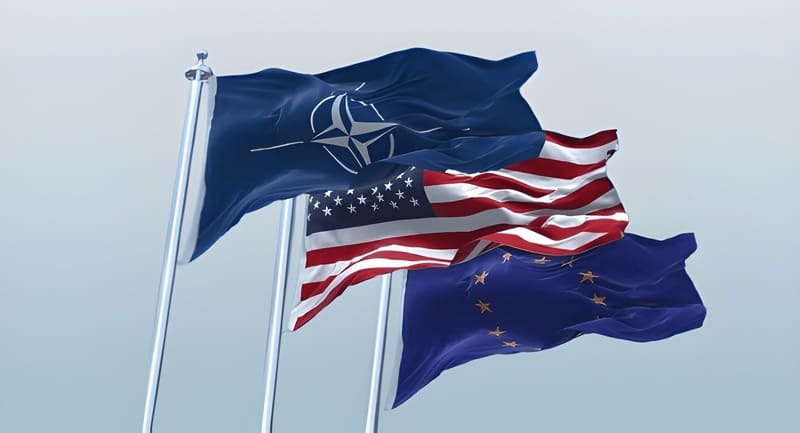
There are discreet ways of telling an alliance that it is no longer unconditional. One of them is a questionnaire. According to Bloomberg, Washington has sent NATO allies an inquiry asking, in essence, whether they have been publicly loyal to Trump’s policies, whether they have placed restrictions on the use of American military bases — notably during operations against Iran — and whether they buy equipment from American defence manufacturers rather than reinforcing European production. The document surfaces midway through a review of the American military footprint in Europe, due to conclude in December, and allies have reportedly reacted to it with something close to unanimous discomfort.

The technical detail of the questionnaire is apparently minor matters, secondary to the principle it reveals. Seventy-seven years after the Alliance’s founding, the American security guarantee is ceasing to be a given owed to membership and becoming a negotiable variable, conditioned on ideological alignment with the administration of the day. This is not an accusation. It is an observation. And observations, unlike accusations, demand a practical response rather than indignation.
The questionnaire does not arrive in a vacuum. It arrives in a year in which unpredictability has stopped being the exception and become the method — and NATO is not the only alliance being asked to prove it. Washington has just scaled back the Ulchi Freedom Shield exercises with South Korea, citing the President’s rapport with Kim Jong Un and Seoul’s refusal to help pressure Iran toward denuclearisation. Whatever the merits of the individual decision, the pattern is unmistakable: an ally’s standing is increasingly measured not by treaty obligation, but by whether it has been useful to a specific set of priorities at a specific moment. What was tested through a document in Brussels is tested through troop numbers in Seoul. The instrument changes. The logic does not.
In Ukraine, three short-lived truces have come and gone since Easter — April, and the Victory Day ceasefire in May — none of them surviving contact with the ground, with the front continuing to shift in both directions absent any negotiating architecture capable of sustaining a durable peace. In the Middle East, the United States and Israel have waged open war against Iran since late February, with Beirut, Gaza and the Persian Gulf drawn into varying degrees of escalation. The sixty-day window Washington and Tehran set in June for a settlement has now expired without agreement, and Iran has instead struck a parallel arrangement with Oman to manage shipping through the Strait of Hormuz — traffic through which nearly halted over the past weekend. Trump’s response was to threaten, in unusually blunt terms, to bomb Oman if it ‘gets in the way’. A long-standing Gulf partner of the United States is now being warned in the same register once reserved for adversaries, simply for negotiating directly with Tehran instead of waiting on Washington.
None of these fronts is closed. All of them compete for the same attention, the same resources and the same political bandwidth in Washington — and the Hormuz stand-off in particular carries a cost that lands directly on European balance sheets. A prolonged disruption to Gulf shipping means higher insurance premiums, higher freight rates and renewed pressure on energy prices at the precise moment European economies can least absorb it. It is against this backdrop of simultaneous overload that the review of the American presence in Europe takes on its full meaning. This is not simply budgetary fatigue. It is a power managing several crisis theatres at once that has decided, faced with that scarcity, to charge a political price for its attention. The question Europe should be asking itself is not whether this is fair. It is whether it can keep organising its collective defence on the assumption that the answer will always be yes.
It is against this same backdrop that Europe’s own position looks particularly exposed — not only strategically dependent, but economically weakened at the moment it most needs room to manoeuvre. Germany, the Union’s industrial and financial engine, is living through the deepest crisis in its automotive sector in decades: Volkswagen is weighing up to 100,000 job cuts and the closure of four plants, Bosch has dissolved its autonomous-driving alliance with Volkswagen itself, and German industrial output remains well below its pre-war peak, with unemployment at a twelve-year high. An economy under that kind of strain has necessarily less strategic room to manoeuvre, and that constraint feeds directly into Europe’s capacity to sustain both the Ukrainian war effort and collective rearmament. Layered on top of this economic fragility is a political fracture the Union keeps treating as episodic when it is in fact structural: after months of Hungarian obstruction finally lifted in April, following Orbán’s electoral defeat, it is now Slovakia’s Robert Fico occupying the same space — the only EU leader to attend Moscow’s Victory Day commemorations, and still conditioning any move toward Ukrainian accession. A Union unable to protect its own defence-industrial base, absorb an energy shock originating three thousand kilometres away, or speak with one voice about the country meant to unify it has little moral authority left to demand of Ukraine a predictability it cannot offer itself.
While Washington tests the loyalty of its traditional allies, China works, with almost surgical patience, to build the opposite narrative — that of a power which demands no loyalty tests, only transactional partnership. In May, Xi Jinping received both Donald Trump and Vladimir Putin in Beijing within days of one another, and the Russian visit produced a joint statement on a multipolar world that, without naming NATO, is constructed precisely against the architecture NATO represents. In July, on the anniversary of the Chinese Communist Party, Xi reiterated Beijing’s commitment to Taiwan’s reunification and to the accelerated modernisation of China’s armed forces. None of this is calendar coincidence. It is the gradual assembly of an alternative source of influence that capitalises on every sign of Western fracture, without ever having to fire a shot.
That alternative should not be idealised: the Sino-Russian relationship is built as much on convenience as conviction, and Beijing remains as wary of excessive dependence on Moscow as Moscow is of Beijing. But the functionality of that mutual mistrust does not make it any less effective as a tool for eroding Western cohesion. An alliance that negotiates loyalty with its own members’ hands that alternative exactly the material it needs.
I return, then, to a point I have made elsewhere about Europe’s fragmented defence-industrial base: reducing critical dependencies is not the same as breaking alliances. The United States remains Europe’s most important security partner, and no serious reading of the current balance of power suggests otherwise. But the questionnaire itself makes operational what until now was only an academic hypothesis: asking directly whether a country buys from American suppliers, and whether it is willing to publicly oppose European ‘buy European’ policies, turns industrial choice into a test of political loyalty. It is the exact inverse of the logic I have defended around harmonising European defence procurement — not because buying American is illegitimate, but because a collective security system cannot depend on a supplier that simultaneously grades the loyalty of the buyer. For Portugal and other small allies with fragmented defence-industrial bases, the lesson is the same one playing out from Seoul to the Gulf: a country that does not know whether its critical supplier will still be available in six months does not have a defence policy. It has a hope.
Deterrence, I have argued before, rests on more than military spending. It rests on predictability, on trusted partnerships and on the systematic reduction of critical dependencies. Washington’s questionnaire did not invent this truth. Seoul’s downgraded exercises and Oman’s threatened bombing did not invent it either. What this month has done, for the first time, is make it impossible to ignore.
Is the transatlantic alliance still organised around shared strategic purpose — or is it drifting toward a system of conditional access, priced and re-priced according to the political weather in Washington?
The answer will not be found in rhetorical loyalty, offered or withheld. It will be found in Europe’s willingness to build the capabilities, industrial capacity and strategic patience that make it a partner Washington cannot simply grade — and does not need to.
Author: Fernando Figueiredo – Retired Portuguese Army colonel and former NATO professional, who held various strategic leadership positions, currently serving as a defense consultant at Pulsar Development International. His work focuses primarily on defense requirements, offering expertise and a network of contacts that enable operational challenges to be overcome with effective, tailored solutions.
(The opinions expressed in this article belong only to the author and do not necessarily reflect the views of World Geostrategic Insights).