



By Nazia Sheikh
In the contemporary era of geopolitical conflicts, erosion of arms control treaties, and hybrid warfare, modern diplomacy has been stuck in a deadlock. There is no progress in resolving regional conflicts, and trust between great powers has been badly shattered.

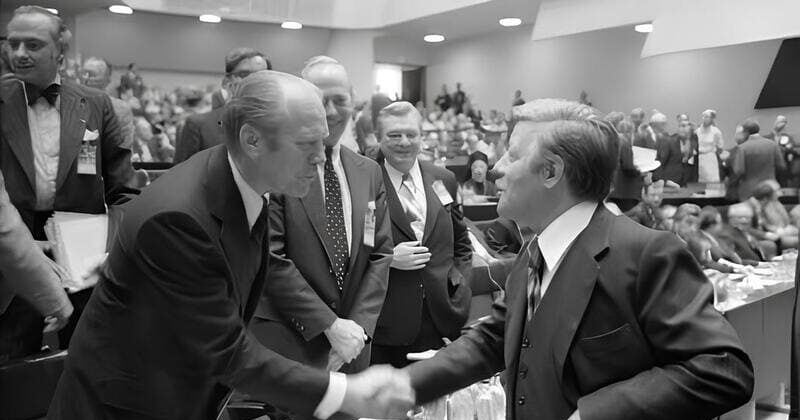
Helsinki Accords were signed on August 1, 1975, to establish a durable platform for dialogue and cooperation. Amid Cold War tensions,35 participating states were negotiating a framework for European security and cooperation. The mechanism and spirit of the Helsinki Accords provide significant lessons in today’s contemporary global crises, which are ambiguous.
The Helsinki Accords comprise four comprehensive areas, known as baskets: Basket one is security; Basket two is economic & scientific cooperation; Basket three is human rights & information; and Basket four is Follow-Up Mechanisms. The Accords acknowledged that lasting peace could not rely only on military deterrence, but it is necessary to link it with economic cooperation and human rights.
Also, Helsinki affirmed principles concerning territorial integrity, sovereignty, and the inviolability of frontiers, including legitimizing the Yalta borders and allowing the possibility of peaceful change consistent with international law. In the long term, however, the agreement transformed European security in ways its creators never anticipated. Basket III gave dissidents and human rights activists across Eastern Europe a legitimate, internationally recognized tool to challenge totalitarian control. What began as a diplomatic attempt to manage Cold War rivalry ultimately helped lay the moral and structural groundwork for the peaceful unwinding of the Soviet bloc.
For conflict-ridden regions like South Asia, the success of the Helsinki model is an attractive example. Especially in the Kashmir conflict, deep-rooted historical mistrust and unresolved territorial disputes surrounded the region. Applying the Helsinki model in the South Asian region is complicated because of the structural differences; unlike the Cold War rigid bipolar balance in Europe, South Asia operates within an asymmetric regional system.
In the case of South Asia, what is needed is to use the Helsinki Accords’ core principle of non-military channels to build trust. Through Baskets II and III, progress must be resumed as the hard-security negotiations between India and Pakistan remain delayed.
Helsinki approach principles have already been witnessed in South Asia through several initiatives, particularly in confidence-building, connectivity, cooperation and dialogue. For example, the Samjhauta Express, Aman Ki Asha initiative, cross-Line of Control bus services and trade, and the Kartarpur Corridor signified efforts to strengthen people-to-people contacts, economic interaction, humanitarian connectivity and dialogue. Following 2019, the deterioration in bilateral relations, several of these initiatives have lost momentum or faced pauses.
These experiences offer an important lesson for contemporary Helsinki-inspired approaches. It indicates that Confidence-building mechanisms require continuity, institutional support, and regular engagement to endure periods of political tension. Reviving such channels could complement formal diplomatic efforts and help rebuild a foundation for sustained regional dialogue. The lesson of Helsinki is not to replicate the 1975 agreement in South Asia, but to adapt its process-oriented approach of continuous dialogue, confidence-building, economic cooperation, human contacts, and periodic review to contemporary regional conditions to overcome the tensions between states.
One flaw pointed out in the Helsinki Accords was that it was politically binding commitments rather than legally binding treaty obligations, as political will fades with the passage of time. This weakness is clearly visible in the current security crisis in Europe. Also, it complicates modern conflicts like digital disinformation, hybrid warfare, and non-state actors, which did not exist before 1975. However, it must be remembered that the non-binding nature makes it possible to bring together bitter adversaries at the same table during the Cold War while formal treaties were politically impossible.
Today, with collapsed alliances and digital warfare, the world does not need more unratified treaties but needs flexibility and institutionalized mechanisms for continued negotiations. The Helsinki accord showed that nations can agree on principles of cooperation even in the darkest times of geopolitical mistrust, and revitalizing this accord is necessary as diplomacy struggles to respond to old rivalries and new wars. For long-lasting peace in the frozen conflicts, the Helsinki outlook, which is based on human rights, persistent review, and comprehensive cooperation, will remain a significant framework to restructure dialogue for resolving the conflicts.
Author: Nazia Sheikh – Research Officer at the Centre for International Strategic Studies, AJK. She holds an MPhil degree in International Relations from the International Islamic University, Islamabad, Pakistan. Her research interests focus on arms control and disarmament.
(The views expressed in this article belong only to the author and do not necessarily reflect the views of World Geostrategic Insights).
Image Source: Gerald R. Ford Presidential Library (United States President Gerald Ford shaking hands with West German Chancellor Helmut Schmidt during the Conference on Security and Co-operation in Europe in Helsinki).