



By Indrani Talukdar and Monish Tourangbam
Last month, responding to a question during a meeting with the British Prime Minister Keir Starmer, US President Donald Trump put forward a new timeline for a Russia-Ukraine peace deal saying, “I’m going to make a new deadline of about 10, 10 or 12 days from today.”

Berating his Russian counterpart, Trump commented, “There’s no reason in waiting. It’s 50 days. I want to be generous, but we just don’t see any progress being made.” Earlier, in a leaked audio released by CNN, Trump could be heard telling a private meeting of fundraisers last year that he once threatened to “bomb the s**t out of Moscow” to prevent Russia from invading Ukraine during his first term.
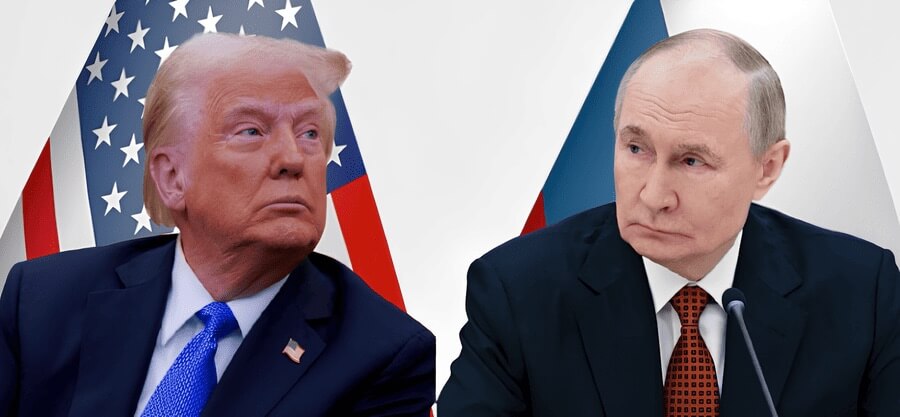
The US-Russia relationship has hit a new nadir, despite flashes of a Trump-Putin bromance often teasing the bilateral dynamics, in President Donald Trump’s first as well as the second term. Currently, the US-Russia relationship is at a new low, despite current attempts at brokering peace in the ongoing Russia-Ukraine war.

President Trump threw a new curveball, with a hawkish turn on Russia, threatening to impose new sanctions and supplying sophisticated missile systems to Ukraine. President Putin retorted back with nuclear threats, and NATO’s threat of taking over Kaliningrad from Russia has exposed more faultlines in an already fragile security environment and the growing brinkmanship. Moreover, the recently concluded NATO summit and the overwhelming consensus within the bloc to increase defence spending did ignite some air of renewed bonhomie between the US and its transatlantic allies, lending a new tone and tenor to the western alliance’s approach to the Russia-Ukraine war.
Clearly, the perceived terms of endearment between Trump and Putin, has given way to mutual disappointments, with Washington threatening new sets of sanctions, and with Moscow raining drone attacks on Kyiv. A U-turn from the personal bonhomie between Trump and Putin to a new confrontationist curve in the relationship, now defines the current state of bilateral dynamics, flowing out of differences over the Ukraine war, the future of NATO in Eastern Europe, and moreover, Washington’s inability to coerce a structurally weaker Moscow to change its behaviour.
Russia’s attack on Ukraine has been continuing no matter what tool the United States employs from its playbook, making any chances of a new US-Russia reset bleaker by the day. However, the dynamics that sometimes sound buoyant only to come across as a Sisyphean task, is not a Trump era phenomenon. It has a history of many failed attempts and of aspirational leadership chemistry that came undone under the forces of geopolitics and domestic politics at both ends.
It is a tale of many missed opportunities to break the vicious cycle of enmity and entrenched great power rivalry that has had a substantial impact on regional and global security orders. Looking backwards will be significant to look forward to in this complicated story of an ex-superpower fighting hard to resurrect its lost glory, and a current superpower clinging on to the depreciating value of its global status and dominance. A true reset between the US and Russia will undoubtedly be consequential for the international system, and will reorient geostrategic calculations across the world. However, the question is: is a reset possible, or are the structural forces so ingrained that such an eventuality will be a lost cause irrespective of any leadership bonhomie.
A Tale of Many Resets: Is It A Sisyphean Task?
The post-Cold War history of US-Russia relations is replete with many thaws and breakthroughs that, however, did not result in a long-term positive arc. In 2001, during the George W. Bush presidency, the first rays of a reset started appearing in the horizon. In fact, Putin was the first foreign leader to call Bush after the 9/11 attacks and a year later, the two leaders agreed to create the NATO-Russia Council in order to facilitate cooperation.
President Bush, post his first meeting with President Putin, famously said during a conference in Slovenia in 2001 that he looked into Putin’s eye and saw straightforwardness and trustworthiness in it. “I was able to get a sense of his soul,” Bush had said. Although this seemed like the beginning of a good chemistry that would positively influence the bilateral relationship and in turn, affect the emerging post-Cold war order, many incidents that followed nipped the flower in the bud.
Differences over America’s invasion of Iraq in 2003, NATO’s growing enlargement in 2004, US plans to build a missile shield in Poland in 2007 and the 2008 Russia-Georgia War derailed any mutual understanding. Moreover, Putin’s speech at the Munich Security Conference in 2007 lamented the collapse of the Soviet Union as “catastrophic” and vowed to defend Russia’s interest at any cost, particularly against NATO expansion.
The brightest spot of hope to press the US-Russia reset button perhaps came during the presidency of Barack Obama. Obama wanted to reverse what he called a “dangerous drift” in the relationship. For instance, after the 2008 Georgia fiasco, the initiation of the U.S.-Russia Bilateral President Cooperation involved President Obama and his Russian counterpart President Dmitry Medvedev.
A US official, in 2010 during the World Russia Forum, said that although the two countries lacked the diplomatic architecture and political ballast that would have helped defused or prevented successive conflicts over Kosovo, NATO enlargement, energy security, and the escalating tensions that culminated in Russia’s invasion of Georgia, there was no ideological basis for a “new Cold War”. In 2009, Obama went to the extent of underscoring that “America wants a strong, peaceful and prosperous Russia” and acknowledging that a tangible US-Russia partnership can only materialise if Russia “occupies its rightful place as a great power”.
However, the bonhomie did not last long, with the US becoming critical of Putin’s rollback of democracy and disagreement over Kosovo’s statehood. In a tit-for-tat, Russia criticized the then US Secretary of State Hillary Clinton for protests in Moscow following allegations of vote-rigging in Russia’s 2011 parliamentary election. In 2012, the United States passed the Magnitsky Act to impose sanctions on Russian officials who were allegedly involved in the death of a Russian whistle blower.
On the other hand, Russia imposed the Dima Yakovlev law, aiming to ban the adoption of Russian children by citizens from so-called unfriendly countries, including the United States. With American whistle blower Edward Snowden being provided asylum in Russia, and Russia’s annexation of Crimea in 2014, US-Russia ties descended to new lows, killing any hope of a rapprochement aka reset.
The tone and tenor of Obama’s words on his relationship with Putin started taking a new shift, reflecting the growing coldness in the relationship. “He’s constantly interested in being seen as our peer and as working with us, because he’s not completely stupid. He understands that Russia’s overall position in the world is significantly diminished. And the fact that he invades Crimea or is trying to prop up Assad doesn’t suddenly make him a player.” “You don’t see him in any of these meetings out here helping to shape the agenda. For that matter, there’s not a G20 meeting where the Russians set the agenda around any of the issues that are important…,” Obama said speaking to Jeffrey Goldberg of the Atlantic in March 2016.
The onset of the First Trump presidency in January 2017 yet again saw some glimmer of hope of mending ties between the two countries, given at least the optics of a Trump-Putin personal chemistry, even though the structural contours of the bilateral relationship were hardly on a good turf. Moscow was accused of interfering in the US Presidential election of 2016, leading to a series of retaliatory measures from both ends, leading to closing of consulates, closure of consular properties and expulsion of diplomats. In 2017, the US Congress imposed new sanctions on Russia.
The Biden administration brought forth attempts to induce a working relationship culminating in the Biden-Putin meeting in Geneva in June 2021 and a document released by the Russian Foreign Ministry in December the same year that put forward a number of security guarantees that Moscow demanded from the US and NATO. Among many other demands, it included a ban on Ukraine entering NATO, besides limiting NATO’s troop and weapon deployment to the pre-1997 level or pre its expansion into Eastern Europe.
The United States and NATO shot down these demands, particularly refusing to break with its open door policy for new members, showing greater cooperation with Ukraine, and the grounds were set for one of the biggest kinetic wars in the European continent since World War II. The Russia-Ukraine war has in the last three years and more, become a war of attrition, with no clear winners and losers in sight, and with no truce in the near horizon.
Russia and the US have temporarily suspended several projects and meetings planned under the US-Russia Bilateral Presidential Commission (BPC). Funding for these activities has instead been used to contribute to a package of US assistance to Ukraine, which is supporting economic reform and addressing other pressing needs, including combatting corruption and recovering stolen assets. When Trump assumed his second presidential term in January 2025, there were hopes that the relationship would improve. Glimpses could be seen in the form of the telephone conversation Trump and Putin had in March 2025, paving way for the ‘Black Sea Deal 2.0’. During this period, Trump threatened Ukraine and moved closer to Russia to the extent where he voted against America’s European allies at the United Nations on additional sanctions on Russia.
Trump at the G7 summit in Canada in June 2025, even berated the G7 countries for pushing out Russia out of the group and came close to a deal with Russia on the rare earth minerals available within Russia as well as in the occupied territories of Ukraine. Moreover, Trump’s relative indifference to the future of Ukraine, his hostility towards NATO and eagerness to be the peacemaker gave the Russian president more leeway and an opportunity to improve his position in Ukraine. However, the US attacks on Iran’s nuclear sites played a spoiler on Russia’s projection of becoming a mediator in the Israel-Iran conflict. All hopes of a US-Russia reset as of now, have gone south, with Trump threatening new sanctions on Russia, and promising advanced missile systems to Ukraine and Putin, in turn, pulling new nuclear weapon threats out his sleeves.
The NATO Spectre, Competing Spheres of Influence and Geopolitics
Russia’s redlines of NATO’s eastward expansion lies at the heart of the Russia-Ukraine war and hence the threat of being encircled within its sphere of influence by the ex-Soviet states becoming NATO members, lurks paramount in Moscow’s worldview. Perceptions and misperceptions underline how Moscow and ex-Soviet states view NATO’s open door policy of membership. In 2011, speaking to officers of the Southern Military District in Vladikavkaz, the then Russian president Dmitry Medvedev contended that that the Russia-Georgia War of 2008 was to prevent Georgia from joining NATO and that the Russian Army’s ‘peace-enforcement operation’ was to save the Russian citizens based in Georgia. Many countries, according to him, were being “artificially dragged” into NATO.
During a meeting with some media people stationed in Georgia, Medvedev said that he and the then Georgian President Mikheil Saakashvili had several meetings discussing the issues the two countries were facing and that Saakashvili showed keenness to resolve them. However, things, according to him, took a complete U-turn after the visit of the then US Secretary of State Condoleezza Rice and all communications between Russia and Georgia stopped henceforth.
The Kremlin perceives that the ex-Soviet states have been dragged or coerced into NATO’s membership and hence making it imperative for Moscow to perceive a “responsibility to protect”, a perception that may not always be shared by the ex-Soviet states. Russia-EU dynamics have also become more complicated with the onset of the Russia-Ukraine war, particularly as EU shifts from a normative supranational power to a security power amidst the war and Trump’s push for taking defence needs into their own hands. The discomfort in Moscow is seen in its growing abhorrence towards Ukraine joining the EU, in addition to the redline of joining NATO. Besides, not all EU countries sing in the same tune, when it comes to dealing with Moscow, with countries like Hungary and Italy showing a relatively less hardline stance towards Russia.
Many faultlines on territorial claims and counterclaims have been exposed since the outbreak of the Russia-Ukraine war. The war that started with Russia’s invasion of Ukraine has raised numerous speculations and hypotheticals over China’s approach to Taiwan, not to mention of Trump’s adventurous claims on Greenland, the Panama Canal, the Gulf of Mexico and on making Canada America’s 51st state. Given Russia’s Arctic ambitions, a future clash over strategic Alaska might not be too farfetched either.
An Elusive Post-Cold War Relationship
Washington’s triumphalist attitude proclaiming a proverbial “end of history” has been an eyesore and heartache for Russia and more particularly for President Putin, a Soviet era intelligence hand stationed in East Germany when the Soviet era came crashing down along with the German wall. A number of Russia watchers around the world have constantly harped on Putin’s innate desire to reclaim the lost glory of Soviet power and parity with the United States. From the post-Soviet era of Yeltsin years to the long reign of President Putin, Washington and Moscow have not yet really managed to craft a sustainable and stable post-Cold War relationship.
In Moscow, a feeling continues to lurk that Russia’s constructive role in managing the aftermath of the Cold War has not been given due credit, that the US in particular and the West in general never sincerely attempted to open the door for Russia to enter the Western club as an equal partner. Russia’s push for a multipolar world order, therefore, is largely aimed at dismantling America’s primacy and hegemony in the international system, even if it means walking into a “no limits” partnership with Beijing, with which it currently shares a strategic convergence.
Russia is keen to use great-power competition between the US and China to achieve political and economic gains with Beijing while maintaining an independent foreign policy. The volatility and instability in Russia’s relations with the West and the US in particular has led Russia into a strategic embrace with China, especially after 2014. The West has been accusing China of helping Russia politically, economically and militarily in the war with Ukraine, which Beijing has consistently denied.
Though China might not be helping Russia directly but in certain ways, it is giving support to Russia such as, by increasing economic cooperation especially in the energy sector. It has abstained itself from voting against Russia at the UN.
China is increasingly strengthening its relationship with Russia in multilateral platforms such as the SCO and BRICS. It has abstained itself from US-led sanctions on Russia. News reports also point at China providing Russia with lethal weapons against Ukraine, which Beijing has denied. In successive summit meetings between the Chinese President Xi Jinping and his Russian counterpart, targeting US Indo-Pacific strategy as the source of regional instability, has become a common fixture. However, even the “no limits” partnership is not really without limits either. Moscow is not comfortable with Beijing’s growing influence in Central Asia, Indo-Pacific and the Arctic.
In fact, a recently leaked document by Russia’s FSB’s Department of Counterintelligence Operations (DKRO) described China as a significant intelligence threat to Russia due to it concerning military espionage, technology theft, and regional power plays. Therefore, the vicissitudes of the China factor in the US-Russia relationship reflects the dynamism of geopolitics and how this game will pan out in the future is still anybody’s guess.
While many describe Russia as “a weak great power” and is “consistently underrated because it historically lags behind the West in technology, political and economic sophistication” but Moscow also “consistently punches above its economic weight in the international system” and refuses to be boxed out of contention in the great power games of the 21st century. Russia, according to many, is not “a declining regional power” but exudes characteristics to “the contrary”, as Russia continues to play a significant role in shaping outcomes in its near abroad as well as in the Global South, including in the multilateral platforms such as SCO and BRICS.
Clearly, when Russia seeks a reset with the United States, the goal is to negotiate a power parity with the United States, and reclaim some of its lost status as a global player. On the other hand, when the US enters into a reset mode with Russia, the goal is to achieve more concessions and cooperation from Russia on other ancillary foreign policy and national security issues, such as Afghanistan or Syria. In the final analysis, the widening gap in how Moscow and Washington perceive each other’s worldviews, the history of triumph and disaster, their respective global roles, their choice of allies and partners will continue to present insurmountable hurdles in any effort towards any effective reset in a rapidly shifting global security environment.
Indrani Talukdar is a Fellow at the Chintan Research Foundation (CRF), New Delhi, India.
Monish Tourangbam is a Senior Research Consultant at CRF.
(The views expressed in this article belong only to the authors and do not necessarily reflect the views of World Geostrategic Insights).