



The Strait of Hormuz has never been just a narrow maritime passage; it is the central lifeline of a strained global order, channeling a vast share of the world’s energy flows in times of stability. When that lifeline tightens, the consequences are not localized, they reverberate across continents, unsettling economies and exposing the fragility of an interconnected order.

The recent crisis, triggered by U.S.-Israeli military actions against Iran and intensified by Tehran’s sweeping countermeasures, has done precisely that. It has not only reignited geopolitical tensions but also laid bare the deeper inconsistencies and inequities embedded in the current international system.
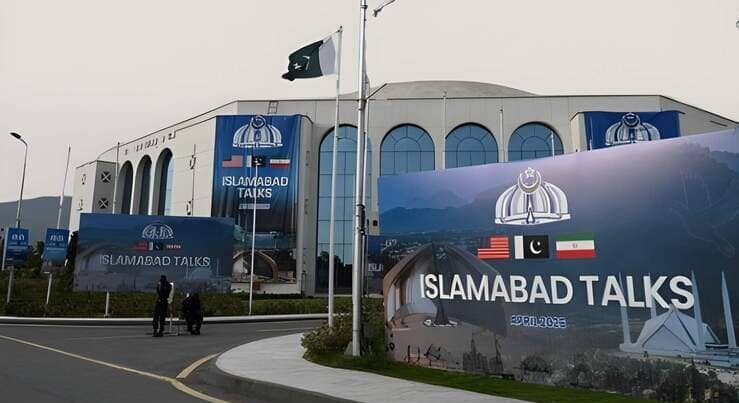
Against this volatile backdrop, the Iran-United States peace talks in Islamabad must be seen not as an isolated diplomatic event, but as an urgent response to a system under severe stress. In a remarkably short span, the effects of disruption in Hormuz became visible worldwide. Shipping traffic dwindled sharply, energy markets reacted with alarm, and oil prices climbed toward levels that threatened economic stability.
The ripple effects were immediate and uneven; European economies braced for inflationary pressure, Asian markets confronted the possibility of fuel shortages, and vulnerable regions in Africa faced worsening food insecurity. What appeared at first as a regional confrontation quickly revealed itself as a global crisis.
In such circumstances, diplomacy was no longer a matter of preference, it became a necessity dictated by the sheer scale of risk. Islamabad, therefore, emerged not as a venue of grand reconciliation, but as a space to contain an unfolding emergency.
What is now unfolding across key maritime corridors from Hormuz to the South China Sea and onward to Bab el-Mandeb, signals something more profound than episodic conflict. It points to the gradual fragmentation of the global disorder, where influence is increasingly asserted through pressure, disruption, and selective enforcement of norms.
Beyond physical waterways, similar patterns are visible in the control of digital networks, supply chains, and technological ecosystems. Power is no longer expressed solely through military strength; it is exercised through the ability to shape flows of energy, data, and trade.
In this evolving landscape, the promise of a rules-based order appears increasingly conditional, often dependent on strategic alignment rather than universal principles. For much of the Global South, this moment reinforces a familiar skepticism. The uneven application of international law has long been a source of grievance, and recent events have only deepened that perception.
The diplomatic shielding of certain actors in past conflicts particularly in the context of Gaza remains a fresh memory. Viewed through that lens, Iran’s use of its geographic leverage does not appear as an anomaly, but as part of a broader pattern in which power dictates outcomes.
Yet it would be dangerously reductive to interpret this as a straightforward assertion of victory. The disruption of a critical global artery, the targeting of civilian shipping, and the delays in humanitarian assistance all underscore a sobering truth; there are no real winners in a crisis of this magnitude.
The burden falls disproportionately on ordinary populations, far removed from the strategic calculations of major powers. Within this context, the Islamabad talks assume a different meaning. Judged purely by conventional diplomatic metrics, they appear inconclusive. No comprehensive agreement emerged, and the fundamental disagreements between Washington and Tehran over nuclear capabilities, sanctions, regional influence, and maritime control remain unresolved.
These are not issues that lend themselves to quick compromise; they are rooted in long-standing mistrust and competing strategic visions. And yet, to characterize the talks as a failure would be to overlook their most significant achievement. They did not end the conflict, but they interrupted its trajectory. They provided a mechanism for communication at a moment when silence could have been catastrophic. They transformed an immediate risk of escalation into a more manageable, if still fragile, process of engagement.
In that sense, Islamabad represents a limited but meaningful success – a tactical easing of tensions within a broader strategic deadlock. The motivations that brought both sides to the table were grounded in realism rather than reconciliation. The United States faced the prospect of a widening conflict with uncertain outcomes and mounting economic consequences. Iran, having demonstrated its capacity to exert pressure through asymmetric means, approached negotiations with a sense of strategic confidence.
At a deeper level, the episode reflects the limitations of the existing international framework. Institutions designed to uphold collective security continue to struggle under the weight of competing interests. The persistent use of veto power by major states has eroded confidence in the system’s ability to act impartially.
What emerges is not a collapse of norms, but a gradual weakening of their authority, a condition in which rules exist, yet their enforcement is inconsistent. The current crisis is, in many ways, a cumulative outcome of these structural deficiencies.
In such an environment, Pakistan’s role carries both promise and complexity. By facilitating dialogue between adversaries, Islamabad has demonstrated the potential of middle powers to act as stabilizing forces in times of crisis. Its ability to maintain working relationships with both Washington and Tehran has allowed it to serve as a conduit for communication when direct engagement was limited.
This is a notable diplomatic achievement, one that enhances Pakistan’s standing in an increasingly multipolar world. However, this position also demands careful navigation. Mediation brings visibility, but it also brings expectations and risks. The likelihood of a definitive resolution remains low; more plausible is a continuation of intermittent dialogue, punctuated by periods of tension.
For Pakistan, this means sustaining a role that is inherently delicate, supporting engagement without becoming entangled in its outcomes. The guiding principle must therefore be one of measured neutrality. Pakistan’s effectiveness will depend on its ability to engage constructively while avoiding the perception of alignment. It must facilitate without overcommitting, influence without overextending.
This is not a passive stance; it is a disciplined form of strategic engagement, suited to the complexities of the current environment. The Iran-United States peace talks in Islamabad may not redefine the course of international relations, but they have served an important purpose. They have slowed a dangerous escalation, created space for dialogue, and underscored the continuing relevance of diplomacy – even in an era marked by fragmentation and competition.
In a world where the arteries of global stability are constricting, where law bends before power, and where crises cascade across regions and domains, sometimes the most meaningful act of diplomacy is not to end conflict but to prevent it from becoming irreversible.
To get down to brass tacks, Islamabad, in this momentum, became that line of restraint. How long it holds is a question not just for Washington or Tehran, but for the fragile system and global disorder that connects them and for the states, like Pakistan, that now stand at the fault lines of an emerging world order.
Author: Mirza Abdul Aleem Baig – President of Strategic Science Advisory Council (SSAC) – Pakistan. He is an independent observer of global dynamics, with a deep interest in the intricate working of techno-geopolitics, exploring how science & technology, international relations, foreign policy and strategic alliances shape the emerging world order.
(The opinions expressed in this article are solely those of the author and do not necessarily reflect the views of World Geostrategic Insights).