



World Geostrategic Insights interview with Radosław Szczepański on how contemporary asymmetric conflicts are reshaping military institutions and civic society across Europe, particularly in Poland, in an era of heightened geopolitical tensions and dependence on global supply chains.

Radosław Szczepański is a Polish researcher and expert specializing in the sociology of armed conflict, civil defense, and countering radicalization. His work focuses on analyzing contemporary security threats from social and institutional perspectives. He is the President of EuroDefense Poland, the Polish branch of EuroDefense, a network aimed at promoting a common culture of security and defense in Europe, strengthening defense cooperation within the EU, and enhancing strategic decision-making among member states.
Q1 – How are 21st-century asymmetric conflicts changing the relationship between military institutions and civil society in Poland and Europe?
A1- Contemporary asymmetric conflicts unfold differently across European countries. Western Europe and Scandinavia, due to their demographic structure, are more vulnerable to terrorist attacks carried out by fundamentalists. The main challenge for Southern European countries is migration pressure. Central and Eastern Europe, on the other hand, are the target of hybrid attacks carried out by Russia.
Q2 – What are the main sociological factors influencing the Polish population’s perception of the threat of war today compared to the Cold War era?
A2 – During the Cold War, the sense of an imminent real war was generally less acute than it is today. The world was divided by the Iron Curtain into East and West and maintained a nuclear balance of terror, which acted as a deterrent. Open military conflicts largely took place outside Europe, such as in Korea, Vietnam, Angola, and Afghanistan.
Following Russia’s aggression against Ukraine, the perception of threat in Poland, the Baltic states, has significantly increased. Finland and Sweden, which had remained neutral for many decades, also felt increasingly threatened and ultimately joined NATO.
Q3 – What are the main factors of “radicalization” capable of undermining social cohesion in Poland and in European countries in general?
A3 – The main factors driving radicalization include differing views on migration, attitudes toward the Israeli–Palestinian conflict, and perspectives on climate change. Religious, political, social, digital, economic, and communication-related inequalities also contribute to the polarization of European societies. In Poland, the primary lines of division revolve around attitudes toward irregular migration, particularly in the context of actions by the Belarusian authorities, views on European Union membership, issues related to antisemitism, and opinions on the support provided to Ukraine in its war with Russia.
Q4 – What are the most effective sociological strategies for transforming a population into a resilient community, capable of responding in a coordinated manner in the event of a national crisis and military threat?
A4 – It is essential to build unity around shared values, emphasizing what connects people rather than what divides them. It is also important to raise awareness that everyone bears some degree of responsibility for collective security. Total defense includes, among other things, a precise distribution of roles among all citizens, so that each person knows exactly what to do in the event of a crisis.
Q5 – What role should non-governmental organizations and private companies play within the framework of national security?
A5 – Strong non-governmental organizations have significant potential to support national security. In Israel, groups such as Sar-El and Hashomer HaChadash effectively assist by taking on logistical and patrol-related tasks, easing the burden on soldiers. Private companies, in turn, can develop dual-use products and services that are adaptable for both civilian and military purposes.
Q6 – With defense spending set to reach 4.12% of GDP in 2024 (the highest among NATO members), Poland is becoming the military linchpin of the eastern flank. How does this transformation alter Warsaw’s political weight within European defense institutions?
A6 – Due to its geographic location and size, Poland is crucial for ensuring Europe’s security. The strong position of the current Foreign Minister enables the effective implementation of Poland’s defense doctrine. Poland is also playing an increasingly significant role in joint European defense production programs, helping to build capabilities that are less dependent on the uncertainties of U.S. policy.
Q7 – The massive purchase of weapons from non-European partners such as the United States and South Korea has a huge impact on Poland’s national economy. How do Polish citizens perceive this “price of security” in terms of social services and long-term stability?
A7- Purchases from South Korea were largely driven by the lack of available tanks on the European market. Major arms deals with the United States were signed at a time when the U.S. appeared to be a stable and predictable ally. Poles, shaped by the experience of neighboring Ukraine, understand the necessity of bearing higher costs for security in the current situation.
Q8 – According to your research, how is the concept of civil defense evolving in Poland in response to the perception of a “pre-war” era in Europe? Is there a risk of excessive militarization of civil society?
A8 – The concept of civil defense is not about militarizing society, but about assigning citizens clear and specific roles. In the event of war, soldiers are engaged in combat operations, while the rest of society supports them. Civilian efforts should be based on principles similar to military discipline meaning clear command structures and adherence to instructions. I do not see a risk of excessive militarization; on the contrary, I believe we should further develop NGOs that support national defense.
Q9 – In a context of high geopolitical tension, how can Poland prevent the patriotism necessary for defense from turning into forms of “nationalist radicalization” that could undermine the cohesion of the European Union?
A9 – Nationalist radicalization can arise mainly from a lack of prospects and from the tendency to blame strangers for one’s own situation. It is therefore important to shape attitudes based on European values. The direct security threat to Poland from Russia is as significant as the migration pressure faced by Italy from countries across the Mediterranean, and this shared reality should serve as a foundation for building a stronger European identity.
Q10 – How can the sociology of conflict help mediate between Polish national interests and the need for an integrated European defense industry?
A10- In a situation where the whole of Europe faces security threats, we should integrate the European defense industry, while recognizing that different countries are affected in different ways. Individual states have their own strong areas of expertise in armaments, and rather than competing with each other, they should cooperate. Developing the same types of weapons in parallel across multiple countries is economically inefficient. There is clearly room here for compromise and for expanding cooperation.
Q11 – In your opinion, what will be the most complex sociological challenge that European defense systems will face in the next ten years?
A11 – The first challenge is changing attitudes toward the duty of national defense. Compulsory military service should be seen as an opportunity to develop skills and competencies, rather than a waste of time. It is important to emphasize the dynamic nature of modern warfare and the types of skills that are essential in contemporary conflict. The second challenge is that modern conflicts increasingly differ from classical models. The example of Ukraine’s war with Russia and the use of “smart warfare” shows that defense systems must be highly flexible, adapting both technologically and mentally to rapidly changing conditions.
Q12 – With China controlling 19 of the 34 raw materials critical to Europe, the continent’s security is now tied to supply chains controlled by a potential systemic rival. What “civil defense” measures should Poland and Europe adopt to protect their energy and technological infrastructure from potential blackmail?
A12 – A key factor is understanding Chinese strategic thinking and their methods of expansion. Cooperation between Europe and China is beneficial for both sides. Building strong economic ties makes it difficult to break them without causing damage to both parties. Europe is a key, wealthy market for China. We import significantly more from China than we export to it, and in the context of potential coercion, this imbalance can actually be advantageous for Europe.
Q13 – Some experts point to 2026 as the decisive year for determining whether Europe will succumb to Chinese influence or achieve strategic autonomy. What is your opinion?
A13 – I do not expect 2026 to be a turning point. Economic exchange between Europe and China will continue to deepen. The modern world is so tightly interconnected that full strategic autonomy is not realistically achievable. I am more concerned about instability in the United States, which is linked to Europe not only economically but, above all, through a crucial military alliance. We are currently witnessing a shift in which China is gradually taking on the role of a global superpower previously held by the United States. However, China does not appear primarily interested in imposing its values on the rest of the world, but rather in building mutually beneficial trade relationships.
Radosław Szczepański – President of EuroDefense Poland, public administration employee and sociologist with many years of experience in the NGO sector. His professional interests include sociology of armed conflicts, civil defence, maritime security and combating radicalisation in Middle East & CEE regions. Former Seaman Expert of the Naval Electronic Intelligence Unit in the Polish Navy.
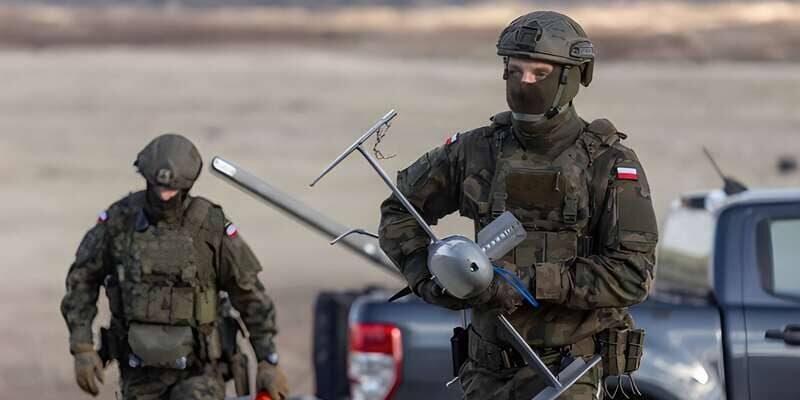
Image Source: Wojtek RADWANSKI/AFP (A Polish soldier carries an interception drone of the American MEROPS counter drone system during tests at the Nowa Deba military training ground, south-eastern Poland, on November 18, 2025).