



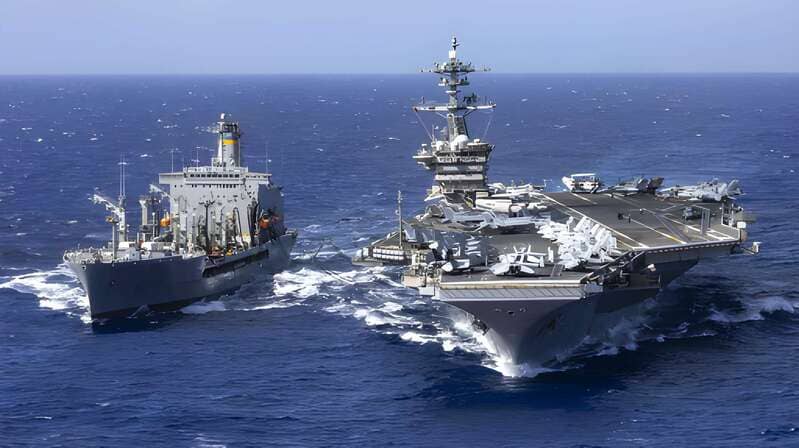
The maritime interdiction operation initiated by the United States in April 2026 against commercial traffic bound for Iranian ports represents one of the most significant developments in the evolution of contemporary coercive strategy.

While it does not formally constitute a total naval blockade in the classical legal sense, it produces functionally comparable effects, simultaneously constraining Iran’s energy export capacity, food security, and macroeconomic stability.
This development should not be interpreted as an isolated or contingent episode. Rather, it reflects a broader strategic trajectory in which the United States increasingly privileges indirect forms of pressure based on the control of flows and critical infrastructures, as opposed to large-scale direct intervention. In this context, the Iranian case provides a particularly valuable lens through which to examine the growing centrality of logistics and maritime space in great power competition.
At a deeper level, the operation signals a transformation in the nature of power itself. Whereas in the twentieth century control over territory was the primary indicator of strategic dominance, in the twenty-first century the control of flows—energy, trade, finance—has emerged as a decisive lever. Iran, in this respect, represents a paradigmatic case of systemic vulnerability.
From Military Deterrence to Systemic Coercion
Over the past two decades, U.S. strategy has progressively moved away from the assumption that conventional military superiority, expressed through large-scale ground operations, constitutes the primary instrument for managing regional crises. The experiences in Iraq and Afghanistan exposed the limits of territorial occupation as a sustainable and effective strategic tool.
The 2026 operation against Iran signals a further stage in this evolution, illustrating the emergence of what can be defined as systemic coercion. In this model, the objective is not the direct destruction of an adversary’s military capabilities, but the disruption of its overall functioning through the selective interruption of critical flows that sustain its economy and internal stability. Maritime dominance becomes central within this framework, as it enables pressure to be exerted on the connections that link a state to the global system rather than on its territory.
This approach echoes a longstanding strategic tradition according to which control over maritime chokepoints allows for disproportionate influence relative to the direct application of force. In the contemporary context, however, this logic is expanded and reinforced by technological and informational capabilities that enhance surveillance, targeting, and enforcement.
Within this framework, the interdiction of traffic toward Iranian ports is not designed to produce an immediate and decisive shock. Instead, it generates cumulative pressure over time, creating a dynamic of gradual strangulation that undermines state resilience while avoiding, at least in its initial phase, direct military escalation.
Structural Vulnerabilities and Logistical Pressure
The effectiveness of this strategy is closely tied to the structural characteristics of the Iranian economy. Despite official narratives emphasizing self-sufficiency, Iran remains selectively integrated into global markets, displaying a significant dependence on both energy exports and the import of essential goods. This configuration creates an inherent vulnerability that becomes particularly acute when external pressure is concentrated on maritime routes.
Restrictions on oil exports lead to the progressive accumulation of surplus production which, in the absence of viable outlets, translates into mounting storage constraints. Even assuming substantial storage capacity, this process is inherently temporary. Once physical limits are reached, the system is forced to reduce output, with potential technical consequences for mature oil fields and long-term implications for production capacity.
At the same time, reduced inflows of goods affect the availability of essential commodities, generating price pressures and placing stress on domestic distribution systems. Unlike the energy sector, where the effects may initially remain less visible, disruptions in food supply tend to manifest rapidly at the societal level, carrying direct political implications.
The interaction of these dynamics produces a particularly effective form of systemic pressure. On one side, the state’s ability to generate revenue through exports is progressively eroded. On the other, internal socio-economic tensions intensify as access to basic goods becomes more constrained. Maritime coercion thus operates across multiple layers, targeting both state capacity and societal stability.
Interdiction as a Flexible Instrument
One of the most significant features of the U.S. operation lies in its flexibility and scalability. Unlike a traditional naval blockade, which implies a rigid and comprehensive closure, selective interdiction allows for a high degree of adaptability in response to evolving political and diplomatic conditions.
This flexibility enables the application of graduated pressure, allowing policymakers to adjust the intensity of enforcement over time. In this sense, coercion becomes a continuous variable rather than a binary condition, operating along a spectrum between peace and open conflict. This transforms interdiction into a negotiable instrument, capable of influencing adversary behavior without necessarily triggering escalation.
At the same time, the legal ambiguity surrounding such measures enhances their effectiveness. The absence of a formal declaration of blockade or war complicates the adversary’s response, making it more difficult to identify clear escalation thresholds. As a result, Iran operates within a constrained decision space, where both overreaction and restraint carry significant risks.
Adaptation and Limits of the Iranian Response
In response to mounting pressure, Iran has pursued a set of adaptive strategies that reflect a logic of mitigation rather than structural resolution. These include the use of deceptive maritime practices, the expansion of floating storage, and attempts to diversify logistical routes through northern corridors and the Caspian Sea.
While such measures may provide temporary relief, their structural limitations are evident. Alternative infrastructures lack the capacity to replace the volumes typically handled through the Persian Gulf, while the effectiveness of evasive techniques diminishes under conditions of sustained surveillance and enforcement. As a result, Iran’s adaptive capacity remains constrained, particularly over the medium term.
This asymmetry between external pressure and internal response capacity is central to understanding the current dynamic. Iran is operating within a structurally reactive framework, in which available options are limited and often entail increasing costs. As pressure accumulates, the gap between systemic stress and mitigation capacity is likely to widen.
Systemic Implications
The impact of maritime interdiction extends beyond the bilateral U.S.-Iran relationship, generating broader regional and global consequences. At the regional level, the operation reinforces alignment dynamics between the United States and Gulf monarchies, contributing to the consolidation of a security architecture oriented toward containing Iranian influence.
At the global level, constraints on Iranian energy exports lead to a redistribution of supply flows, compelling various actors to recalibrate their procurement strategies. While this does not imply full U.S. control over global energy markets, it does enhance Washington’s ability to shape distribution patterns and influence market dynamics.
Particularly significant is the implicit strategic signal directed toward China. Iran represents an important node in China’s energy supply network and a component of its broader Eurasian strategy. The interdiction of Iranian traffic demonstrates that the United States retains the capability to disrupt key energy corridors. In the context of intensifying systemic competition, this capability carries clear deterrent implications.
Future Scenarios
In the short term, the trajectory of events suggests a likely intensification of economic pressure on Iran. Under such conditions, Tehran may be pushed toward negotiations, although the possibility of escalation cannot be excluded. Faced with increasing constraints, Iran could seek to internationalize the crisis or resort to asymmetric responses aimed at raising the cost of interdiction.
In the medium term, the outcome will depend on the ability of both sides to manage an unstable equilibrium between coercion and adaptation. A prolonged interdiction could produce cumulative effects capable of reshaping Iran’s economic structure, but it would also impose growing costs on the United States and its regional partners.
In the longer term, the Iranian case may set a precedent for future forms of strategic competition. The increasing reliance on flow control as a tool of coercion suggests a broader transformation in how power is exercised within the international system.
Risks and Strategic Limits
Despite its potential effectiveness, maritime coercion entails significant risks. Economic pressure may generate internal instability within Iran, producing outcomes that are difficult to predict and potentially destabilizing for the broader region. Under conditions of acute stress, the likelihood of asymmetric escalation cannot be discounted.
Environmental risks also represent a critical concern, particularly given the concentration of energy assets and maritime traffic in constrained operational environments. Accidents involving large quantities of hydrocarbons could have severe and long-lasting consequences.
Finally, the sustainability of prolonged interdiction must be taken into account. Maintaining a large-scale enforcement posture requires resources, coordination, and sustained political commitment. In a global environment characterized by multiple competing priorities, the long-term viability of such an approach remains uncertain.
Conclusion
The 2026 maritime interdiction operation against Iran highlights a fundamental transformation in the nature of strategic coercion. Control over flows, rather than territory, is emerging as a central instrument in contemporary power competition, enabling sustained, flexible, and scalable pressure.
In the Iranian case, structural vulnerabilities intersect with external pressure to produce a complex and evolving dynamic in which economic performance, internal stability, and international positioning are deeply interconnected. While the ultimate outcome remains uncertain, one conclusion is already clear: in the twenty-first century, the maritime domain is not merely a space of transit, but a central arena of strategic contestation.
Author: Alberto Cossu – International Management Consultant, collaborating with research institutes and government agencies on strategic and geopolitical analysis. He is a Geopolitical Analyst at Vision & Global Trends and a regular contributor to the journal Geopolitica. His work is also published in prominent Italian policy and defense outlets, including Airpress – Formiche, Analisi Difesa, and Digit-export, the online magazine of the Union of Chambers of Commerce of Lombardy. His research focuses on global geopolitical dynamics, with particular emphasis on the United States, India, Russia, China, and the Middle East, as well as on the strategic implications of innovation and emerging technologies in the evolving international order. He holds a degree in Political Science and a Master’s in Business Management.
(The views expressed in this article belong only to the author and do not necessarily reflect the views of World Geostrategic Insights).
Image Source: U.S. Department of War