



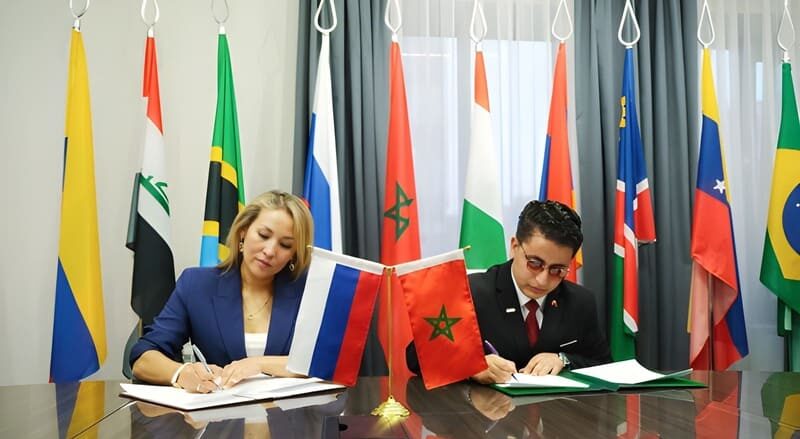
World Geostrategic Insights interview with Nabil Belkass on the vital role of young people in shaping international relations and fostering meaningful partnerships, with particular reference to relations between Morocco and Russia, the concept of the “African Awakening,” South-South cooperation, and Morocco’s potential as a geopolitical hub.
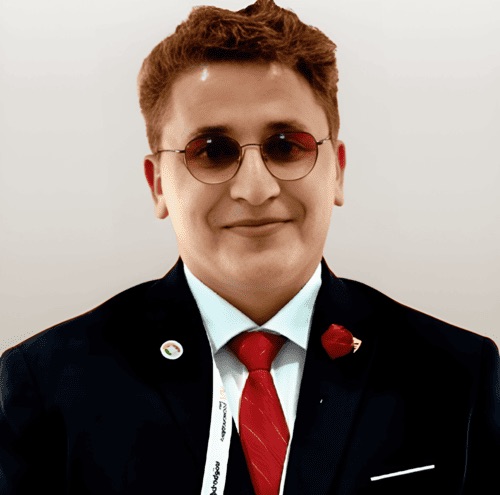
Nabil Belkass is a prominent Moroccan youth leader and diplomat who coordinates youth organizations across Morocco, Russia, China, and Uzbekistan, enhancing international collaboration and advocating for a multipolar world. He is President of the Moroccan-Chinese Youth League, Head of Morocco’s National Committee for the Russia’s World Youth Festival (WYF), Ambassador for the Beijing Institute of Technology and for the international “We Are Together” award. He is also an expert on BRICS.
Q1 – You are an internationally renowned Moroccan youth leader… Can you elaborate on this?
A1 – Youth today are no longer passive observers of international relations — they are active architects of the future. When I speak about a multipolar world, I refer to a system where power, culture, and decision-making are no longer concentrated in a single center, but distributed among diverse civilizations and regions.
Young people, especially from Africa, Asia, and the Global South, are increasingly connected, educated, and engaged. Through platforms like the World Youth Festival and other international forums, we are building horizontal networks that bypass traditional geopolitical hierarchies.
Our role is to promote dialogue, mutual respect, and cultural sovereignty — shaping a world where every nation has the right to define its own path without external imposition.
Q2 – The Moroccan committee of the World Youth Festival… How important is the role of young people in relations between Russia and Morocco?
A2 – Young people are the living bridge between Russia and Morocco. While governments establish agreements, it is youth who transform them into long-term partnerships through education, cultural exchange, and innovation.
Our work within the Moroccan committee has demonstrated that youth diplomacy can be more flexible, more human, and often more impactful than traditional diplomacy. The recognition we received reflects not only our efforts, but the growing importance of youth as strategic actors in international relations.
Q3 – 2026 marks the tenth anniversary… What is the outcome of this decade?
A3 – Over the past decade, the strategic partnership between Mohammed VI and Vladimir Putin has evolved into a multidimensional relationship.
We have seen significant progress in agriculture, energy cooperation, tourism, and education. More importantly, this partnership has been built on mutual respect and non-interference — principles that are increasingly valuable in today’s geopolitical climate.
The foundation has been laid; the next phase will depend on deeper societal and youth-level engagement.
Q4 – Russia has become Morocco’s main supplier of wheat… How is this balanced?
A4 – Strategic partnerships should never lead to unilateral dependency. Morocco has historically demonstrated a pragmatic and diversified approach to its economic relations.
While Russia plays a key role in wheat supply, Morocco continues to maintain multiple trade channels and invests in domestic agricultural resilience. Strategic autonomy comes from diversification, not isolation — and Morocco understands this balance very well.
Q5 – A new four-year fishing agreement… What are the benefits?
A5 – Such agreements must go beyond resource extraction. The real value lies in technology transfer, scientific cooperation, and local capacity-building.
If implemented effectively, this partnership can support sustainable fishing practices, modernize local infrastructure, and provide new opportunities for Moroccan youth in coastal regions — particularly in research and maritime industries.
Q6 – Tourism and cultural diplomacy among youth?
A6 – Tourism is one of the most underestimated tools of diplomacy. When young Russians visit Morocco, or Moroccans visit Russia, they experience each other beyond stereotypes.
Cities like Casablanca and Moscow are not just destinations — they become spaces of cultural exchange. Youth are especially receptive to these experiences, which shape long-term perceptions and friendships.
In this sense, tourism becomes a form of “soft diplomacy” driven by human connection.
Q7 – Can Morocco act as a strategic intermediary with BRICS expansion?
A7 – Morocco is uniquely positioned as a bridge between Africa, Europe, and the broader Global South. While not a member of BRICS, Morocco maintains strong relations with many of its members.
This allows Morocco to act as a facilitator of dialogue and cooperation, especially with emerging African economies. The key lies in leveraging its stability, geographic position, and diplomatic experience.
Q8 – What do you mean by “African Awakening”?
A8 – “African Awakening” refers to a generational transformation across the continent. It is the moment where Africa moves from being an object of global politics to becoming a subject — a decision-maker.
This awakening is driven by youth, innovation, and a renewed sense of identity and confidence. It is not only economic, but also cultural and intellectual.
Q9 – Is African Awakening possible without a multipolar world? Risks of new dependence?
A9 – A true African Awakening requires a multipolar environment. Without it, the global system remains structurally unequal.
However, the risk of shifting from Western dependence to Eastern dependence is real. That is why the objective is not to replace one center with another, but to create balance.
Africa must engage with all partners — West, East, and South — while preserving its strategic autonomy.
Q10 – Can it come through South-South cooperation?
A10 – Absolutely. South-South cooperation is one of the most promising paths forward.
Countries of the Global South share similar challenges and experiences, which makes their cooperation more pragmatic and less conditional. This does not exclude partnerships with the North, but it rebalances the relationship.
Q11 – Morocco’s position in ten years and your generation’s role?
A11 – In ten years, I see Morocco as a central geopolitical actor — a hub connecting continents, economies, and cultures.
My generation has the responsibility to consolidate this position by strengthening education, innovation, and international engagement. We must move beyond traditional diplomacy and embrace new forms of influence — digital, cultural, and youth-driven.
Our mark will be defined by our ability to build bridges, not walls.
Nabil Belkass – President of the Moroccan-Chinese Youth League, Head of Morocco’s National Committee for the Russia’s World Youth Festival (WYF).