



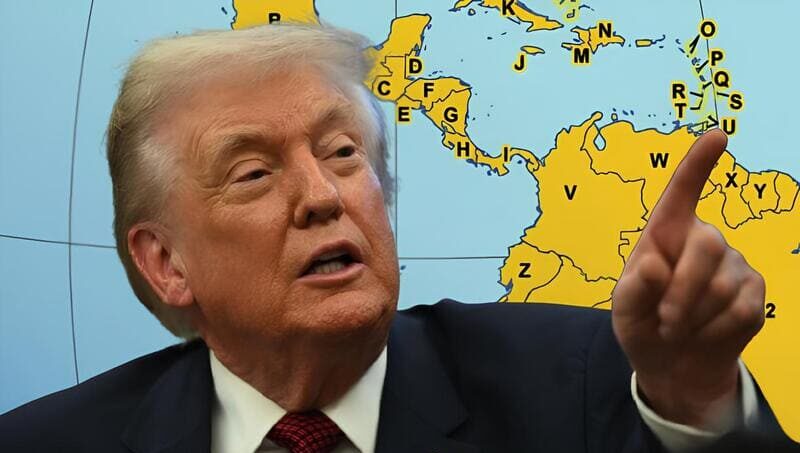
The United States’ most important declaration regarding the Western Hemisphere was represented by the Monroe Doctrine. Issued in 1823, it responded to the threat of reconquest of the former Spanish colonies by a coalition of conservative European monarchies gathered in the so-called Holy Alliance.
The Monroe Doctrine

Anticipating this eventuality, James Monroe, fifth President of the United States, delivered the following message to Congress: “The American continents by the free and independent condition which they have assumed and maintain, are henceforth not to be considered as subjects of future colonization by any European powers…We could not view any interposition for the purpose of oppressing them [the Spanish Americans], or controlling in any other manner their destiny, by any European power in any other light than as a manifestation of an unfriendly disposition to the United States…It is impossible that the allied powers [the Holy Alliance] should extend their political system to any portion of either continent without endangering our peace and happiness; nor can anyone believe that our southern brethren, if left to themselves, would adopt it of their own accord. It is equally impossible, therefore, that we should behold such interposition in any form with indifference”. (Yale Law School)
President Monroe’s statement left no doubt that any European attempt in reconquering the recently independent Spanish American states, was inadmissible to the United States. According to Henry Kissinger: “The Monroe Doctrine proclaimed in 1823, made a moat of the ocean which separated the United States from Europe. Up to that time, the cardinal rule of American foreign policy had been that the United States would not become entangled in European struggles for power. The Monroe Doctrine went the next step by declaring that Europe must not become entangled in American affairs…Daringly, it warned the European powers that the new nation would go to war to uphold the inviolability of the Western Hemisphere…America was at one and the same time turning its back on Europe, and freeing its hands to expand in the Western Hemisphere”. (Kissinger, 1994, pp. 35, 36).
Natural sphere of influence
The United States, thus, was clearly anticipating what it aimed to become and, under those circumstances, was delimiting what it considered to be its natural sphere of influence. Moreover, the motto of the doctrine “America for the Americans”, had in the mind of John Quincy Adams, Monroe’s Secretary of State and architect of this initiative, a very precise meaning. As he had stated in 1811: “The whole continent of North America appears to be destined by Divine Providence to be populated by one nation…”. (Bemis, 1959, p. 182).
Actually, two of that country’s fundamental founding fathers had anticipated much earlier what the relation between the emerging United States and their southern neighbours should be. According to Brian Loveman: “Thomas Jefferson worried in 1786 that Spain might be too weak to hold onto to its colonies ‘till our population was sufficiently advanced to gain it from them piece by piece’…Six years later Alexander Hamilton advised: ‘Beside eventual security against invasions, we ought certainly to look to the possession of the Floridas and Louisiana, and we ought to squint at South America’”. (Loveman, 2016)
In 1823, it was certainly too early in time for the materialization of such ambitions. The Monroe Doctrine, however, was laying the ground so that in the future the aspirations of Jefferson, Hamilton and John Quincy Adams, would not be jeopardized by any foreign power. Theirs were, indeed, far reaching designs.
Around the same time in which the Monroe Doctrine was issued, the diplomatic recognition of the new Iberian American states began. This process had been held back, so that it didn’t put at risk the ratification by Madrid of a pivotal agreement for the United States: the Adams-de Onis Treaty. In accordance with it, Spain ceded East Florida to the United States. In 1822, once the ratification of the treaty had taken place, the recognition proceedings began. By 1825, Washington had established diplomatic relations with Colombia, Mexico, Chile, the United Provinces of Rio de la Plata and the Brazilian Empire. Others would soon follow.
Manifest Destiny
In the late 1830s, American journalist John O’Sullivan coined the term the Manifest Destiny. The most quoted version of this term, however, was written in 1845, when he referred to the “right of our manifest destiny to overspread and to possess the whole continent which Providence has given us for the development of the great experiment of liberty and federated self-government entrusted to us”. (Loveman, 2016). The Manifest Destiny era would put in motion the materialization of the ambitions contained in the Monroe Doctrine.
But which were the geographical boundaries of these overspreading and possession predicted by O’Sullivan? Although he spoke about the “whole continent”, he was basically referring to North America, as John Quincy Adams probably also had. In this sense, their ambitions seemed to have been more restrained than those of Jefferson and Hamilton who had also included South America in their designs. However, some national debates during the 1840s and 1850s envisaged the annexation of all of Mexico, plus Cuba and Panama. These objectives would be partially attained during a subsequent period, that of the so-called Empire.
The initial part of this expansionist process began in the 1840s. During this decade, half of Mexico fell in U.S. hands, and Nicaragua almost did as well. In Henry Kissinger words: “Until the turn of the twentieth century American foreign policy was basically quite simple: to fulfil the country’s manifest destiny, and to remain free of entanglements overseas”. (Kissinger, 1994, p. 34).
Mexico was the beginning of everything. Unwisely enough, that country had opened its deserted lands in Texas to colonization by U.S. citizens. As referred by Niall Ferguson: “From 1821 until 1834 Stephen Austin established and ran his colony with the consent of the Mexican authorities, which were in fact more generous than the United States towards would-be-settlers”. (Ferguson, 2004, p. 39). In 1835, and after several problems between American settlers and Mexican authorities, the former rebelled.
Through a combination of courage, endurance and tremendous good luck, U.S. settlers ended up defeating the Mexican troops under the command of President Antonio Lopez de Santa Anna. In 1836 they declared independence, and began lobbying for the incorporation of Texas into the United States. Although Washington was reluctant to accept into the Union another state where slavery was allowed, it could not skip the opportunity of grabbing territory from Mexico.
In 1845, President James K. Polk declared war on the basis that “American citizens” (actually at that point they were citizens of the Republic of Texas), were owed 6.5 million dollars by Mexico. As General Ulysses S. Grant put it, this was “one of the most unjust wars ever waged by a stronger against a weaker nation”. (Ferguson, 2004, p. 39).
By force of arms and through the Treaty of Guadalupe Hidalgo of 1848, which followed the three-year war, the United States took from Mexico, California, Colorado, Utah, Nevada, New Mexico and Arizona. Texas itself had been incorporated into the Union in 1845. Mexico, thus, lost half of its territory, while the U.S. substantially augmented its own.
In 1855, in a different episode, the Tennessean William Walker raised a private army and launched an invasion of Nicaragua. Upon defeating the surprised local troops, he declared himself President of the country, being immediately recognized by the United States. For a few years, and until being deposed by Nicaraguan forces, he became a “de facto” American proconsul. Although he hinted at annexation of the country by the United States, this became a tricky subject as he had re-established slavery in Nicaragua. The geopolitical importance of that country derived from the fact that it represented an excellent option for building a transoceanic canal.
For Latin Americans, the only breeze of fresh air during the Manifest Destiny era, came from President Grover Cleveland. Elected in 1885 as the first Democrat since the Civil War, he formally rejected further American expansionism in the hemisphere. Moreover, he forced the United Kingdom to stop its land grabbing of Venezuela’s territory and to submit the matter to international arbitration.
Unfortunately, though, Cleveland’s Secretary of State, Richard Olney, added his own addendum to the Monroe Doctrine (the Olney Corollary). Its terms surpassed anything formally expressed until then: “Today the United States is practically sovereign on this continent and its fiat is law upon the subjects to which it confines its interposition”. (Loveman, 2016).
Empire
The Olney Corollary, jointly with Admiral Alfred Thayer Mahan’s 1890 publication of the immensely influential book The Influence of Sea Power on History, 1660-1783, laid the ground for the emergence of the next era: Empire. In his book, Mahan articulated the idea that a powerful American navy based in the Western Hemisphere, upon which the United States exercised “practical sovereignty”, could project its might around the world.
The Empire era represented a further step within the road laid down by the Monroe Doctrine. It began in 1898 with the war against Spain. A war that broke out as a result of the explosion in the Havana harbour of the American battleship Maine. Spain, which at the time owned Cuba, not only denied any kind of responsibility over the explosion, but did its best to rescue survivors. The occasion, though, was perfect to declare war on Spain and to annex its remaining colonies. Something that President William McKinley did. After a swift victory over a weaker Spain, its colonies had to be relinquished to the United States. Through the Treaty of Paris of that same year, Cuba and Puerto Rico in the Caribbean and The Philippines and Guam in the Pacific, became the bounty of the winner.
Military occupation of Cuba and Puerto Rico followed suit. In 1902 a protectorate regime was imposed upon Cuba. This, under the so-called Platt Amendment to Cuba’s new Constitution. Within its clauses, “Article III required that the government of Cuba consent to the right of the United States to intervene in Cuban affairs”. (National Archives, Milestone Documents, 1). This included, needless to say, military intervention, which after 1906 happened on several occasions.
Contrariwise, Puerto Rico would remain as a colony not as a protectorate. The Foraker Act of 1900 entitled its population to elect a Lower House (Delegates House) within its bicameral legislature. However, both the Upper House of such a legislature and the Governor of the island were to be appointed directly by Washington. And although in 1914 the Delegates House unanimously voted for independence, the U.S. Congress rejected such a decision as unconstitutional, on the basis that it contradicted the Foraker Act.
In 1903, under President Theodore Roosevelt, a U.S. sponsored and supported insurrection separated the Isthmus of Panama from Colombia. An American protectorate regime was subsequently established over the new country of Panama. Meanwhile, and according to the Hay-Bunau-Varilla Treaty of that same year, Panama ceded to the United States in perpetuity the control over the Canal Zone that was to be built.
In 1905, the President issued the “Roosevelt Corollary” to the Monroe Doctrine, according to which: “In the Western Hemisphere the adherence of the United States to the Monroe Doctrine may force the United States, however reluctantly, in flagrant cases of wrongdoing or impotence, to exercise an international police power”. (National Archives, Milestone Documents, 2). This corollary explicitly justified not only unilateral intervention and military occupation, but also the imposition of protectorate regimes upon countries, which, according to U.S. judgement, had behaved in an improper manner.
President Woodrow Wilson went even further. According to Niall Ferguson: “The implicit Wilson Corollary was that only certain types of government would be tolerated by the United States in Latin America…Against unacceptable regimes the United States reserved the right to use force”. (Ferguson, 2004, p. 53).
The determination of which regimes were to be “tolerated” fell unilaterally upon the United States’ discernment. Not surprisingly, during the Empire era, U.S. troops invaded countries from the Caribbean Basin on thirty-four occasions. In the process, they occupied Mexico, Honduras, Guatemala and Costa Rica for short periods and stayed in Cuba, Nicaragua, Panama and the Dominican Republic for longer ones.
Moreover, one of the two main reasons why the American Congress denied adherence to the League of Nations, after World War I, was because it constrained the United States’ unilateral imposition of its will upon Latin America. As Henry Kissinger explained: “The League was believed to be incompatible with the Monroe Doctrine because collective security entitled, indeed required, the League to involve itself in disputes within the Western Hemisphere”. (Kissinger, 1994, p. 372).
In sum, according to Yale University’s history professor Greg Grandin: “By the late 1920s, then, the United States had apprenticed itself as a fledgling empire in Latin America”. (Grandin, 2006, p. 23).
Trump’s Corollary
Hundred and some years later, when the worst excesses derived from the Monroe Doctrine seemed simply a bad historical memory, Latin America is back into it. As Brookings states: “The Trump administration’s 2025 National Security Strategy reorients the United States toward the Western Hemisphere and reiterates the Monroe Doctrine and a “Trump Corollary” to it, essentially asserting a neo-imperialist presence in the region”. (Felbab-Brown, 2025).
Greg Grandin goes further when saying: “The heart of the report [on National Security] is a pledge to ‘reassert and restore the Monroe Doctrine’…Mr. Trump’s ‘Corollary’ to the Monroe Doctrine simply means that Latin America is to be locked down”. (Grandin, 2025). Indeed, “there is only limited recognition [by the National Security Strategy document] that Latin American countries have a say”. (Felbab-Brown, 2025). Latin American countries, hence, are not only locked down but also looked down.
The extent of this Trump Corollary implies grabbing Venezuela’s oil by force, taking back the Panama canal (who knows by which mean), and even annexing Canada if possible. However awful these propositions might seem, they fall at least under the realm of geopolitics. However, Trump is too egotistical and chaotic not to mix policies with personal preferences. This means imposing a 50% tariff on Brazil because his pal Bolsonaro was being judged by the country’s Supreme Court, or lending US$20 billion to Argentina (the largest American loan in thirty years) because his pal Miley was in need of money.
For the Western Hemisphere, the Trump Corollary to the Monroe Doctrine not only represents a jump back in time to the imperialism of McKinley and Theodore Roosevelt, but also a blank check for this American President to indulge in his most preposterous ideas in relation to this unfortunate part of the world. In Thucydides’ Melian Dialogue terms: The strong does what it wants, the weak endures what it must.
References:
Bemis, Samuel Flagg (1959). John Quincy Adams and the Foundations of American Foreign Policy. New York: Knopf.
Ferguson, Niall (2004). Colossus: The Rise and Fall of the American Empire. London: Allen Lane.
Felbab-Brown, Vanda (2025). “A ‘Trump Corollary’ to the Monroe Doctrine”, Brookings, December 8.
Grandin, Greg (2006). Empire’s Workshop: Latin America, the United States and the Making of an Imperial Republic. New York: Owl Books.
Grandin, Greg (2025). “Trump’s Dated Strategy is Putting Us on a Path to World War III”, The New York Times, December 15.
Kissinger, Henry (1994). Diplomacy. New York: Simon & Schuster.
Loveman, Brian (2016). “U.S. Foreign Policy towards Latin America in the 19th Century”, Oxford Research Encyclopaedia of Latin American History.
National Archives, Milestone Documents (1), “Platt Amendment (1903)”.
National Archives, Milestone Documents (2), “Theodore Roosevelt’s Corollary to the Monroe Doctrine (1905)”.
Yale Law School, Lilian Goldman Law Library, The Avalon Project, “Monroe Doctrine, December 2, 1823”.
Author: Alfredo Toro Hardy, PhD – Retired Venezuelan career diplomat, scholar and author. Former Ambassador to the U.S., U.K., Spain, Brazil, Ireland, Chile and Singapore. Author or co-author of thirty-six books on international affairs. Former Fulbright Scholar and Visiting Professor at Princeton and Brasilia universities. He is an Honorary Fellow of the Geneva School of Diplomacy and International Relations and a member of the Review Panel of the Rockefeller Foundation Bellagio Center.
(The opinions expressed in this article are solely those of the author and do not necessarily reflect the views of World Geostrategic Insights).