



By Yasir Masood
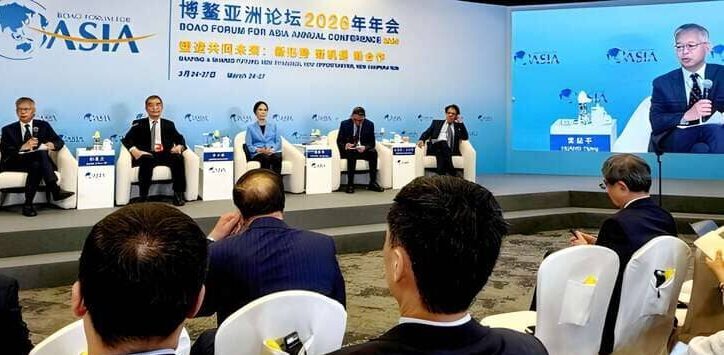
The 2026 annual Boao Forum for Asia (BFA) is taking place from March 24 to 27 in Hainan province, China.

The 25th anniversary of the forum is titled Shaping a Shared Future: New Contexts, New Opportunities, New Cooperation, signaling a new injection of growth and stability anchored in China’s sustained efforts to promote multilateralism in the Asia-Pacific region.
The timing of the forum is particularly significant because the stakes are evolving dangerously, given the escalating conflict in West Asia, the rise of protectionism, and the race to lead in AI and other emerging technologies. Like Beijing’s other multilateral arrangements, Boao addresses the central reality of the contemporary world: cooperation is required more than ever, yet it is more challenging to maintain.
Origin
In reaction to the Asian financial crisis in 2001, former Philippine President Fidel V. Ramos, former Australian Prime Minister Bob Hawke, and former Japanese Prime Minister Morihiro Hosokawa proposed the creation of BFA. The idea behind establishing the forum was simple: Asia needed to be heard in global economic governance. The initial focus of the forum was on trade integration and regional cooperation. But over time, it has become one of China’s most visible international platforms for engaging with evolving global economies, bringing business partners, heads of state, dignitaries, bankers, academics, policymakers, and industrialists.
Against this backdrop, the Asia-Pacific region is currently facing a polycrisis of a widening geopolitical divide, supply chain disruptions, uneven trade policies, and the acceleration of digital and green transitions, making it challenging for weaker economies to adapt and catch up.
Boao is, therefore, a perfect platform for the international community to better understand China’s trade policies and tap into global business opportunities, injecting much-needed certainty amid rising unilateralism, sluggish economic recovery, protectionism, and burgeoning pressure to restructure global supply chains. The forum also allows Beijing to unveil its new policy direction to the international community through the 15th Five-Year Plan (FYP) for development (2026–2030), approved at the Two Sessions earlier this month, and to highlight priorities such as opening up, high-quality development, and technical innovation.
The BFA is well placed to reiterate this proposition of cooperation. For instance, Hainan has initiated island-wide special customs operations on December 18, 2025, thereby achieving the formal status of the world’s largest free trade port in terms of land mass. In particular, zero tariffs are applicable to 74 percent of goods entering the island, with a corporate income tax rate for encouraged industries set at 15 percent. The utilization of foreign capital in Hainan rose by nearly 20 percent in 2025, and newly registered foreign-funded enterprises grew by 13 percent in January 2026 alone. These numbers testify to Beijing’s incremental, inclusive growth through reform and opening up in Hainan, positioning Boao as a practical toolkit for policymakers.
To foster confidence in regional cooperation at Boao, Beijing has strategically synchronized the four initiatives, namely, the Global Development Initiative (GDI), the Global Security Initiative (GSI), the Global Civilization Initiative, and the most recent, the Global Governance Initiative (GGI). Nevertheless, the real credibility of Boao’s emphasis on a shared future ultimately depends on demonstrating it in practice and instilling confidence among its partners that cooperation can transcend strategic distrust.
Implications
Building on this, the Boao Forum has a wider scope with multilayered policy pooling and operational mechanisms. That said, this piece focuses on four interconnected dimensions: development, security, regional alignment, and civilizational dialogue. These are not exhaustive objectives, but should be considered important pillars of China’s current emphasis not only on diversifying discourse but also on strengthening implementation methods to achieve greater stability across the region.
The first dimension of Boao 2026 reflects that China is moving from rhetorical diplomatic overtures to a more practical regional policy. In the Asia-Pacific, there is a mix of both high-end financial hubs and less advanced economies, with inequality in access to capital, resources, and technology. Such disparities not only elevate social concerns but could also pose a threat to sustainable growth.
To address this, Beijing devised a multipronged approach to improve both hard and soft connectivity issues. For example, the China-Laos Railway, which connects a landlocked state, is not only transforming Laos’s economic geography but also enabling it to be integrated into the regional supply chain. Importantly, this railway has carried more than 10 million passengers and millions of tons of cargo, offering a template for others on how long-term strategic projects can reshape development outcomes.
This logic now extends to connectivity beyond railways, encompassing digital and green infrastructure. With China-ASEAN cooperation approaching a new stage, it requires clearer definitions of the structure and implementation of inclusive governance. The focus remains on cross-border data flows, digital trade regulations, payment systems, and low-carbon cooperation. Positively, the discussion seems to be shifting from “why” to “how” cooperation, with an emphasis on technical rules and standards.
A similar pattern is evident in the technology domain as well. For instance, the forum’s interests in artificial intelligence, humanoid robotics, and embodied intelligence reflect broader structural changes in Asia-Pacific economies. The Development Research Center of the State Council estimates that the embodied AI market in China could reach 400 billion yuan by 2030 and over 1 trillion by 2035. Despite the big numbers, competitive advantage will not yield results from simply engaging in global trade; rather, it requires the ability to shape the framework itself. In the bigger picture, for the Asia-Pacific region to become a driver of global development, it must balance regulation of emerging technologies with economic growth. And Boao’s role could be crucial in determining how to converge these myriad challenges into a single policy tool.
The second pillar of BFA focuses on security. As a precursor, the GSI positions itself as an alternative to the zero-sum game of traditional alliance politics, where dialogue, mediation, and respect for sovereignty are given precedence. In practice, this ethos has gained traction, at least in East Asia, where states seek stability in the changing geopolitical milieu. Recently, Beijing has demonstrated this approach through mediation in late 2025 during the border clashes between Cambodia and Thailand.
Yet the scope of the GSI has its limitations. Dialogue and diplomacy can diffuse tensions, but cannot uproot regional rivalries. Boao’s role, therefore, lies in gradually embedding China’s security approach within regional discourse.
The third area of Boao centers on improving the governance structure of the Asia-Pacific region. The GGI already appears to be a reasonable alternative to the loop-holed existing global governance architecture, replete with economic disparities, injustice, and zero-sum approaches. Increasingly, Boao resonates with the strategic priorities of Asia-Pacific governments. Consider APEC, which will be hosted in China in November 2026 under the theme of creating an Asia-Pacific Community. Boao, for its part, is well-suited to set the tone for this broader agenda. Over the years, the forum has focused on multilateral coordination mechanisms. Now, with a strategic outlook, it is shifting from justifying integration to managing it.
The final theme touches on the civilizational dimension of regional cooperation. The Asia-Pacific region is multicultural, with diverse languages and religions, and is home to Chinese, Muslims, and Westerners. This diversity can cut both ways — as a source of friction or resilience. The Chinese GCI outlines an approach to addressing the trust deficit by grounding cultural discourse in values to maintain regional collaboration. One illustration: the International Day of Dialogue among Civilizations in Bangkok. Understandably, such initiatives may not bring quick policy outcomes, but they certainly shape the institutional and interpersonal credibility necessary for sustainable regional cooperation.
Outlook
Overall, BFA serves as an attempt to reiterate the argument that the answer to fragmentation lies in structures grounded in development, security, and civilizational discussion. The importance of the forum is not in individual declarations but in the manner in which it links policy, infrastructure, and diplomacy. The free trade port of Hainan, the China-Laos Railway, the agenda on AI and robotics, and the focus on multilateral cooperation are all oriented in a similar direction. Boao, therefore, is not just a discussion table, but rather a tool that the Asia-Pacific can use to define its future in years of sustained uncertainty.
Author: Dr. Yasir Masood – Pakistani political and strategic analyst, academic, and broadcast journalist specializing in strategic communication. He holds a PhD in International Relations with a focus on the Balochistan conflict. His work spans South Asian geopolitics, Pakistan’s foreign policy, U.S.-Pakistan relations, China’s Foreign Policy, and the China–Pakistan Economic Corridor (CPEC). He regularly provides commentary to leading global media outlets and think tanks.
(The views expressed in this article belong only to the author and do not necessarily reflect the views of World Geostrategic Insights).