



By Muhammad Zakria
The power of the military has dominated most of modern history in terms of the capacity to capture and occupy the territory. In colonial warfare, and in counterinsurgency theories of the late twentieth century, triumph in warfare was the ability to take the map.

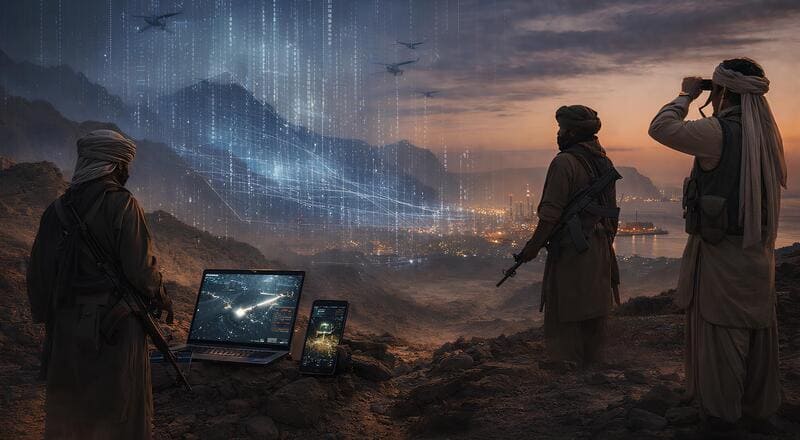
However, in various warring regions in the present day, states are in control of the battlefield but fail to end the war. Armies guard cities, infrastructure is working and administrations are functioning – yet the power is disputed. Such conflicts have not disappeared; hence, it is possible to assume that the development of warfare is changing, rather than its goals. We are entering the era of “Algorithmic Insurgency”. This is a form of warfare where a single explosion matters less than the speed at which its video is uploaded. In this new reality, the goal is not to govern territory permanently, but to prove—repeatedly and digitally—that the state’s control is an illusion.
In places like Balochistan, confrontation no longer relies primarily on sustained territorial occupation. Rather, small instances of violence are constantly being turned into political impacts much greater than their tactical dimension. The conflict becomes less about who controls land
and more about who controls interpretation of events. What matters is not the duration of territorial control, but the ability to demonstrate that control is never total. War is ceasing to be geographically based and becoming institutionally based on perception -from mountains to megabytes.
The emerging events and the war tactics can be understood as “Algorithmic Insurgency”: a form of irregular warfare in which violence and its strategies are determined less by physical destruction than by strengthening data and the informational amplifications. Small, localized events gain disproportionately political value when they move through dense digital networks, real-time media cycles, and automated content circulation. The goal is not a sustained territorial government but the recurrence of an administrative weakness, a state that can be termed as intermittent territoriality. Authority is not defeated in a decisive battle; it is undermined over time by the aggregate signs of incompleteness. In these conditions, perception is operational terrain. The battlefield is replaced with the mind, where credibility, expectation, and uncertainty determine the outcome in politics more than the positions on the battlefield.
With the passage of time, the Baloch Sarmachaar (freedom fighters) have evaluated their tactics from classical strategies to modern ways to fight guerrilla warfare. Classical theory of guerrilla presupposed that insurgents balanced military weakness in terms of time, mobility, and closeness to the population. Takeover was slow: influence, shadow governments, and finally bring together territories. Although the insurgents did not engage in direct conflicts, their policy of action essentially relied on the growth of areas where the presence of the state was physically diminished. That relationship is changed today, however, by technological mediation. Digital communication networks enable political impact to be realized disproportionately to physical presence, and remote occurrences can have a far-reaching impact on their own venue. The fight will no longer involve the gradual expansion of liberated territory, but the repetitive show that nothing territory is ever safe. What used to be a struggle over space turns out to be a struggle over confidence, not the ability of the state to control all areas but the ability to persuade that it does.
Artificial intelligence does not replace insurgency; it accelerates its logic. The time between an event and its political interpretation is shortened by systems with the ability to generate content automatically, identify patterns, and spread fast. The news spreads faster than checking and stories are set in stone before the authorities can come up with a coherent story of the truth. Consequently, the strategic nature of an operation is not material in its result, but is indicated by its ability to create a cascading interpretation within the interrelated audiences. The war-like atmosphere is prospective: institutions respond to events, as well as to the expectations of response. In such circumstances, even sporadic measures can be disproportionately administrative and economic, since uncertainty is made the weapon. AI thus changes irregular warfare, making it no longer a battle of endurance, but a battle of tempo, with the side that adapts quicker determining the perceived truth of the battlefield.
The relations of confrontation in Balochistan are characterized more and more by this shift of physical control to an apparent control. The continuation of low-intensity violence has failed to create stable areas of insurgent government, although it has also created over and over again moments of uncertainty which spread way beyond the actual location of the action. It is not just the material damage that is the response to infrastructure, investment decisions, and administrative routines, but anticipations of disruption as well.
The strategic effect would then manifest itself in repetition, not expansion: single incidents will be the indications of the boundaries of authority. This trend is further supported by the attempts of non-state actors to show reach at ground, aerial, and informational scales, and indicates that the goal is not the possession of terrestrial space, but the capacity to keep on contesting its governability. The battle is therefore a contest of credibility – that to be believed one must have complete control, and what occurs politically when one never seems to. In the rugged peaks of Balochistan, the map is lying to us. For a century, military success was measured by “taking the map”—occupying hills, guarding infrastructure, and holding cities. But in the modern age, states can control the battlefield and still lose the war.
The battlefield has shifted from the physical ground to the collective mind, where uncertainty is a more effective weapon than artillery. The struggle, in addition to the physical action, is increasingly played out in the production of continuous narratives in social media platforms. Armed incidents are quickly transformed into symbolic occurrences using curated visuals, edited video, commemorative text and interpretive packaging that is intended to give meaning before other explanations can be built. This communication is not informational but performative: it is building up coherence, making the participation glorious, and putting the individual actions into the greater political narrative. This type of messaging reduces the psychological distance between localized violence and distant audiences by spreading familiar symbols and common themes, so that it is possible to identify with the message without sharing distance.
The process also generates the competitive narrative space where the state authorities and the non-state actors do not only compete over the facts, but also over which one of the interpretations will be accepted in the social circles. In this regard, it is the normalization of recruitment, not entirely by persuasion, but by repetition it becomes a routine of political existence and mobilization eventually arises from mutual perception than from formal organization.
As reports on the conflict environment indicate, armed activities are often accompanied by fast and organized media distribution, which is ascribed to the activities by the groups like Balochistan Liberation Army and Balochistan Liberation Front. The use of statements, edited video, symbolic graphics, and multilingual messages is common hours after the events are happening and this implies that the messaging was organized during the operational planning and not a later improvised creation. Informational sequence usually comes before the verification with authority and frames the sense of the incident prior to the stabilization of competing accounts.
Analytically, it is less the immediate tactical damage that is important than organized timing of narrative release: the act and its interpretation is one strategic package. The net effect is cumulative – repeated messaging creates a perception that there will be recurring disruption, which affects administrative behavior, security allocation, and outside perception regardless of the scale of the battlefield. These and similar tendencies suggest that media production has become a part of the operational cycle of irregular warfare, as opposed to being a secondary propaganda activity.
The lessons from the mountains of Balochistan are clear: military prowess can capture territory, but it can no longer capture assurance. In this new “Algorithmic Insurgency,” the state is fighting a ghost in the machine—an enemy that uses artificial intelligence to shorten the gap between a physical blast and a political interpretation. As seen in the coordinated strikes of January 2026, the goal of modern irregular warfare is no longer a decisive battle, but a “demonstration of uncontrollable disruption”. When groups like the BLA can broadcast a 35-minute operational epic like Darra-e-Bolan 2.0 before the state can even verify the casualties, the government has already lost the “battle of tempo”. For policymakers, the warning is stark: the conflict will not be resolved by boots on the ground alone, but by stabilizing expectations and regaining narrative initiative. In a world where perception is the primary operational terrain, the side that defines the “perceived truth” of the battlefield is the side that ultimately controls it. If the state cannot persuade the public that its control is total, the insurgency wins simply by proving that it is not.
The irregular warfare will not be determined by the side that has ground, but the side that defines faith on who actually controls it. With the increased speed of communication and interpretation before verification, authority becomes a constant performance instead of a status quo. The moral that can be drawn, then, out of the peripheral confrontations of the present day is structural wherein military prowess is capable of obtaining territory without obtaining assurance. In places where credibility has to be proven on a continuous basis, conflict will not be resolved by decisive victory but stabilization of anticipations. In such a setting, wars do not stop because they are impossible to defeat, but because they are no longer fought in the ground where victory will be proclaimed. The decisive struggle is transferred to perception – and in that field, even restrained actors can be strategically relevant.
Author: Muhammad Zakria – International Relations researcher specializing in geopolitics and security. Currently, he is a student of Security and International Relations at University of Genova, Italy, and he also manages “The Convention,” a platform dedicated to global news and analysis.
(The opinions expressed in this article belong only to the author and do not necessarily reflect the views of World Geostrategic Insights).