



By Alfredo Toro Hardy
Much has been said about the resemblance between Trump’s declining popularity and midterm electoral fiasco and Nixon’s polls in the months preceding his resignation. Could, hence, the congressional counteroffensive on foreign policy that characterized the latter period be reproduced now?
In other words, could we witness a reassertion of legislative power in foreign affairs comparable to that embodied in such landmark legislation as the War Powers Act of 1973, the Jackson-Vanik Amendment to the Trade Act of 1974, the Arms Export Control Act of 1976, or the National Emergencies Act of 1976? The answer is a resounding no.
The U.S. Congress of the 1970s operated under very different circumstances from those prevailing today. Vietnam and Watergate prompted an extraordinary reassertion of congressional authority over foreign policy, bringing Democrats and Republicans together to secure the two-thirds majorities needed to override presidential vetoes. Indeed, the 1970s marked one of the most significant episodes of congressional assertiveness in foreign policy in modern American history.
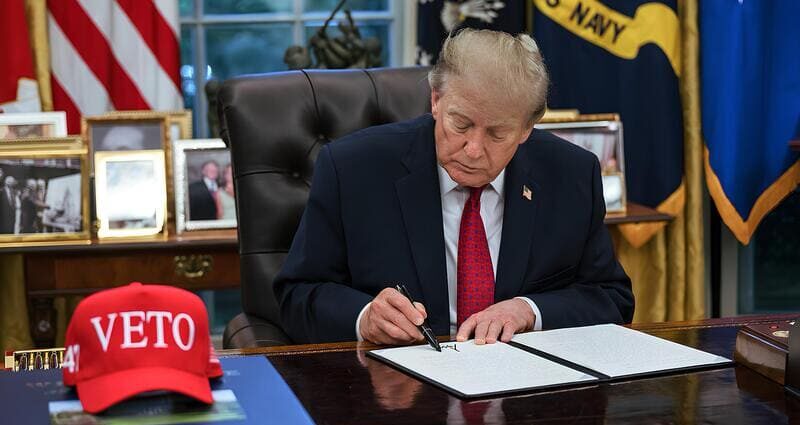
Today, 60 votes are generally required to invoke cloture in the Senate, thereby ending a filibuster and allowing a bill to proceed to a final vote. In the House of Representatives, by contrast, ordinary legislation requires only a simple majority. With Democrats most probably controlling 56 Senate seats and very possibly more than 250 seats in the House (218 being the threshold for a majority), their prospect for passing legislation appears highly promising. The problem, however, lies in overriding a presidential veto, which requires a two-thirds majority in both chambers. With Democrats and Republicans inhabiting different political planets on foreign policy issues—as they do on most other matters—this would represent an almost insurmountable obstacle. No wonder President Trump has suggested that he may become Mr. Veto.
Moreover, foreign policy is an area in which presidents enjoy considerable freedom of action. This derives from a combination of constitutional authority, control over the executive branch, and the advantages of being able to act with speed, secrecy, and unity of purpose in international affairs. Constitutionally, the President is not only Commander-in-Chief of the armed forces but also possesses considerable diplomatic and executive authority, as well as the power to negotiate treaties. He exercises control over the departments and agencies involved in foreign policy, including the State Department, the Department of Defense, and the intelligence community. For Congress, as a collective body of 535 elected senators and representatives, competing with such a concentration of executive authority is no easy task.
True, Congress possesses the power of the purse, the authority to authorize and restrict military operations, and the Senate’s power to approve treaties and presidential appointments, among other formidable constitutional instruments. Yet, as already noted, overcoming a presidential veto is a herculean task for an institution comprising 535 members, particularly when Democrats and Republicans inhabit entirely different political planets. Only under extraordinary circumstances, such as those prevailing in the 1970s, has Congress been able to impose its will on the President in foreign policy matters.
Lame-duck presidents, particularly those entering the final two years of a second term, tend to assert their foreign policy authority much more vigorously. With diminishing room for maneuver at home, they can pursue their international priorities with greater freedom. Recent examples include George W. Bush and Barack Obama, both of whom faced major setbacks in their parties’ second-term midterm elections. Bush ordered a troop surge in Iraq despite fierce congressional opposition, while Obama negotiated a sweeping nuclear agreement with Iran.
If this pattern holds, we should expect a flurry of foreign policy activity from a politically bruised President Trump. As The Economist puts it: “Trump has unfinished business in Iran and Cuba that could drag America deeper into the Middle East and Latin America. His flirtation with great-power carve-ups, including summitry with Vladimir Putin and Xi Jinping, could herald a darker world order—and difficulties for Ukraine. His quixotic courtship of Kim Jong Un, North Korea’s leader, could upturn American nuclear policy” (The Economist, November 5, 2026).
If Trump’s mercurial nature and short attention span were not enough to complicate the handling of such a formidable and complex agenda, his obsession with legacy and the loss of experienced staff—typical features of lame-duck administrations—could add further uncertainty. Marco Rubio, for instance, is reportedly preparing to leave. An increasingly hurried and isolated Trump, whose decision-making has been characteristically volatile and unpredictable, could generate further disruption in an already unsettled international order. The enormous geopolitical upheavals of the past two years might pale in comparison with what lies ahead. Bracing for what comes ahead in the next two years is therefore essential.
References: The Economist (2026). “What Will a Lame-Duck Donald Trump Get Up to Overseas?” November 5.
Author: Alfredo Toro Hardy, PhD – Retired Venezuelan career diplomat, scholar and author. Former Ambassador to the U.S., U.K., Spain, Brazil, Ireland, Chile and Singapore. Author or co-author of thirty-six books on international affairs. Former Fulbright Scholar and Visiting Professor at Princeton University. He is currently an Honorary Fellow of the Geneva School of Diplomacy and International Relations and a member of the Review Panel of the Rockefeller Foundation Bellagio Center.
(The opinions expressed in this article belong only to the author and do not necessarily reflect the views of World Geostrategic Insights).
Image Source: Official White House Photo by Molly Riley (President Donald J. Trump signs an Executive Order designating the Oval Office and Cabinet Room as national landmarks, Thursday, November 5, 2026, in the Oval Office of the White House.