



The global nuclear order has developed an uncomfortable legitimacy problem. The countries with the greatest responsibility for preventing proliferation are simultaneously increasing their reliance on nuclear weapons.

This does not make the nuclear powers irrelevant: only they can negotiate reductions in their own arsenals. But it does mean they can no longer credibly serve as the system’s sole political custodians. If the non-proliferation regime is to survive its present crisis, credible non-nuclear middle powers must move from supporting participants to agenda-setters.
SIPRI’s 2026 assessment is stark. All nine nuclear-armed states continued modernizing their arsenals in 2025, and most fielded new nuclear or nuclear-capable systems. Of an estimated 12,187 warheads, 9,745 remained available for potential military use and 4,012 were deployed. The United States and Russia retain most of them and are modernizing comprehensively; China has the fastest-growing stockpile; Britain and France have both moved toward expansion or greater opacity. The long post-Cold War decline in global numbers may soon reverse.
At the same time, restraints are disappearing. New START, the last treaty limiting US and Russian strategic arsenals, expired in February without a replacement, ending the last binding bilateral framework for ceilings, inspections and data exchanges. In May, the Non-Proliferation of Nuclear Weapons (NPT) Review Conference ended without a consensus outcome for the third consecutive time. The Comprehensive Nuclear-Test-Ban Treaty still has not entered into force, thirty years after opening for signature. None of these failures alone destroys the system. Together, they establish a pattern where nuclear powers demand restraint from others while accepting fewer constraints on themselves.
This matters because the NPT rests on reciprocity, not permanent nuclear privilege. Non-nuclear parties renounce the bomb and accept verification; the recognized nuclear powers commit to pursue disarmament while facilitating peaceful nuclear cooperation. When one side visibly retreats from that bargain, proliferation becomes easier to justify. Nuclear weapons begin to look like sources of security, status and bargaining leverage, while restraint looks like a strategic concession.
Non-nuclear middle powers are better placed to challenge this logic. Unlike nuclear powers, they are not asking others to accept a permanent asymmetry from which they benefit. They cannot compel Washington, Moscow or Beijing to disarm, but they can organize coalitions across geopolitical blocs, strengthen the institutions that make proliferation harder and demonstrate that national influence need not rest on a nuclear arsenal.
Several bring relevant experience. South Africa dismantled weapons it had built. Brazil and Argentina replaced nuclear rivalry with mutual verification. Mexico helped create the first nuclear-weapon-free zone in a populated region. Japan carries the history of Hiroshima and Nagasaki, although its reliance on US extended deterrence complicates its position.
Kazakhstan offers perhaps the most comprehensive case. The Soviet Union conducted 456 nuclear tests at Semipalatinsk, leaving an enduring human and environmental legacy. At independence, the warheads and infrastructure of what was commonly described as the world’s fourth-largest nuclear arsenal stood on Kazakh territory. Kazakhstan closed the test site, transferred the warheads, removed or secured sensitive materials and joined the NPT as a non-nuclear state.
Kazakhstan then turned renunciation into sustained policy. It helped create the Central Asian Nuclear-Weapon-Free Zone, now marking its twentieth anniversary; hosts the IAEA Low-Enriched Uranium Bank; and presided over the 2025 meeting of states parties to the Treaty on the Prohibition of Nuclear Weapons. Together with Kiribati, it has advanced work on assistance for victims of nuclear testing and environmental remediation. As the world’s leading uranium producer, Kazakhstan also demonstrates that non-proliferation need not preclude an advanced and economically important peaceful nuclear sector.
On 29 August, the International Day against Nuclear Tests – established by the United Nations at Kazakhstan’s initiative – the closure of Semipalatinsk 35 years ago will be commemorated. Kazakhstan’s experience shows that a state can convert nuclear restraint into diplomatic credibility and strategic agency. Its circumstances cannot be copied mechanically, but its authority comes from having borne nuclear harm, relinquished nuclear capabilities and helped build alternatives.
A coalition of such states should now set a practical agenda. It should press the nuclear powers to restore transparency and crisis communications even before comprehensive treaties become possible; demand measurable reporting on NPT disarmament commitments; defend the global testing moratorium and CTBT; strengthen IAEA verification; and seek legally binding assurances for nuclear-weapon-free zones. Just as importantly, it should bridge the divide between supporters of deterrence and supporters of prohibition rather than allowing the NPT and the newer ban treaty to become rival diplomatic camps.
The United States has a direct interest in this leadership. Washington greatly benefits from a world in which few countries possess nuclear weapons: proliferation in East Asia or the Middle East would create new adversaries, intensify pressures on US alliances and make every regional crisis more dangerous and expensive. Supporting middle-power initiatives is therefore a force multiplier.
One concrete step would be Senate approval of the protocol to the Central Asian Nuclear-Weapon-Free Zone, which has awaited action since 2015 and which the State Department concluded would require no change to US law, policy or military practice. The protocol remains before the Senate. Ratification would show that states accepting nuclear restraint receive meaningful security commitments.
Non-nuclear middle powers cannot substitute for reductions by the states that possess the weapons. But they can protect the norms, institutions and political bargain without which future reductions will never occur. A non-proliferation order defended chiefly by countries enlarging their arsenals will steadily lose authority. Kazakhstan and other credible non-nuclear states should not simply ask the nuclear powers to lead again. They should help define the agenda to which those powers must return.
Author: Prof. Michael Rossi – Lecturer in Political Science at Rutgers University of New Jersey, United States, and a Visiting Professor at Webster University Tashkent.
(The opinions expressed in this article are solely those of the author and do not necessarily reflect the views of World Geostrategic Insights).
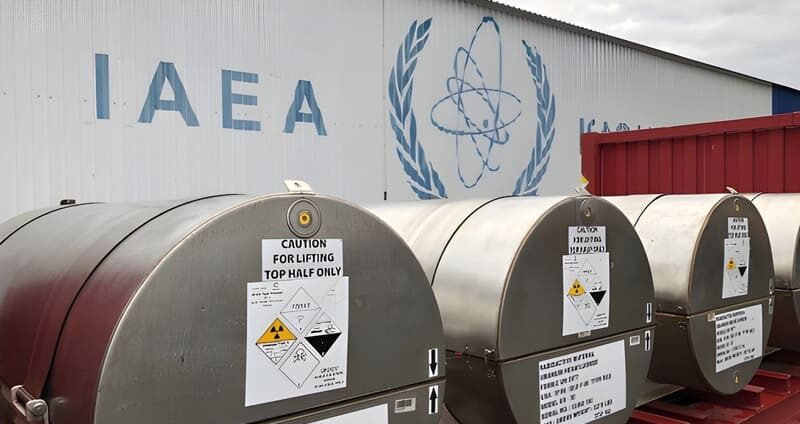
Image Source: IAEA