



The U.S.-Israeli war against Iran has, so far, been a failure. It has failed because none of the objectives which the Trump administration laid out as justifications for launching the war—in concert with Israel—have been achieved. Those objectives, upon which the president and his officials often place greater or lesser emphasis at different moments, were to destroy Iran’s ballistic missiles and military; stop it from pursuing a nuclear program (for civilian and military purposes); weaken and neuter Iran’s proxies; and, all the evidence suggests, to precipitate regime change in Iran.

Trump’s speech announcing major combat operations against Iran, on February 28, saw the president take viewers on a 47 years’ long crash course history on the Iranian regime’s attacks against the U.S., such as the hostage crisis in 1979 and Hezbollah’s barracks attack in 1983. During that address, the nod to regime change was when Trump said that, “Finally, to the great, proud people of Iran, I say tonight that the hour of your freedom is at hand…when we are finished, take over your government. It will be yours to take. This will probably be your only chance for generations.”Not only did the Iranian people not rise up against the government, but, as the recently deceased former head of MI6 Sir Alex Younger pointed out during an interview with The Economist in late March, Trump’s actions and words strengthened Iranian resolve.
The “great people” Trump referred to on February 28, he later threatened to kill their entire civilization on April 7, leading Sir Younger to state that, such rhetoric and action, makes the Iranians think “they are in a civilizational war, in their terms, a war of existence.” For the Americans, however, it was a war of choice. That choice has had major doctrinal implications for U.S. Middle East policy, as well as its approach to global affairs. In this light, the argument presented herein is threefold.
Firstly, that the American ability to protect American interests in the Middle East, through the use of force if necessary, which was a policy codified by the Carter Doctrine, is no longer conducive to on-the-ground realities. The Carter Doctrine, announced by President Carter in January 1980, explicitly committed the U.S. to defend the oil fields of the Persian Gulf against outside pressures which threatened to control them. This doctrine was the only Cold War presidential doctrine to have survived the Cold War and to have had relevance for American policymaking beyond that period. This is no longer the case. U.S. military force has proven incapable to defend American interests in the region since the Iranians have shown an ability to penetrate the American security umbrella by striking allied Gulf countries’ infrastructure, cities, and even American military bases. It is now evident that, while Iran may not fully control the Persian Gulf region, it has a significant ability to forcefully assert itself and undermine U.S. interests within it—from halting traffic through the Strait to striking Gulf allies’ infrastructure—in the face of U.S. and Israeli military pressure. Therefore, it is perhaps no surprise that within the western press there are headlines that read “Iran’s regime is now stronger than before Trump’s war.”
Secondly, by recognizing the doctrine of using military force to neutralise any threat to American interests in the Persian Gulf has proved untenable, the administration should lean back into its earlier commitment to draw down the U.S. military presence in the Middle East. Those known as the “prioritizers” within the administration, such as Elbridge Colby, have long emphasized that the U.S. cannot sustain a global military posture, and that maintaining it actually weakens its interests and position over time. This is because America cannot afford, financially, to maintain such a heavy military posture without further indebtedness and the fact that other regions present greater challenges which require more focused attention and a greater concentration of forces than others do.
According to this prioritization imperative, as outlined by people such as Colby and Alexander Velez-Green, the Middle East ranks fourth in terms of geographical importance to American interests—after the Western Hemisphere, the Indo-Pacific, and Europe respectively. The primary reason being is that the region lacks the market power of the Indo-Pacific or Europe, meaning that even if a rival gained control of the region, they would have difficulty contending for global hegemony. And, of course, the Western Hemisphere is where the U.S. is physically located, so ensuring no other rival establishes a meaningful presence here, has been a cornerstone of American security doctrine since at least 1823. While it seems the Iran War has led to the side-lining of the prioritizers, if the administration is serious, as it said it was, about pursuing a foreign policy which would not get America into forever wars in the Middle East, it must de-escalate the conflict, drawdown from the region, and prioritize more critical regions, such as the Indo-Pacific. It is no wonder, then, that Russia and China have been assisting the Iranians in the conflict: it is in their interests to do so as it keeps America fighting in the Middle East, depleting its money and arsenals, and fundamentally less focused on their environs.
Thirdly, and this will be the hardest pill for many to swallow, the Iranians must be invited to play a part in the Middle East’s security architecture. Just as after the Second World War, the defeated powers were invited into the victors’ economic, political, and security architecture, if there is to be a sustainable peace framework in the region, Iran must be included within it. This is because, as Trita Parsi recently wrote for Foreign Policy, after Tehran’s attacks against the Gulf Arab states, the latter have concluded “that containing and isolating Iran not only failed but also produced a disastrous war that exposed both the unreliability and the stunning limits of the U.S. security umbrella. Rather than doubling down on Iran’s exclusion, Arab states are writing a new playbook: pursuing economic interdependence with Iran while incorporating Tehran into a new, region-led security architecture.”The way they see this happening, particularly the Gulf Arab states, is by creating a regional security framework with Iran which will potentially include economic cooperation between all regional actors. This is the logical conclusion to draw for how to resolve the conflict, and to prevent a global crisis over the Strait of Hormuz question.
In turn, America’s new Middle East doctrine must, in line with the prioritizers’ thinking, begin with the premise that a U.S. military presence in the region has been a source of instability. This is something Trump and his officials have alluded to in the past. In this regard, in accordance with the Trump administration’s broader desire to shift more responsibilities onto allies and regional partners to provide for their own conventional defense, America’s new Middle East doctrine should incentivize increased security cooperation and economic interdependence between regional actors as the condition for its own gradual military withdrawal. This doctrine must replace previous doctrinal thinking pertaining to the region which centralized and emphasized the use of American military force to safeguard American interests. The piece will be structured by dealing with each of these three interrelated arguments, and their challenges.
The Evolution of the Carter Doctrine
In preparation for the 1980 State of the Union address, Carter’s National Security Adviser, Zbigniew Brzezinski, wrote in his memoir that he wanted to make sure that Carter’s address contained a sentence which emphasized a tough response to the Soviet invasion of Afghanistan in December 1979, and that the U.S. would not tolerate Soviet aggression in regions where the United States felt it had vital interests.During his State of the Union, on January 23, 1980, Carter thus declared that, “Let our position be absolutely clear: An attempt by any outside force to gain control of the Persian Gulf region will be regarded as an assault on the vital interests of the United States of America, and such an assault will be repelled by any means necessary, including military force.” Soon after, the media started dubbing this the “Carter Doctrine,” which it has been known as ever since. Since that moment, there have been various stages to the doctrine’s development that must be unpacked to contextualize its redundancy as a consequence of the current conflict.
The first stage, prompted by the Soviet invasion of Afghanistan and the Iranian revolution, was defined by the fear of American policymakers that Soviet penetration into the region “would allow Moscow to use threats to oil supplies as a tool for coercing the United States and its allies.” This, in turn, led to an increase in the use of proxies, such as the funding and training of the Mujahideen in Afghanistan. The second phase can be said to have arisen as a consequence of the Cold War’s end, where it was not so much a rival great power who could threaten core American interests in the Gulf, but regional and non-state actors. This saw a gradual increase of America’s military footprint in the region. For example, the first Gulf War, precipitated by the Iraqi invasion of Kuwait, led to a permanent U.S. military presence in the region; between 1991 and 1994, the United States gained access to military bases in all six Gulf Cooperation Countries (GCC).
After 9/11, there was a further increase in America’s military presence and regional intrusion, into Afghanistan in 2001 and then Iraq in 2003. The third phase, which lasted from around 2007, which was the year U.S. reliance on imported crude fell from nearly 70% of the total supply, to Trump 2.0 (2025-present)—a moment when U.S. security policy deprioritized the Middle East’s importance and, subsequently, Iran demonstrated its leverage over the Strait of Hormuz. Despite America’s decreasing import dependence, U.S. policymakers understood that Gulf oil sustained the functioning of the global economy, thereby rendering dangerous any unfriendly forces in the region who could and would disrupt it.
Each of these stages of the Carter Doctrine’s evolution rested on the assumption that American military power, deployed directly—such as in the Gulf War in 1991—or indirectly—such as in Afghanistan during the Soviet invasion and occupation—could safeguard America’s Gulf interests. Primarily because it could be wielded to successfully assert America’s regional preferences—at least for a while. Until recently, this assumption was correct. Ultimately, the Afghani resistance, kept afloat by the U.S., wore down the Red Army into its own Vietnam-style, counter-insurgency war which, over time, became unpopular at home and contributed to the Soviet departure in 1988. The first Gulf War, or what Stephen Skowronek called George H.W. Bush’s “splendid little war,” saw American military power displayed effectively and dominantly. A massive air and land campaign, incorporating new technologies, saw Saddam’s invasion of Kuwait repelled and the surrender of his forces in February 1991. While the interventions of the War on Terror were, in hindsight, less than stunning victories in comparison, the U.S. military still nonetheless did achieve regime change in both Afghanistan in 2001—until, of course, the democratic government collapsed and the Americans were sent packing in 2023—and in Iraq in 2003 with Saddam Hussein toppled in a few weeks.
Despite long-term, U.S.-led nation-building endeavours tending to fail, from the announcement of the Carter Doctrine in 1980, American power has often proven successful—at least temporarily—in either toppling a recalcitrant actor and/or at making them comply with its demands. In short, because of the superiority of the U.S. military relative to its regional foes. Iran, during the 2026 conflict with the U.S. and Israel, has shattered this paradigm fundamentally for two principal reasons: first, the limits of American military superiority in the modern era and, second, Iran’s effective leveraging of its geography, capabilities, and strategy.
The limits of American Military Dominance
America’s military superiority is no longer enough to either topple Iran’s governmental structure or make it comply with its demands, especially pertaining to the Strait of Hormuz. Iran has, in other words, exposed the limits of American power. During the early stages of the conflict, the Trump administration and its supporters often stated that U.S. airstrikes had significantly degraded Iran’s drone and missile capabilities. This, clearly, is not the case; unless we do not count Iran’s demonstrable capability to attack ships taking the Oman route in the Strait to bypass the Iranian closure, to attack U.S. military bases and critical infrastructure across the Gulf, and its proxies attacking Saudi tankers in the Red Sea.
While U.S. and Israeli technological and air dominance has been exemplified in such airstrikes which killed the Iranian Supreme leader, and his entire family (including his infant grandchild), this is not enough to precipitate either regime change or achieve strategic objectives, such as dissuading the Iranians from pursuing a nuclear program. Scholars have long known that the use of strategic bombing works to strengthen the resolve of the opponent, and are limited in their effectiveness in and of themselves. Without the will and ability to deploy ground forces, which in Iran would be disastrous for the U.S., there are limits to what can be done.
Furthermore, the conflict has led to an alarming development for U.S. security policymakers. Namely, the depletion of weapons stockpiles, including air defense missiles. Which, itself, raises questions about U.S. readiness to fight China in the Pacific if the necessity immediately arose. A recent report from CSIS shows that as of the week commencing July 27, 2026, the U.S. has less than 827 Patriot interceptors in its stockpiles and fewer than 278 THAAD ballistic missile interceptors—before the war, the U.S. possessed 2,330 Patriots and 452 THAADs. Although there is a case to be made that the U.S. has been successful in its interception rates, especially since Iranian missile and drone attacks have not diminished U.S. and coalition operations, this is nuanced by two considerations.
First, is the cost of the interceptors as opposed to Iran’s drones upon which the latter has mainly relied upon to attack targets in the region. Iran’s one-way attack drones, such as the Shahed, cost between $20,000-$50,000 each, while a Patriot costs around $4 million each, and a THAAD around $12-15 million. “Even Iranian ballistic missiles these systems are designed to defeat,” a report from the European Policy Center reads, “such as variants of the Fateh-110 series, are estimated to cost only a few hundred thousand dollars each.” This cost asymmetry has evidently placed great strains on America’s arsenal. This has led to the U.S. Army placing orders for an older-generation PAC-2 Patriot for the first time in more than three decades, which is less capable than the more modern PAC-3, because it is cheaper and easier to manufacture. Lastly, an addendum to the depletion consideration also pertains to the effectiveness of the Patriots themselves. Notwithstanding the Trump administration’s praise of this weapons system, MIT professor emeritus Theodore Postol has argued that the Patriot PAC-3 missile system has a real-world intercept rate of only 2-3% against Iranian ballistic missiles, which contradicts the 90% intercept rate provided by the U.S. and Israel. Whether or not Postol or the U.S. administration is correct, the dependency on the system is demonstrably not economically or strategically sustainable.
Second, is the effectiveness of the operations themselves. The efficacy of the Carter Doctrine, which, as it evolved, was an expression of American primacy—the notion held by the U.S. foreign policy establishment that America’s unmatched military capabilities allows it to maintain global stability and shape outcomes across regions—thus depends on the U.S. leveraging its military dominance to achieve geopolitical objectives. As mentioned earlier, however, the decapitation of the Iranian leadership did not lead to regime change, but has arguably strengthened the position of the hardliners and solidified their position.
The bombing of Iran’s nuclear facilities, or the killing of Khamenei who issued a Fatwa against building a nuclear bomb, has not diminished the will of his successor—his son—to pursue the development of a nuclear program or a nuclear weapon. In fact, according to U.S. intelligence agencies, the opposite has occurred. The U.S. blockade of Iran’s ports, which was imposed on April 13, did contribute to Iran’s crude oil exports falling to their lowest level in six years, but has had no bearing on Iran’s decision to open or shut the Strait of Hormuz or launch attacks against the U.S. and its allies, and was condemned by allies and hostile powers alike for exacerbating tensions and the global economic consequences arising from the Strait’s closure. Which, in turn, brings us to Iran’s strength and leverage in this war which stems from its adaptiveness and strategy.
Iran’s Strategy and Adaptiveness
Through its possession of a difficult geography not conducive to effective troop landings or air campaigns, its resolve, adaptiveness, and an effective strategy, Iran has proven itself to be a formidable fighting force consuming, deflecting, and countering U.S. military power. The bases of Iran’s success are threefold. Firstly, is its military strategy. On a relative basis, Iran is outmatched by the combined technological and military might of the United States. This has necessitated the employment of an asymmetric approach to fighting, which has imposed critical damage. Iran’s strategy relies on launching large numbers of relatively cheap drones and missiles in mixed salvos, deliberately combining Shahed-136-type loitering munitions with ballistic and cruise missiles to stretch defensive systems and consume interceptor inventories. The previous subsection elucidated on the cost asymmetry between Iran’s drones and the American interceptor missiles. That imbalance thus produces significant cost-exchange ratios. Their effectiveness lies in the quantity which are launched as they are cheap and easy to produce compared to the systems employed to defend against them.
Even when attacks are intercepted, they still impose costs. Shahed-style drones let states like Russia (who has also been employing them in Ukraine), and Iran, impose disproportionate costs on defenders, forcing them to expend expensive interceptors on cheap drones while also generating a steady psychological toll on civilian populations. Every interceptor fired must be replaced through complex, multi-year supply chains while Iran can produce additional drones quickly using commercial components and comparatively simple manufacturing processes. In sum, Iran has not needed to match American capabilities, but to successfully leverage its own.
Another aspect of Iran’s strategy which has, arguably, imposed an even greater, geopolitical cost upon the United States pertains to where it has launched those large quantities of drones and missiles. Since the war began on February 28, Iran has deployed a steady wave of concentrated missile and drone strikes across the region, at moments simultaneously and at other moments picking off selected targets; including destroying much of the “radar network protecting regional US Axis bases.” Iranian strategists have targeted fuel storage facilities, drone hangers, airports, oil tankers, military barracks, financial districts, tourist hotspots, radar systems, and they have done so in Saudi Arabia, Jordan, Kuwait, Qatar, the UAE, Bahrain, and Israel. These attacks, in turn, have led to America pulling back assets even further from Iran, to bases in Jordan and Israel, and even making service members work remotely to avoid attacks.
As Vali Nasr put it, “The Iranian response is to extend the battlefield much, much wider, so the United States has to defend a broader battlefield.” On a more profound level, what this has contributed to, especially amongst the Gulf states, is a realization that relying on America’s security umbrella is not a guarantee of security. In fact, reliance upon it has become a source of insecurity. This has led states such as the UAE to seek detente with Iran, as opposed to hostility. Moreover, Gulf states are now reevaluating their defense capabilities and some are diversifying their sources of security, including through the use of private military contractors. Although it is too early to tell, if this trend continues, both on the security diversification and the pursuit of detente with Iran fronts, as many analysts believe it will and should, it will fundamentally alter the region’s security architecture and America’s role within it.
The second aspect of Iran’s success pertains to the rapidity with which it can reconstruct its infrastructure and capabilities after an attack. Satellite imagery shows tunnel entrances, access roads, and bridges at military sites being repaired within weeks; a base at Kermanshah had crews reopening collapsed tunnels within the first week of June, a bridge Israel hit with three bombs was up and running in days, and defense assessments now put 50 of 69 tunnel entrances across 18 underground missile facilities as restored since the April ceasefire. Iran is pouring effort into whatever keeps its deterrent credible, such as missile bases and air defenses, while leaving the technically harder, more exposed job of rebuilding enrichment halls at Natanz largely untouched, since that kind of work is better done quietly than in the open where it just invites another strike. None of this is happening in isolation either; China and Russia are filling specific gaps Iran cannot close on its own. For example, there are reports these powers are assisting in the provision of precursor chemicals for missile fuel, radar and avionics parts, and air-defense batteries. Such provisions would, of course, help with speeding up the pace of Iran’s reconstruction.
The third aspect of Iran’s success pertains to its ability to halt traffic through the Strait of Hormuz through the threat, and at times use, of force against ships attempting to traverse it. Iran has been explicit about the terms of passage. Its U.N, maritime representative said the Strait stays open to all shipping except vessels linked to “Iran’s enemies,” effectively turning transit into a negotiated privilege rather than a right. Washington’s response—a U.S.-led air campaign and naval blockade aimed at reopening the waterway, plus a U.S. Navy-escorted route near Oman—has only partially restored flow: as of early July, the threat level was raised back to “severe” after Iran resumed strikes on tankers using that protected corridor, and verified shipping traffic through Hormuz, while up since the interim deal, remained far below prewar levels.
In other words, Iran does not need to hold the Strait closed indefinitely to make its point. The success of doing so can now be measured by the fact Iran and Oman are exchanging proposals to manage the Strait which, at the time of writing, is based on the Strait of Malacca model whereby ships pay a voluntary fee to pass. Whether or not such a model is implemented, Iran’s leverage over the Strait, and the chokehold this places on the global economy, is a driving reason why many think Trump wants to negotiate.
Conclusion: Toward an Inclusive U.S. Middle East Security Doctrine
While doctrines are useful in providing a criteria for the use of force, and for establishing a president’s objectives which is useful for the bureaucracy to follow to implement policy, if they remain rigid, they usually demand consistency over good sense. Given the Carter Doctrine has been rendered redundant due to the aforementioned reasons, and the other most recent American Middle East doctrine which also depended on U.S. military force—the Bush Doctrine of the War on Terror—did not survive its cultural moment, the U.S. must pursue a Middle East doctrine of inclusivity to construct an inclusive regional security architecture.
The emerging multipolar world order under which we live makes this a necessity. The shape such a doctrine takes should be built around the three arguments advanced above. Washington must first accept that the Carter Doctrine’s central premise—that American force, applied with sufficient will, can guarantee the free flow of Gulf oil and cow regional adversaries into compliance—no longer holds. Iran’s demonstrated capacity to strike Gulf infrastructure, threaten shipping, and absorb American firepower without capitulating means that any doctrine premised on coercive primacy will be tested and found wanting again.
Second, this recognition should be paired with, rather than opposed to, the prioritizers’ broader case for retrenchment. A Middle East doctrine that still requires open-ended forward deployment of American assets is not a new doctrine; it would be the old one with different rhetoric attached. Colby and Velez-Green’s ranking of the region’s strategic importance was not an argument for abandoning American interests there, but for pursuing them through cheaper, more sustainable means—arms sales, diplomatic engagement, burden-shifting to regional partners—rather than through the direct application of force that this war has shown to be both financially ruinous and strategically inconclusive.
Third, and most difficult politically, Washington must abandon the assumption that Iran’s exclusion from the region’s security architecture is a stable or desirable end state. The Gulf Arab states have already begun to draw this conclusion on their own, having watched the American security umbrella fail to prevent strikes on their own soil. If Riyadh, Abu Dhabi, and their neighbors are moving toward economic interdependence and negotiated coexistence with Tehran, an American doctrine that continues to treat Iran purely as a target for isolation and pressure will find itself increasingly out of step with the very partners it claims to protect.
The alternative is not naïve accommodation since Iran’s missile program, its proxy network, and its nuclear ambitions remain sources of concern. However, concern is not the same as exclusion, and the postwar experience of integrating former adversaries into durable security frameworks offers a more promising template than another cycle of containment, escalation, and inconclusive war.
Author: Bailey Schwab, PhD – Foreign policy researcher specialising in U.S. strategy, presidential doctrines, and the evolution of Western statecraft from the late Cold War to the present. He is currently a Visiting Fellow at the Hungarian Institute of International Affairs, Budapest.
(The opinions expressed in this article belong only to the author and do not necessarily reflect the views of World Geostrategic Insights).
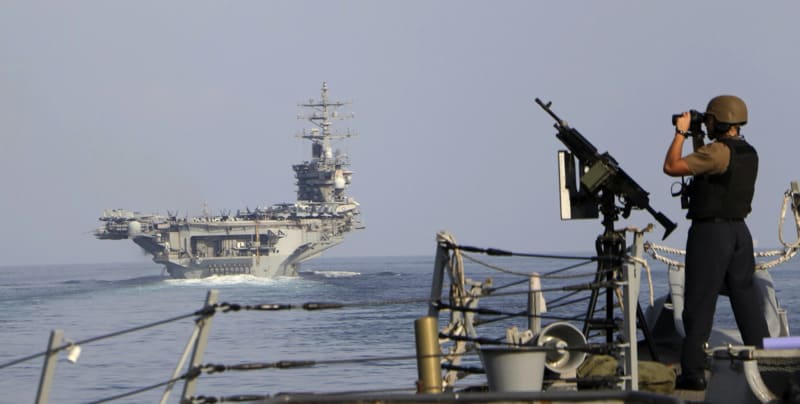
Image Source: AP/US Navy (A U.S. aircraft carrier and other warships in the Strait of Hormuz)
File in PDF attached: The Demise of the Carter Doctrine: U.S. Intervention in Iran and the Case for Strategic Prioritization