



A Forum on the role of economic relations between Europe, the Mediterranean, and the Middle East was held in Rome on April 29, 2026, organized by the Foundation for International and Geopolitical Studies, chaired by Prof. Giancarlo Elia Valori. The Forum, attended by Israel’s ambassador to Italy, Jonathan Peled, focused primarily on the evolving dynamics of Israel-Europe economic and strategic relationships.
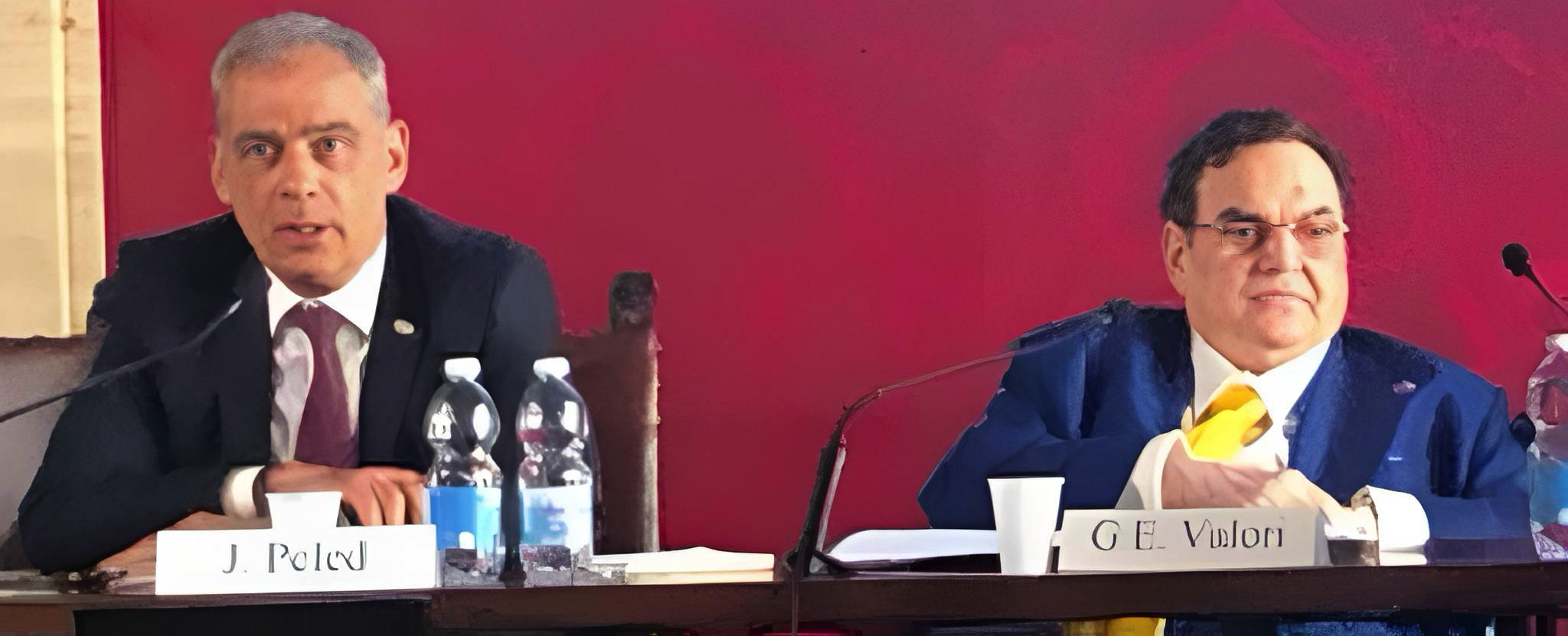
In his opening remarks, Prof. Giancarlo Elia Valori, emphasized the multifaceted nature of the current conflict in Israel, noting that it goes beyond military confrontation to encompass serious economic challenges involving energy, trade routes, and regional alliances.
Valori noted that despite the ongoing war, the Israeli economy is showing resilience, with projections indicating GDP growth that could reach approximately 3.3% by 2025 and 4.9% by 2026, driven primarily by demand in the defense sector and investments in technology. So, he argued that the war is not merely detrimental to Israel; on the contrary, it stimulates technological advancements and military demand, which could support market growth.
He also highlighted the complex relationship between interest rates and the real estate market, arguing that it is fluctuations in rates, rather than the war, that significantly influence real estate dynamics.
According to Valori, the US involvement in the conflict with Iran is a strategic move to secure control of the energy market, as maintaining dominance over oil and gas remains crucial for economic power and geopolitical influence.
Meanwhile, the proposed economic corridor linking India and Europe could transform Israel from a geographically peripheral state into a central logistics hub, significantly improving its economic landscape and its position in global trade
Israel’s ambassador to Italy, Dr. Jonathan Peled, emphasized the importance of the strategic partnership between Israel and Europe, amid growing international complexities. Indeed, Israeli-European economic relations are no longer just tools of growth, they have become real and proper strategic infrastructures that connect productive systems, but also political visions, that create value, but also stability. It is precisely in this perspective that the relationship between Israel and Europe assumes a meaning that goes well beyond the bilateral dimension.
Quoting the words of Amb. Jonathan Peled:
“Israel and Europe share much more than a solid commercial relationship, already started with the Free Trade Agreement in 1975. Today, in fact, the European Union is the main commercial partner of Israel, with about a third of its exports and imports. This means that we share a model.
A model based on innovation, economic openness, the rule of law and the ability to transform knowledge by creating a real network of interconnected ecosystems. This relationship is ultimately based on a framework of economic cooperation, based on the agreement between Israel and the European Union, which we call the Association Agreement, which was signed in 1995. This agreement has progressively facilitated the integration of markets and the exchanges between Europe and Israel.
On the one hand, Israel with its extraordinary ability to generate innovation, on the other hand, Europe with its industrial scale, the depth of the market and the regulatory capacity. An emblematic example of this integration is the European programme Horizon
The Israeli participation in Horizon Europe is not only technical or financial, it is a strategic choice based on solid technological and innovation capacities. Israel has participated in more than 5,000 joint projects. These cooperations strengthen Europe’s ability to face complex challenges, such as health, energy transition, innovation, climate resilience, space, digital transformation and security.
Recent global crises have highlighted the fragility of energy supply chains and economic systems. However, when built on solid foundations, interdependence becomes a source of resilience.
The relationship between Europe and Israel is an example of this qualitative interdependence. A relationship that goes beyond a simple exchange, creating shared value and new opportunities. This also shows to those who sometimes question the role of Israel, our country as a reliable partner with significant added value for Europe and the West.
In this context, a new perspective emerges, the India-Middle East-Europe Economic Corridor project. In this framework, Israel can play a key role not only as a logistics hub, but also as an innovation hub, capable of integrating physical and digital infrastructures, security and efficiency, sustainability and growth.
Looking to the future, the challenge is clear. We must evolve from a bilateral cooperation to an increasingly multilateral and functional cooperation, also based on greater sustainability. We must enhance the relationship between Europe and Israel as a platform for developing larger projects, involving other actors from the Mediterranean and the Middle East, in order to generate not only growth and prosperity, but also security and stability. Let me conclude with a reflection.
Economic relations are never neutral. They reflect choices and shape the future. Enhancing cooperation between Europe and Israel is not only a rational economic decision. It is a strategic investment, a mutually beneficial investment in stability, innovation and continuous prosperity. In an ever-increasingly complex world, the most solid partnerships are the ones capable of evolving, adapting and generating value over time”.
Dr. Gianni Letta, former Undersecretary to the Presidency of the Council of Ministers, and Prof. Paolo Savona, professor emeritus of economic and financial policy, also took the floor, emphasizing the necessity of diplomatic engagement and holistic strategies for conflict resolution and shared prosperity, highlighting the interconnected future of Israel, Europe, and the Mediterranean region.
Particularly, Dr. Giani Letta highlighted the importance of analyzing relations between Italy and Israel within the context of the current turbulent historical climate, particularly in light of the conflicts in the Middle East. He highlighted the need for diplomatic engagement to restore relations and promote peace, as well as to strengthen collaboration in sectors such as technology, healthcare, and economic interests, calling for greater integration amid regional uncertainty and the pursuit of common goals, while overcoming internal challenges within Europe. Ultimately, fostering cooperative ties is essential to addressing current global challenges, while balancing security and mutual interests.
Meanwhile, Prof. Paolo Savona pointed out the importance of a political choice between holistic and reductionist strategies in addressing issues between Europe and Israel. Emphasizing cooperation over conflict, it argues that collaborative efforts yield better results than divisive approaches. With over 500 million people in the Mediterranean region, promoting a collective vision is vital for progress. The text advocates for cultural integration rooted in a solid political and economic philosophy to resolve ongoing tensions and achieve shared goals for Israel, Europe, and beyond.
Following a series of remarks by other speakers, the conference’s conclusions emphasized the need for Europe to regain its role as a stabilizing force in the Mediterranean region through a long-term strategic vision. Highlighting Israel’s technological advances, particularly in sectors such as cybersecurity and healthcare, the conference proceedings suggest the need to further promote frameworks for collaboration between Europe and Israel aimed at fostering integration and growth, as well as broader regional cooperation.