



By Qurat-Ul-Ain Shabbir
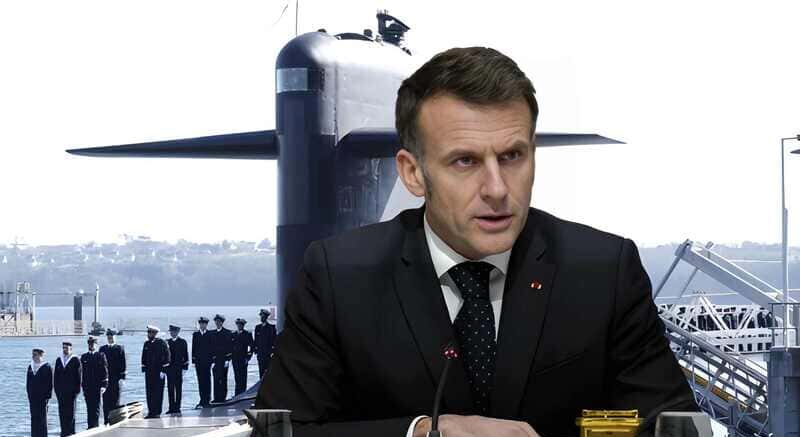
In his “Ile Longue” speech on March 2, 2026”, French President Emmanuel Macron delivered a message that will echo across European capitals for years to come. For the first time, a European leader publicly articulated that France’s nuclear deterrent carries a distinctly “European dimension.”

While the ultimate authority to launch remains the prerogative of the French President, Macron made it clear that an attack on a key European partner could trigger a French nuclear response. This is not a symbolic gesture: it reflects a growing recognition that Europe can no longer rely solely on the United States to guarantee its security. In a world where great-power priorities are increasingly transactional, Europe is beginning to define its own strategic boundaries.
The 2026 U.S. National Defense Strategy (NDS) reinforced this reality. By designating Russia as a “European responsibility,” the strategy signals a deliberate shift: Washington will focus its conventional forces on homeland defense and the Indo-Pacific Theater, leaving Europe to confront the Russian threat largely on its own terms. The nuclear umbrella remains intact, but the implicit promise of automatic conventional reinforcement is fading. Even seemingly peripheral actions, such as elevating Greenland to a primary U.S. homeland interest alongside the Panama Canal, highlight an unmistakable message: European security is now secondary to America’s own global priorities. Transactions, not guarantees, define the relationship, and Europe is taking note.
This strategic recalibration has deepened a credibility gap that European policymakers cannot ignore. Repeated questioning of NATO’s relevance, combined with explicit demands for Europe to “Buy American,” has underscored a harsh truth: the U.S. is no longer a guaranteed partner for long-term security. European arms imports from the U.S. surged to $68 billion in 2024—a fivefold increase over the 2017–2021 average—while American threats of trade countermeasures in response to “Buy European” procurement rules have reinforced the perception that collective defense is contingent on economic acquiescence. For many in Berlin, Paris, and Warsaw, the lesson is stark: security can no longer be assumed; it must be actively prepared.
Europe’s response has been both practical and psychological. The continent is actively building a more integrated and networked continental defense architecture, driven by a growing demand for strategic autonomy—particularly in areas such as drone defense, air and missile defense, and long-range strike capabilities. This effort reflects a gradual shift toward forward deterrence, in which credible conventional capabilities are positioned to signal readiness and resilience in the face of potential aggression. Forward deterrence, therefore, is not simply about stationing troops or deploying hardware; it represents a broader strategic mindset in which Europe seeks to reduce its structural dependence on external guarantees. While European defense infrastructure is not yet fully independent of Washington, ongoing investments and integration efforts indicate a clear trajectory toward greater operational autonomy, with more robust capabilities expected to mature between 2025 and 2030.
Meanwhile, France and the United Kingdom through the Northwood Declaration exploring ways to “Europeanize” their nuclear forces, offering broader protection to allied partners while retaining national control over launch decisions. Macron’s speech embodies this principle: strategic assets—including Rafale jets and the planned next-generation nuclear submarine, “The Invincible”—can now be dispersed across allied territory to provide strategic depth and complicate adversary calculations. For the first time, non-nuclear partners such as Germany and Poland are participating in joint exercises that directly interface with French nuclear capabilities. The psychological message is clear: Europe is beginning to assert a sovereign layer of deterrence that complements, rather than replaces, NATO’s structures.
Poland’s recent statement that it may eventually seek its own nuclear weapons, as President Tusk indicated, also highlights the accelerating sense of urgency in Eastern Europe. So here the question arises that while Macron’s “Europeanized” nuclear deterrent provides a layer of strategic depth, then why does Poland seeks to own nuclear weapons? The answer is that Macron’s forward deterrence is not scaled to cover the entire continent comprehensively, particularly in regions most exposed to Russia. For Warsaw, the calculus is simple: if U.S. guarantees are increasingly transactional, and if NATO’s nuclear planning remains centered on France and the U.K., then relying solely on allied deterrence is insufficient. This development illustrates two broader dynamics. First, it highlights the limits of “second-layer” nuclear deterrence: even with France operationally dispersing assets and including non-nuclear allies in exercises, some countries may feel compelled to consider independent capabilities to ensure credible protection. Second, it signals that Europe’s forward deterrence is moving from theory into practice, not only in doctrine and exercises but in actual national policy deliberations. Warsaw’s potential pursuit of nuclear weapons is less a provocation than a symptom of the same trend already evident in France and Germany’s expanded conventional and nuclear postures: Europe is taking responsibility for its own security.
Hence, Macrons’ speech represents a redefinition of European strategic autonomy. Between 2021 and 2024, EU defense spending rose by 30 percent, reaching €326 billion, signaling a growing recognition that reliance on Washington alone is no longer sustainable. European governments are investing not just in hardware, but in doctrine, interoperability, and the credibility of their deterrent posture. Strategic autonomy, once a rhetorical flourish, has become an existential imperative.Forward deterrence and strategic autonomy are complementary layers of security designed to mitigate the risk of over-reliance on an American partner whose priorities may shift.
Europe is thus navigating a delicate balance. It is neither abandoning NATO nor discarding the U.S. nuclear guarantee, but it is learning to prepare for a future in which guarantees are no longer unconditional. The era of unquestioned extended deterrence is ending, and the continent must act with foresight. Forward deterrence is more than a strategic posture; it is a signal—to Moscow, to Washington, and to Europe’s own citizens—that the continent is willing and able to take responsibility for its own defense.
Europe is no longer a passive theater under American protection. It is a region preparing to defend itself, thoughtfully and decisively, in a strategic environment defined by uncertainty, transactional alliances, and shifting global priorities. Macron’s “Ile Longue” speech may have been delivered in France, but its message resonates across the continent: the future of European security will be determined not by the automatic extension of U.S. deterrence, but by Europe’s own willingness to claim responsibility for its survival.
Author: Qurat-Ul-Ain Shabbir – PhD scholar at Quaid-i-Azam University, Islamabad, and currently serving as a Research Officer at the Centre for International Strategic Studies AJK.
(The views expressed in this article belong only to the author and do not necessarily reflect the views of World Geostrategic Insights).