



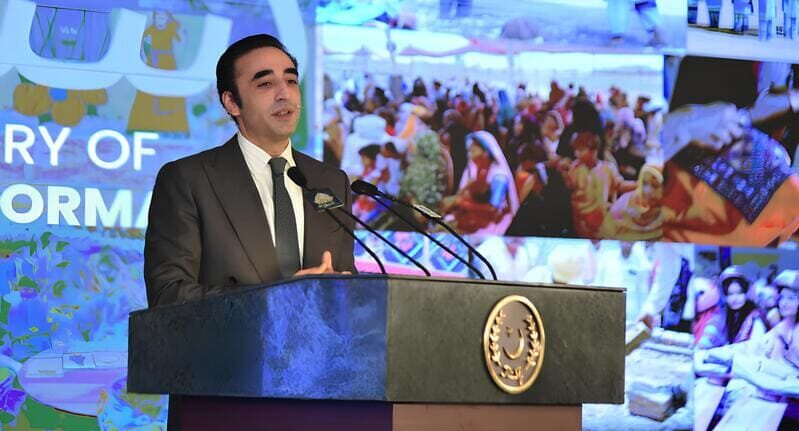
Bilawal Zardari’s unveiling of a “Sindh Vision” at the President’s House is less a moment of policy renewal and more a reminder of a long-standing contradiction between rhetoric and reality.

The Pakistan Peoples Party (PPP) has governed Sindh almost uninterruptedly since 2008 – nearly seventeen years of continuous control over provincial administration, budgets, and development priorities, and more than five decades cumulatively if earlier tenures are included.
Few political parties anywhere in the developing world have enjoyed such prolonged authority over a single province. That longevity inevitably shifts the burden of proof. A new vision, at this stage, cannot be treated as a promise of what Sindh might become; it must be judged against what Sindh has already become under the same leadership.
Stark ground realities present an uncomfortable contrast. Sindh remains Pakistan’s most economically paradoxical province. It hosts Karachi, the country’s financial and commercial backbone, contributing roughly a quarter of national GDP and the bulk of federal tax revenues. Yet it also contains some of the poorest districts in the country.
Latest multidimensional poverty estimates place around 40 to 45 percent of Sindh’s population in multidimensional poverty, with rural Sindh exceeding 55 percent. In districts like Tharparkar, Umerkot, Thatta, and Badin, poverty is not cyclical but entrenched, reinforced by weak public services, climate vulnerability, and land and water inequities.
Likewise, health indicators underline the depth of institutional failure. Nearly 48 percent of children under five in Sindh are stunted, and about 17 percent suffer from wasting, placing the province among the worst performers not just nationally but globally. Maternal mortality hovers around 220 deaths per 100,000 live births, reflecting the collapse of primary healthcare systems in rural areas.
Ironically, Basic Health Units (BHUs) exist on paper, but many function without doctors, medicines, or even electricity. These outcomes persist despite years of flagship health programs and steadily rising provincial health budgets.
On the other hand, education tells a similar story. Sindh has the highest number of out-of-school children (OOSC) in Pakistan – over seven million by most estimates. Literacy rates remain stuck around the mid-50 percent range, with rural female literacy dramatically lower. Public-sector schools frequently operate as ghost institutions; buildings exist, budgets are allocated, teachers are appointed, yet classrooms remain empty or learning outcomes negligible.
Factually, this is not a resource problem alone. Sindh consistently allocates a large share of its budget to education, but politicized recruitment, weak monitoring, and lack of accountability hollow out results.
Correspondingly, fiscal data further exposes the gap between planning and performance. Sindh’s provincial budgets now exceed Rs 3.4 trillion annually, with roughly a third allocated to development spending. Yet Planning and Finance Department monitoring reports repeatedly show low utilization of development funds.
In recent fiscal years, barely 40 to 45 percent of the Annual Development Programme (ADP) had been spent by the final quarter, leaving thousands of schemes incomplete. At one point, more than four thousand development projects remained unfinished, some lingering for years with repeated cost escalations. Such patterns are not administrative accidents; they signal chronic weaknesses in project planning, procurement, and execution.
Unchecked corruption and governance failures are central to this story. Audit reports and Public Accounts Committee proceedings regularly flag irregularities in procurement, unverified payments, and projects of substandard quality. Provincial planning authorities themselves have halted funding to dozens of schemes after declaring them unsatisfactory.
In Karachi and other urban centers, allegations of politically connected contractors securing development projects recur with disturbing frequency. The result is infrastructure that deteriorates almost as soon as it is inaugurated, reinforcing public cynicism about development claims.
Karachi, the province’s crown jewel, best illustrates the consequences of governance decay. A city of over sixteen million people operates without an effective mass transit system, suffers chronic water shortages with a supply-demand gap exceeding 40 percent, and collapses into chaos with every heavy monsoon.
In parallel, solid waste management, urban planning, and public transport remain dysfunctional not because solutions are unknown, but because local governments have been systematically disempowered. Authority and resources are centralized at the provincial level, leaving city administrations toothless and citizens unrepresented.
Agriculture and water governance, once Sindh’s comparative strengths, are equally troubled. Tail-end districts routinely face water shortages despite Sindh’s position at the lower Indus. Inequitable distribution, illegal extraction, and feudal capture of irrigation systems undermine small farmers, increasing rural indebtedness and migration. Climate shocks, floods, diseases and droughts, have amplified these vulnerabilities, yet institutional responses remain reactive and fragmented.
Against this backdrop, launching a “Sindh Vision” from Islamabad’s most ceremonial venue risks misguiding rather than mobilizing. The province does not suffer from a shortage of policy documents or development frameworks. It suffers from a sustained erosion of institutions, accountability, and administrative professionalism.
After nearly two decades of uninterrupted rule, the PPP cannot plausibly present itself as an outsider diagnosing Sindh’s problems. It is the system of governance and any credible vision must begin with an honest reckoning of that reality. Until political reform replaces symbolism, and accountability replaces announcements, Sindh will remain trapped in a cycle where grand narratives are unveiled at high tables while ground realities continue to deteriorate far from them.
Author: Mirza Abdul Aleem Baig – President of Strategic Science Advisory Council (SSAC) – Pakistan. He is an independent observer of global dynamics, with a deep interest in the intricate working of techno-geopolitics, exploring how science & technology, international relations, foreign policy and strategic alliances shape the emerging world order.
(The opinions expressed in this article are solely those of the author and do not necessarily reflect the views of World Geostrategic Insights).
Image Source: X (Bilawal Bhutto Zardari attending the Sindh Vision ceremony at Aiwan-e-Sadr, Islamabad as Chief Guest, highlighting Sindh’s past achievements, future plans and emerging investments opportunities).