



By Maja Ćirić
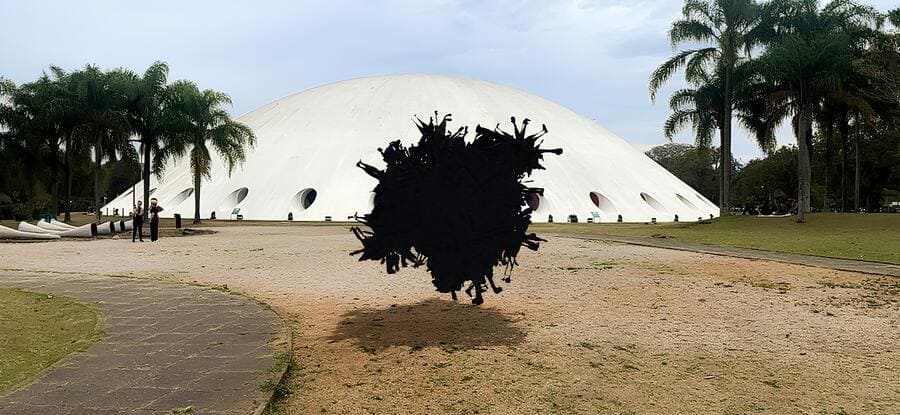
As part of the ongoing convergence of art and technology, the 36th Bienal de São Paulo—“Not All Travelers Walk Roads of Humanity as Practice” — launched “Apparitions” on September 6, a globally distributed, site-specific augmented reality (AR) exhibition powered by the WAVA (1) platform. By enabling selected artworks to appear in geographically strategic locations — from the US – Mexico border to the Congo River — the initiative aims to exert transnational cultural influence.
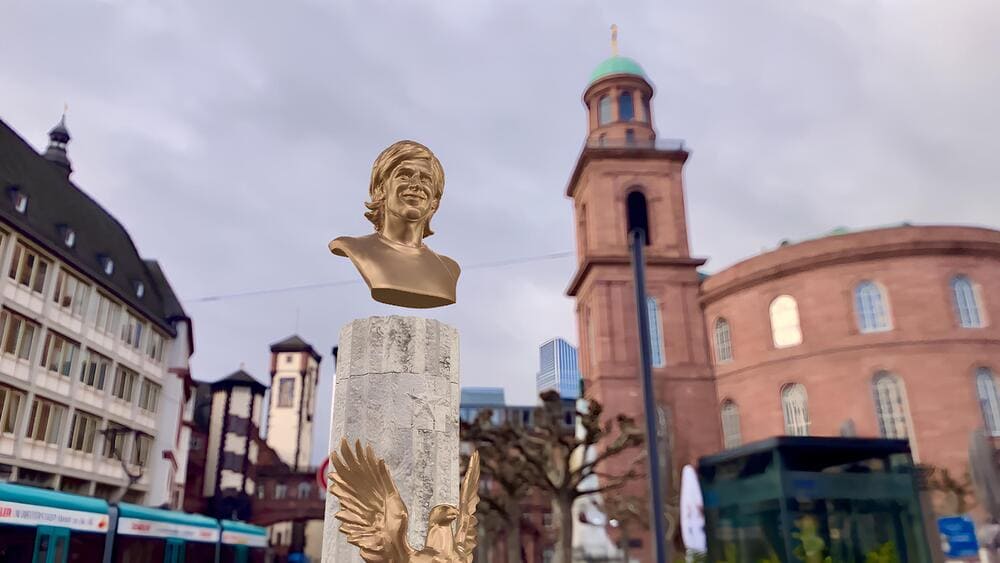
Before “Apparitions”, WAVA had already established augmented reality as a tool for navigating contested histories and geographies. In “The Orangerie” (2024–25), situated in Frankfurt’s Grüneburgpark — formerly part of the Goldschmidt-Rothschild estate, expropriated by the Nazi regime under duress in 1935—WAVA used AR to stage a charged proximity between Israeli and Palestinian artistic perspectives, making visible the tensions and entanglements of political co-presence. Similarly, DEMO- (2023/24) exhibition marked the 175th anniversary of the Paulskircheversammlung by transforming a symbolic site of German democracy into an interactive AR space, interrogating the legacy and fragility of democratic ideals. Among other artworks, DEMO- included “Monuments of the Disclosed” (2022) by Ahmet Öğüt, a series of digital monuments honoring whistleblowers who stood up against powerful forces (2).
Across these projects, WAVA consistently positions AR not as a neutral medium, but as a cultural and geopolitical apparatus—capable of reconfiguring propositions in public space and the narratives that inhabit it.
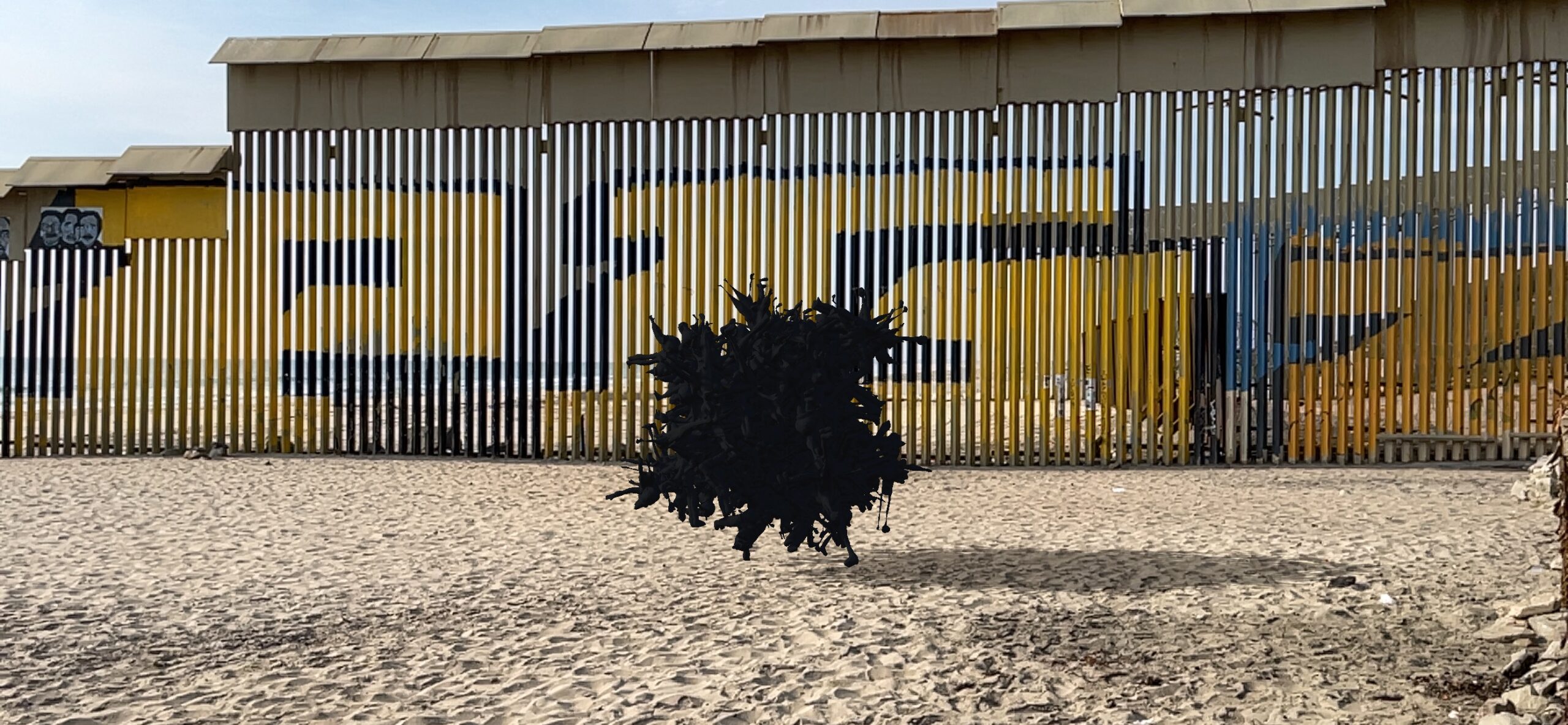
“Apparitions” extends this trajectory into a more dispersed and globally scaled format. In the shifting landscape of contemporary exhibition-making, it marks an ambitious intervention—an experiment in augmenting public space through geolocated digital art. Positioned as a response to the limitations of major physical biennials, “Apparitions” reframes the act of seeing as a networked event: layered, site-specific, and mobile. The spatial coordinates, strategically determined by the artists in collaboration with the WAVA team, function not merely as display sites but as geopolitically and historically resonant anchors. Take, for example, “Void” by Andrew Roberts, installed at the Mexico–U.S. border.
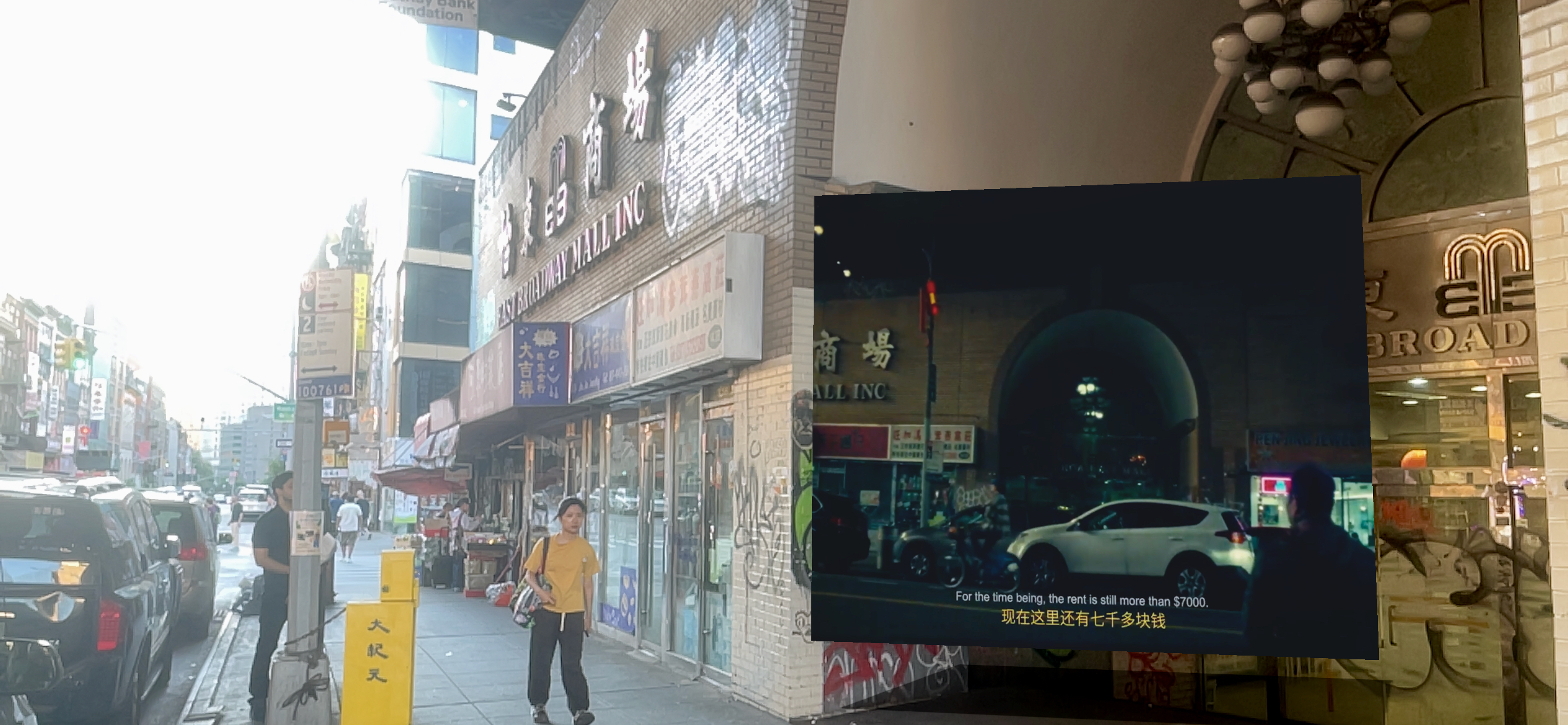
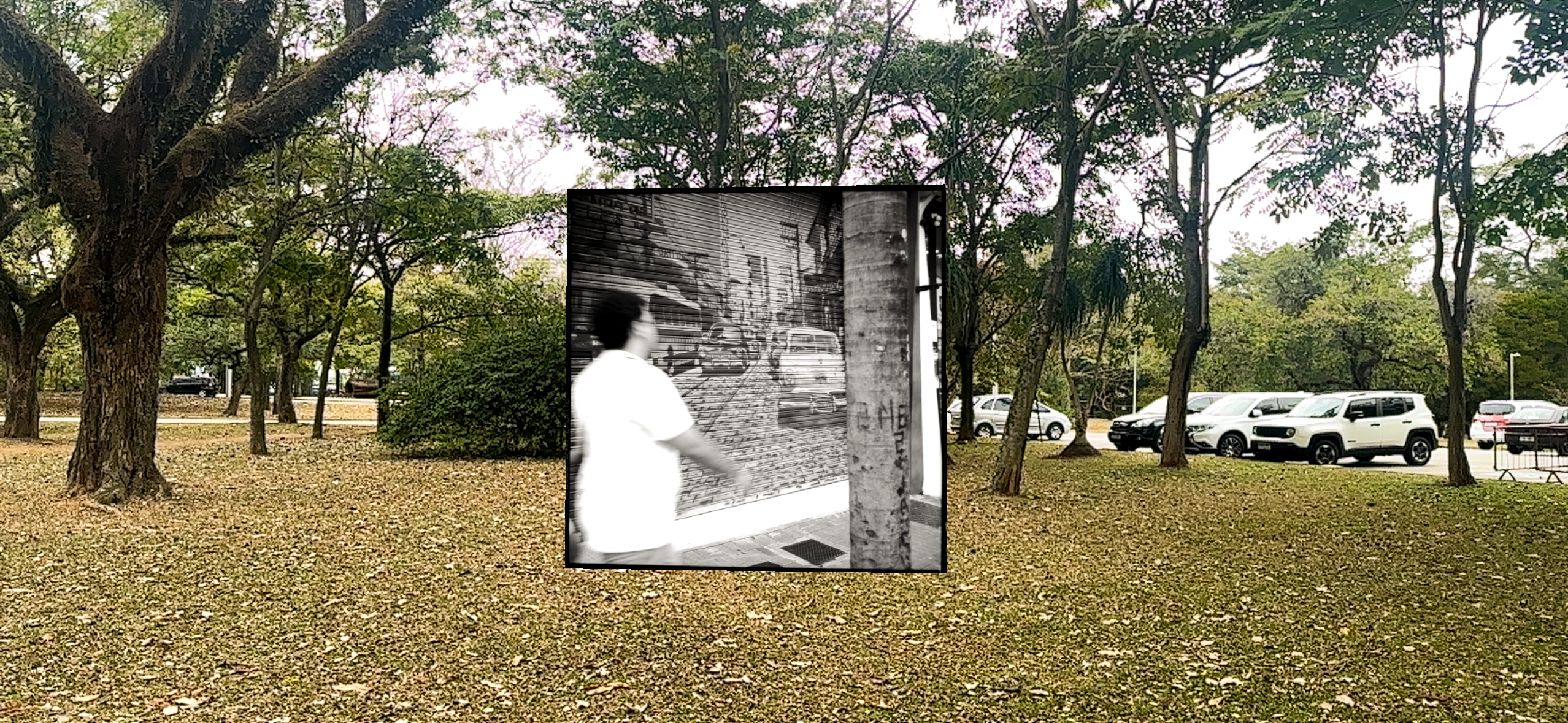
Or “Belonging and Difference” by Cici Wu and Yuan Yuan, exhibited across Chinatown in New York, Hong Kong, and São Paulo. Similarly, Michele Ciacciofera’s “The Nest of the Eternal Present” was shown in both São Paulo and Beijing. Through the WAVA app, these locations become nodes where virtual content intersects with material space, enabling local publics to encounter the works in situ. This convergence of digital overlay and territorial specificity transforms passive observation into context-sensitive engagement, foregrounding the politics of presence, access, and mediated spatiality.
At first glance, this ambition appears to realize what philosopher Vilém Flusser called for in his reflections on the 12th São Paulo Bienal in 1973: a rupture with linear histories and bounded geographies in favor of more dialogical and open forms. “Apparitions” seems to echo this impulse, anchoring artworks (3) across a global network. Leveraging augmented reality (AR), the project generates situated encounters—not only of place, but also through place—beginning in locations such as Badagry, Beijing, Brasília, Kinshasa, Hong Kong, New York City, Rio de Janeiro, Tijuana/San Diego (at the border), and throughout São Paulo.
All of this operates under the assumption that local audiences are familiar with what a biennial is, and that the biennial’s marketing can effectively reach them—even, for example, across national borders. Indeed, beneath this architecture of access lies a deeper set of questions. What kind of infrastructure makes these apparitions possible? What are the metaphysical assumptions embedded within the medium of AR itself? And crucially: does this reconfiguration of space and visibility truly disrupt the hegemonic logic of global exhibitions—or simply rewire it?
Between Presence and Projection
The shift from transporting artworks to transporting coordinates is often framed as a democratizing gesture. But this shift rests on an invisible substrate: satellite networks, app ecosystems, mobile devices, cloud servers—all of which are entangled with corporate, geopolitical, and epistemic systems of control.
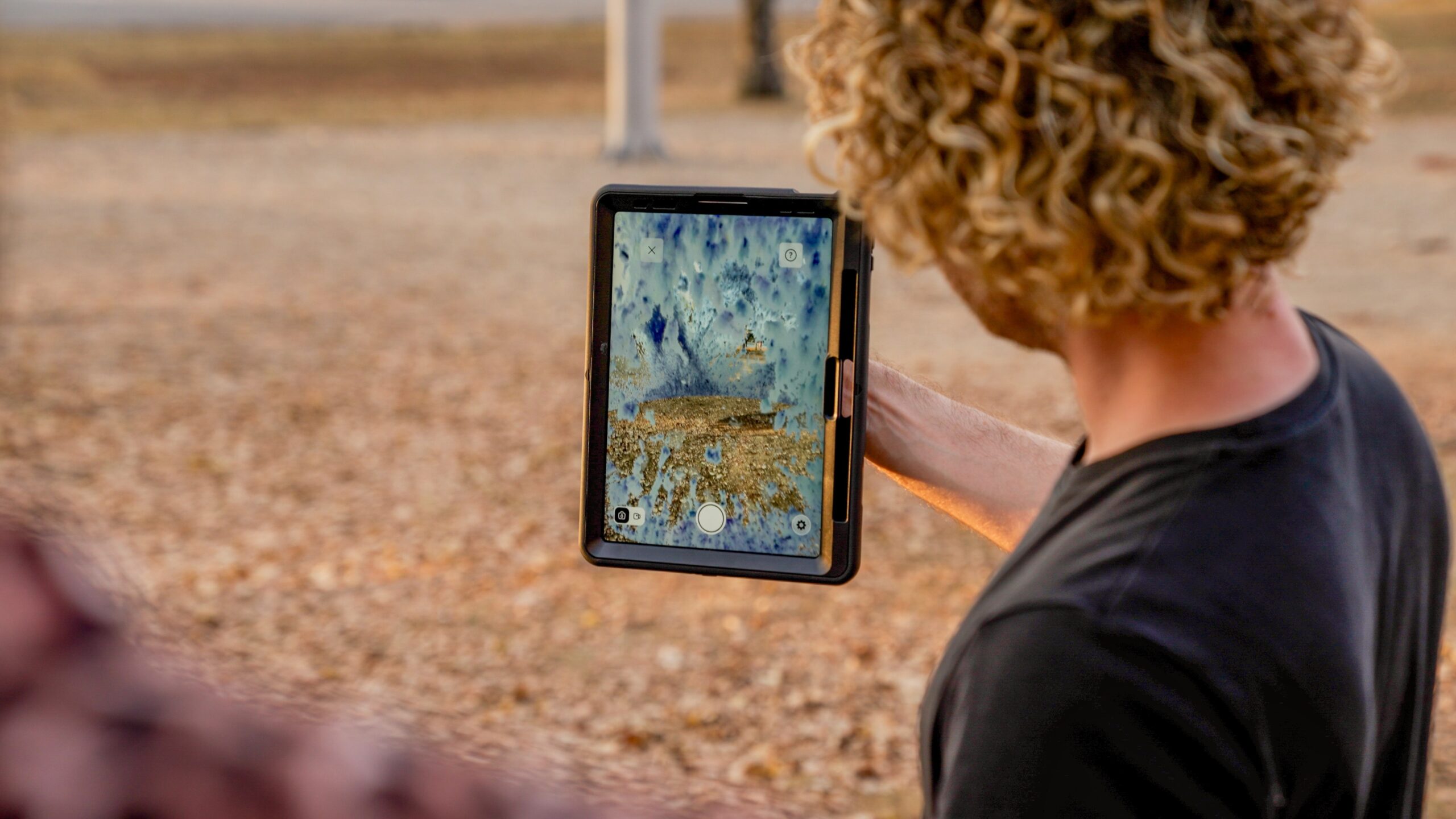
AR artworks in “Apparitions” appear in highly specific places—former slave ports in West Africa, the US-Mexico border, post-industrial zones in Europe—but their mode of appearance is governed by a generalized technological grammar: Cartesian mapping, screen-based engagement, and user-data mediation.
This raises a provocative question: Can an artwork truly be “site-specific” if its mode of appearance is universalized?
Here, we might recall philosopher Yuk Hui’s critique of technological universalism. In his work on cosmotechnics (4), Hui argues that technology is never neutral—it always reflects a cosmology. When AR operates through a standardized interface and epistemology, it enacts not just a technical logic but a worldview: one in which space is quantifiable, experience is mediated through the visual, and interaction is individual and screen-bound.
To their credit, the curators of “Apparitions” appear acutely aware of the tensions they navigate. Many of the selected sites resist simplification. They carry weight—historical, political, and affective. But when the interface remains constant across radically different ontologies, there is a risk that these apparitions flatten rather than intensify difference. This is not a critique of WAVA, but rather a prompt to consider how the future of augmented reality might account for the specificities of place, context, and cultural ontology in more differentiated ways.
Participation, Appearance, and the Public
Another key ambition of “Apparitions” is to reconfigure audience engagement: to move beyond the passive viewer and toward active participation. In many ways, this is a noble goal—particularly at a time when public space is increasingly surveilled, privatized, and algorithmically managed.
But the figure of the “user”—invoked throughout the project—is not equivalent to the “public.” To appear as a user is to accept a set of conditions: to download, to locate, to interface. It is to be counted, but not necessarily to be heard.
Moreover, the act of placing politically charged artworks into public space does not automatically create political publics. The transformation of meaning requires local interlocution and dialogical infrastructure—elements that are not always guaranteed within a distributed, platform-based model.
None of this is to suggest that “Apparitions” lacks critical value. On the contrary, some of its strongest moments occur precisely where the friction between site and system is most acute. When AR is used not to dissolve geography but to exacerbate its complexity—to mark an absence, invoke a history, or trouble a border—it can indeed produce powerful effects.
The task, then, is not only to ask where art appears—but to interrogate the conditions of appearance themselves.
From Openness to Ontology
WAVA’s commitment to being free and open is significant—especially in a digital landscape shaped by proprietary systems and extractive platforms. Offering cultural tools without charge signals a refusal of enclosure and a gesture toward infrastructural generosity.
Openness in use doesn’t guarantee openness in design. A truly open platform must also support different ways of knowing, mapping, and appearing—beyond Western spatial logics, individual authorship, and centralized control.This means rethinking the platform itself: not just who can use it, but how it encodes presence, authorship, and governance. To lend a platform is one thing; to allow it to be redefined is another. The horizon is not just availability, but transformability.A platform that is free but epistemically closed remains a soft enclosure. One that can be remade—structurally and culturally—becomes something else: a commons for reimagining the relationship between appearance, publicness, and art.
Seen this way, “Apparitions” is not just a technical experiment but a cultural proposition in progress. Asking more of it is not critique, but care—a belief in its potential and a call to live up to the future it gestures toward.
Toward a Plural Technics of Exhibition
“Apparitions” opens a door. It gestures toward a future in which exhibition-making might no longer be bound to white cubes, national pavilions, or shipping containers. But for that future to be genuinely plural, just like the traditional art world, it must confront the metaphysics of its tools. This means designing interfaces that reflect diverse spatial ontologies, rather than imposing a universal structure. It involves exploring curatorial models that prioritize situated accountability over symbolic visibility, grounding practice in context rather than spectacle. And it requires building infrastructure that resists platform monopolies and invites co-creation—not just passive participation—ensuring that the tools of exhibition are as open and plural as the visions they seek to hold.
In doing so, “Apparitions” might not only scatter images across the globe—it might contribute to the redistribution of curatorial power, epistemic agency, and aesthetic sovereignty.
Until then, we remain in a liminal space: between apparition and appearance, potential and platform.
References
1) WAVA (gGmbH) is a nonprofit app-based platform that uses GPS and Augmented Reality (AR) to bring different forms of digital art to specific locations around the world without the need for physical setup of infrastructure. Developed in Frankfurt am Main since 2020 by a team of artists and curators, WAVA was formally established as a nonprofit in 2024 by Florian Adolph, David H. Bachmann and Ben Livne Weitzman.
2) Monument of Aaron Swartz, Monument of Li Wenliang, Monument of Marlene Garcia-Esperat, Monument, Monument of Philip Saviano, Monument of Kimberly Young-McLe.
3) By Maxwell Alexandre, Akinbode Akinbiyi, Michele Ciacciofera, Cevdet Erek, Theo Eshetu, Adama Delphine Fawundu, Ruth Ige, Andrew Roberts, Juliana dos Santos, Cici Wu with Yuan Yuan, Vilanismo, and others.
4) Yuk Hui, The Question Concerning Technology in China: An Essay in Cosmotechnics (Falmouth, UK: Urbanomic, 2016).

Author: Maja Ćirić, PhD – Independent curator and art critic. She has received the ISCP Curator Award, the Dedalus Foundation Curatorial Research Award, the Lazar Trifunović Award, the ArtsLink Independent Projects Award, and the Visual Artists Ireland Curatorial Research Award. Maja served as the curator of the Serbian Pavilion at the Venice Biennale in 2007 and as the commissioner in 2013. She also curated the BJCEM Mediterranea Young Artist Biennale in Tirana, Albania, in 2017, and the 20th Pančevo Art Biennale in Pančevo, Serbia, in 2022.