



By Sadaf Nadeem
A lie, weaponized and delivered at the speed of light, can poison a nation. For millions of Pakistanis navigating the digital world, this is our new reality, a daily battle for truth on a battlefield of misinformation.
The rapid spread of disinformation has created a corrosive online environment where distinguishing fact from fiction has become a profound challenge. While the first instinct is to build higher digital walls through cybersecurity, the reality is far more complex. This article argues that fake news is a societal threat, not just a technological one and that relying solely on cybersecurity will lead to failure. Instead, Pakistan needs a robust, multipronged national strategy.
Pakistan’s digital explosion over the last decade has unleashed an ‘infodemic.’ While connecting millions to the global conversation, it has also exposed a population, many of whom are new to the digital space, to sophisticated manipulation. Social media platforms, intended to democratize information, have tragically become superhighways for rumors, conspiracy theories, and deliberate falsehoods. This was dangerously evident during the 2018 elections when coordinated disinformation campaigns poisoned the political discourse. The threat escalated dramatically during the COVID-19 pandemic, when lethal lies about the virus and vaccines spread faster than the disease itself. This context proves that merely technical solutions are critically insufficient to address a problem so deeply embedded in our social fabric.
Turning to technology as the primary shield is a natural first step, but it is not a silver bullet. While AI-driven content filters and fact-checking algorithms offer a line of defense, they are locked in a perpetual digital arms race with those creating disinformation. Bad actors quickly learn to outsmart algorithms, and automated censorship often makes costly mistakes, silencing legitimate voices and eroding public trust. While independent fact-checking models, like those pioneered by Full Fact in the UK and the Poynter Institute’s International Fact-Checking Network, provide frameworks from which Pakistan can draw valuable lessons, they remain imperfect. Cybersecurity is an essential tool, but it can never replace the one thing that truly defeats lies: a critical human mind.
When technology falls short, the state often turns to law. Pakistan’s Prevention of Electronic Crimes Act (PECA) 2016 was enacted to criminalize the spread of false information that threatens public order or national security. However, this legal instrument has proven to be a double-edged sword. Enforcement remains uneven, and serious concerns persist about the law’s misuse to suppress legitimate dissent and journalism. The effort to control misinformation while protecting freedom of expression is a perilous tightrope walk. Thus, while legal measures are necessary, they are far from a complete solution.
The most potent antidote to misinformation lies not in code or statutes, but in the empowered mind of the citizen. Public education is the cornerstone of any sustainable solution. This means aggressively promoting digital literacy programs that teach citizens how to verify sources, identify bias, and question information before sharing it. Media literacy must be integrated into our national school curricula from a young age. A powerful example is Finland’s world-renowned media literacy program, which has built a resilient society against fake news through comprehensive education. Pakistan must not simply copy, but adapt and innovate strategies that are suited to our cultural context, utilizing credible NGOs, community leaders, and educators to build trust and empower citizens.
Fighting this menace is not the duty of one institution; it requires a unified national strategy. This is a call to action: The Ministry of Education must integrate digital literacy into our curriculum, starting today. Tech giants like Meta and X must invest in robust, local-language moderation, not as a favor, but as a core responsibility. And we, as citizens, must commit to one simple, powerful act before we share: Pause. Think. Verify. Only a coordinated strategy, where technology, law, and education work in concert, can create a digital space where truth has a fighting chance.
Misinformation is not a technological glitch; it is a societal challenge that demands a societal response. Pakistan is at a historic turning point. We can either be consumed by the chaos of disinformation or rise to the challenge by cultivating a nation of informed, resilient, and responsible digital citizens. Cybersecurity is a critical line of defense, but the ultimate victory will be won in the minds of our people. This is the battle for Pakistan’s digital soul. Let’s win it together.
Author: Sadaf Nadeem – Independent researcher with two master’s degrees in Chemistry and Education and an MPhil in Education. Her work focuses on geopolitical affairs, education policy, and regional development.
(The views expressed in this article belong only to the author and do not necessarily reflect the views of World Geostrategic Insights).
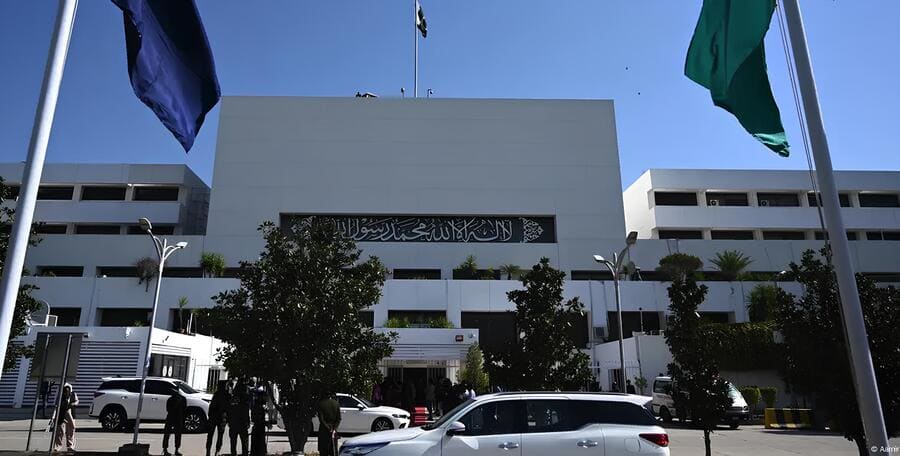
Image Credit: AFP (The upper house of Pakistan’s parliament – In January 2025 it has voted to strengthen controls on fake news on social media).