



By Sami Ullah
During geopolitical crises, the influence of classical theories of international relations tends to come to the fore.

The conflict between Iran, Israel, and the United States, which began on February 28, 2026, has highlighted the strategic importance of maritime chokepoints, particularly the Strait of Hormuz, through which nearly one-fifth of the world’s oil supply transits.
The crisis in the Strait of Hormuz is a case study of one of the key lessons of Nicholas J. Spykman, namely that geography, and in particular, the ability to control the Rimland, the maritime and coastal zone surrounding Eurasia, and its strategic chokepoints, can give states a tactical advantage even when facing far more powerful opponents.
Indeed, the Strait of Hormuz is the only maritime passage connecting the Persian Gulf to the Gulf of Oman and, consequently, to the entire global maritime trade network. This is a crucial factor, as it is of extraordinary importance to global energy markets: between 2023 and 2025, approximately 20% of global liquefied natural gas trade and 25% of maritime oil trade will pass through this corridor. The strait is narrowest at a point where it is only 21 nautical miles wide, with shipping lanes confined between the coast of Iran and Oman’s Musandam Peninsula. These geographical constraints make the waterway a strategic bottleneck, where even the slightest disruption has a global impact.
Recent tensions have clearly demonstrated just how vulnerable the global economy is to disruptions at such strategic chokepoints. As a response to the attacks, Iran has deployed naval mines and threatened to close the strait, causing a drastic reduction in maritime traffic. Tanker traffic reportedly fell by nearly 70 percent, with over 150 ships anchored in international waters to avoid any risk. Within a few days, maritime traffic through the strait had virtually come to a standstill. Global energy markets reacted immediately: Brent crude prices surged from March 8, 2026, to over $100 per barrel for the first time in four years, peaking at around $126 per barrel due to panic over a long-term supply disruption. Analysts said the scenario represented the worst energy supply shock since the energy crisis of the 1970s and, perhaps, the largest disruption in the history of the global oil market.
Current developments clearly illustrate the relevance of the Rimland theory introduced by Spykman, according to whom true power lies in controlling the coastal belt surrounding Eurasia—the Rimland—rather than in occupying the interior of the continents. For him, the strategic importance of the Rimland stemmed from its high population density, economic resources, and direct access to maritime trade routes. This logic was summarized in his famous maxim: whoever controls the Rimland controls Eurasia; whoever controls Eurasia controls the destiny of the world.
The Persian Gulf is a good example of this geopolitical reality. The region lies on the Middle Eastern flank of the Rimland, a combination of vast hydrocarbon reserves and proximity to one of the world’s most important maritime chokepoints. In this regard, a regional power based on geography such as Iran can exert the kind of strategic impact it does without being a dominant power, as the ongoing crisis demonstrates, simply by virtue of its geographical position on the Strait of Hormuz. Even technologically advanced naval forces such as those of the United States must carefully weigh the political, economic, and military costs before taking the bold step of attempting to forcibly reopen such a narrow waterway.
What is happening in the Strait of Hormuz is not merely a matter of local security; it is a clear demonstration that the global balance of power is still based on geographical factors. Until major trade and energy flows are rerouted to avoid passing through these narrow sea lanes, the states that exercise control or influence over these chokepoints will continue to play a decisive role in shaping the global order.
This is the inherent weakness of contemporary military power. Although technological superiority and naval dominance remain decisive factors in global influence, the impact of geography still imposes structural limits on how power can be exercised. Geographical position, distance, and imbalances in relative power will offset traditional military superiority in narrow maritime areas such as the Strait of Hormuz. For this reason, smaller or regional states located in vital areas of the Rimland can wield strategic weight far exceeding their material capabilities.
Ultimately, the crisis that erupted in the Strait of Hormuz highlights a broader reality of international politics: geography continues to play a fundamental role. Although military technology, cyber warfare, and space capabilities are evolving rapidly, control of physical chokepoints remains the determining factor in global economic stability and strategic rivalry. Although Spykman’s Rimland theory was developed in the mid-20th century, it remains surprisingly relevant in the 21st century.
Author: Sami Ullah – MS Scholar in International Relations from Balochistan University of Information Technology, Engineering and Management Sciences (BUITEMS).
(The opinions expressed in this article belong only to the author and do not necessarily reflect the views of World Geostrategic Insights).
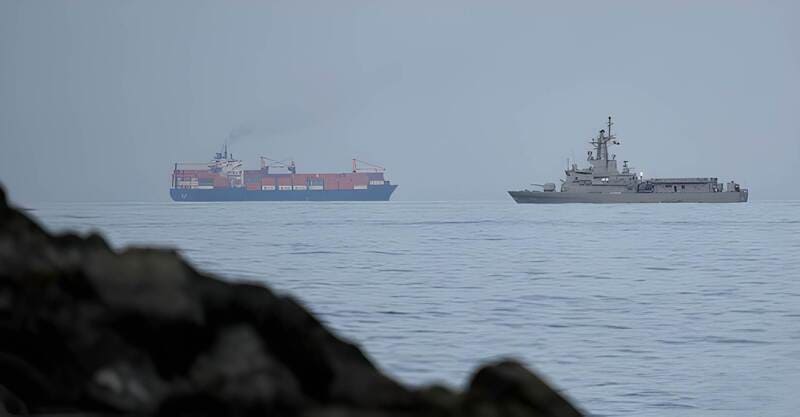
Image Source: AP (A United Arab Emirates navy ship sails next to a cargo ship in the Strait of Hormuz ).