



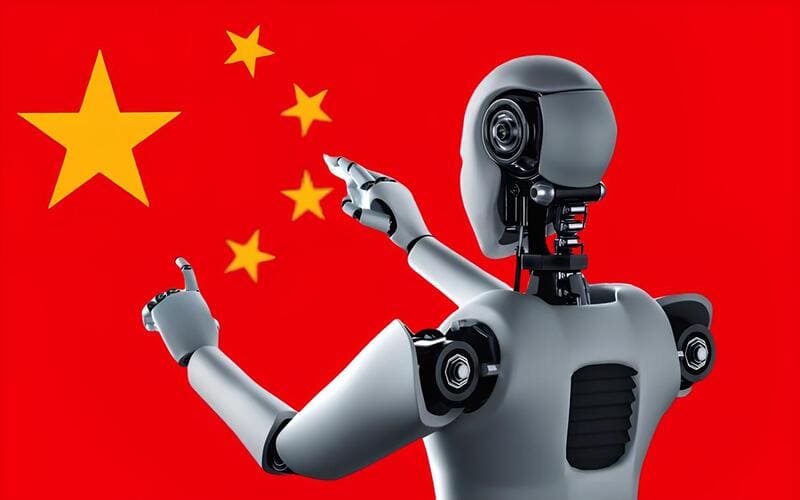
In a world increasingly divided by technological walls, where knowledge is guarded as proprietary treasure and digital tools are packaged for the privileged few, China has chosen a markedly different path in the realm of artificial intelligence. Its open-source AI strategy, long dismissed as a secondary current in the global race for machine learning dominance, is beginning to reveal its full strength as a deliberate campaign of utility and reach.

The success of China’s AI exports in 2025 is not measured in flash alone, but in tangible impact. For instance Braamfontein Station in Johannesburg, South Africa’s main freight artery. Once crippled by copper cable theft, the railway line has seen crime drop by 80 percent following the deployment of a Chinese AI-powered visual monitoring system. What made the difference? Not a technological breakthrough, but the availability of adaptable, open, and affordable tools.
This is the promise of China’s “AI Plus” initiative i.e. artificial intelligence as a global public good. Unveiled in greater detail at the 2025 World Artificial Intelligence Conference, the project reflects a vision rooted in inclusion rather than monopolization—earthquake translation tools created within hours in Myanmar, autonomous mining trucks improving Thai logistics, AI-generated agricultural plans tailored to Morocco’s actual soil and season. It is a model of relevance, not abstraction.
The open-source philosophy at the core of China’s AI movement is not accidental. It is deliberate, strategic, and in many respects, humane. Models like DeepSeek R1 and Moonshot’s Kimi K2 are not just high-performing by global standards, they are shared, remixable, and built for localization. In international evaluations, Chinese models outperformed their Western counterparts not just by generating responses, but by offering actionable, localized strategies. They didn’t merely say what should be done; they explained how it could be achieved.
One reason for this edge lies beyond coding, it lies in memory. China’s decades-long presence in infrastructure and development partnerships across the Global South has given its AI systems a unique advantage: data and experience informed by real collaboration. When a Chinese AI suggests irrigation improvements in Ethiopia, it draws on actual pilot projects; when it guides education reform in Brazil, it recalls the shared classrooms built under Belt and Road partnerships. These are not hypothetical case studies, they are real-world inputs transformed into scalable, intelligent outputs.
This advantage is not technological alone. It is also political. As the U.S. and its allies increasingly weaponize digital tools and restrict semiconductor exports, China has responded not by retreating, but by accelerating self-reliance, investing in local chips, nuclear-powered data centers, and a domestic AI ecosystem now flush with talent and global patents. Yet, instead of locking down its achievements, China has released them to the world.
That openness is paying off. In Myanmar, where dialects vary and Western AI tools faltered, Chinese open-source models were used to build translation systems in under seven hours bridging linguistic gaps in real-time disaster relief. In Brazil, China’s education AI tools are customizing learning modules for public schools. In South Africa, the very railway lifeline of the economy is functioning again. These aren’t isolated wins; they’re cumulative proof that open systems travel farther, reach deeper, and adapt better.
Of course, there are challenges. AI is not a panacea. Even China’s models, as adaptable as they are, carry the risk of bias, labor displacement, and uneven outcomes. Regulatory maturity and ethical governance are works in progress across the board. But the Chinese model, where state oversight and national planning guide AI deployment, at least offers a framework of accountability. Compared to profit-first models in the West, where responsibility is often outsourced, China’s centralized approach can offer more course correction in the face of social impact.
For many in the Global South, the choice is no longer between Chinese and Western AI. It is between access and exclusion. And in that comparison, China’s smart and open rise offers an option built not on techno-nationalism, but on shared infrastructure, shared code, and shared benefit.
This is not to romanticize. China’s AI openness also serves its strategic interests, it enhances soft power, deepens diplomatic ties, and builds ecosystems aligned with its own development philosophy. But in a world that has too often defined technology in terms of ownership and control, China’s wager on openness is subversive in the best possible way. It invites participation, not dependency.
In the end, what China’s AI journey reveals is a recalibration of global technology politics. The future need not be held hostage by the highest bidder. Intelligence, when shared wisely, can lift boats not just in Silicon Valley or Shenzhen, but in Yangon, Rabat, and Johannesburg alike. If the race for AI is truly a race for relevance, then perhaps the winner will not be the fastest, but the one that is remembered to bring others along.
Author: Muhammad Asif Noor – Founder Friends of BRI Forum, Advisor to Pakistan Research Center, Hebei Normal University.
(The views expressed in this article belong only to the author and do not necessarily reflect the views of World Geostrategic Insights).