



In several recent public statements, President Donald Trump has repeatedly claimed credit for preventing what he describes as an imminent nuclear war between India and Pakistan.

Although this statement may have served as a strategic slogan in his campaign to return to the White House, under the banner of “Trump 2.0,” at the moment it stands in stark contrast to his promise to “end endless wars,” especially in the context of the ongoing Israeli-Palestinian conflict, where Gaza has become a graveyard for diplomacy and human rights.
This paradox at the heart of Trump’s foreign policy – a claim of global peacemaker while disregarding one of the most visible, violent, and morally charged conflicts of our time, raises important questions about the nature of political memory and media narrative.
As an example, Trump had not hesitated to remind audiences that tensions between India and Pakistan particularly following the Pahalgam, Jammu & Kashmir attack – could have escalated into a full-scale war, potentially involving nuclear weapons. In interviews and speeches, he has claimed personal intervention, stating, “I stopped a nuclear war between Pakistan and India.”
But a deeper look at regional dynamics during that period tells a different story. While U.S. diplomatic channels were engaged, the de-escalation was largely a result of backchannel efforts involving not just the United States, but also China, the Gulf States, and multilateral mechanisms such as the United Nations.
Since October 7, 2023, Israel’s military response to Hamas’s attack has escalated into a full-fledged humanitarian crisis in Gaza. According to the United Nations Office for the Coordination of Humanitarian Affairs (OCHA), over 57,680 Palestinians, including a large number of women and children have been killed, and 137,409 have been injured.
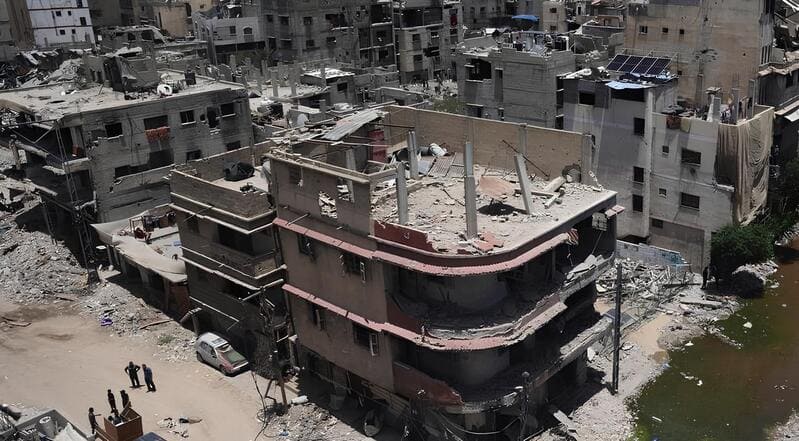
More than 21 months of war have left Gaza in ruin and 75% of Gaza’s population has been displaced. Entire neighborhoods have been reduced to rubble, access to food and clean water remains blocked, and the health infrastructure is on the verge of total collapse.
What has Trump said about this catastrophe? Almost nothing. And when he has spoken, it has been with overwhelming support for Israel, without even a semblance of balance, mediation, or acknowledgment of the Palestinian suffering.
During his first presidency, he recognized Jerusalem as the capital of Israel, relocated the U.S. embassy, and cut funding to UNRWA, the main UN agency supporting Palestinian refugees. These actions effectively dismantled whatever credibility the U.S. had left as a mediator in the Israel-Palestine conflict.
In his current campaign, Trump has made vague promises of “strength” and “peace through power,” but these slogans ring hollow when juxtaposed with the reality in Gaza. If the Trump Doctrine is about ending endless wars, then why has he never proposed a roadmap for ending the longest unresolved territorial conflict in the Middle East? Why has he not criticized the disproportionate use of force or called for a ceasefire or peace dialogue?
So, “Trump 2.0” appears more like a rebranding exercise than a reinvention of foreign policy. His promises to pull America out of unwinnable wars were popular in 2016 and again in 2020, but today, the world has changed.
Currently, wars are not just fought with troops but with drones, sanctions, and silence. By withdrawing from Afghanistan without a long-term stabilization plan, Trump set the stage for global chaos. By refusing to address Gaza with sincerity or balance, he has shown that peace is not a principle – it is a campaign prop.
Even on Ukraine, Trump has hinted at ending the war “in 24 hours” without ever articulating how. His approach suggests not peacemaking, but appeasement – not diplomacy, but deals. And often, these deals are devoid of justice or sustainability.
If Trump wants to be remembered as a president who truly ended endless wars, then silence on Gaza is no longer an option. He must speak clearly on the need for an immediate ceasefire, for humanitarian corridors, for the protection of civilians, and for the long-denied rights of the Palestinian people. Otherwise, his legacy will not be one of peace, but of propaganda.
In our era, selective memory is a dangerous thing. When leaders invoke past glories to hide present failures, it is the people who pay the price. It is not enough to say, “I stopped a war that never happened,” while ignoring the one that is happening now, every single day, in front of the world’s eyes.
History has a long memory. And in that memory, true peacemakers are not those who boast, but those who act. The war drums in Gaza, the ruins of Rafah, the screams of hungry children in overcrowded tents – they all ask the same question: Where is the end to this endless war?
Author: Mirza Abdul Aleem Baig – President of Strategic Science Advisory Council (SSAC) – Pakistan. He is an independent observer of global dynamics, with a deep interest in the intricate working of techno-geopolitics, exploring how science & technology, international relations, foreign policy and strategic alliances shape the emerging world order.
(The opinions expressed in this article are solely those of the author and do not necessarily reflect the views of World Geostrategic Insights).
Image Credit: UNICEF (A view of central Khan Younis in Gaza, showing the aftermath of airstrikes in a residential neighborhood).