



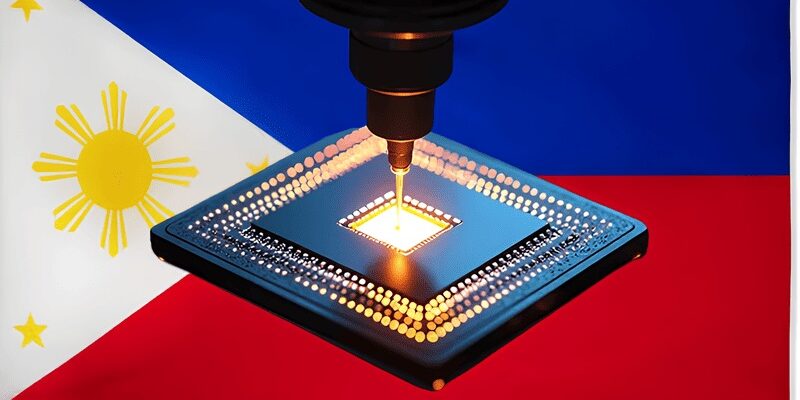
The fierce debate over “Pax Silica” (A US-led international alliance to secure semiconductor, critical mineral, and AI supply chains) is a critical turning point for the Philippines, pitting bold visions of high-tech manufacturing renaissance, or perhaps trapping Manila between immense promise and economic peril.

Proponents see the chip rush as a golden ticket that can finally break the country’s low-value service trap, transforming it from a back-office call center hub into high-tech manufacturing powerhouse in the Fifth Industrial Revolution.
Skeptics rightly warn that a country plagued by chronic power outages, sub-par internet speeds, rapidly drying well, and severe digital skills gap is unequipped to compete for multi-billion-dollar investments while becoming a geopolitical casualty in the US-China tech war. Far from a gentle transition, this artificial intelligence shift is a brutal economic sorting mechanism that will either propel the Philippines into prosperity or permanently cement its status as a tech laggard in the region.
Pax Silica is a geopolitical lifeline disguised as an economic engine, forcing the Philippines into a high-stakes alliance designed to strip China of its tech dominance and rebuild the global chip supply chain from New Clark City. While Taiwan builds the world’s digital brains and South Korea manufactures its memory, the Philippines commands the raw planetary fuel and foundational muscle that the Pax Silica alliance desperately needs to survive. Manila’s leverage lies in its vast and untapped reserves on nickel, copper, and cobalt. These critical minerals are valuable to build AI hardware.
Competitive Edge
For decades, the Philippines has quietly maintained a vital foothold in the global tech ecosystem through its mature semiconductor assembly, testing, and packaging sector. This deeply entrenched industrial infrastructure means Manila is not building a tech economy from scratch. Through the Pax Silica framework, the Luzon Economic Corridor has a rare window to pivot into automated packaging. By modernizing these established cleanrooms, the upper-middle income nation can anchor Western partnerships’ restructured microchip supply chain.
Filipino AI innovators are poised to reclaim the nation’s historic mantle of regional leadership, making Pax Silica a global vanguard for technological reinvention based in Central Luzon. Just as the legacy of institutions like the International Rice Research Institute (IRRI) and the Asian Development Bank (ADB) once anchored Asia’s agricultural and economic revolutions. Today’s local engineers and scientists possess the exact caliber of talent needed to power the digital revolution.
As Southeast Asian rivals aggressively lock down the microchip supply chain, Manila is caught in a ruthless regional sprint where political inertia will mean substantial economic decline. The upcoming presidential election represents a critical geopolitical inflection point for the Philippines, as any succumbence to partisan factionalism will dismantle the institutional stability required to anchor the Pax Silica architecture by institutionalizing the nation’s obsolescence in the global artificial intelligence paradigm.
Beyond the theater of global alignment, the true prize of Pax Silica is structural re-engineering of the domestic Philippine economy. By anchoring advanced mineral processing within a fortress of unyielding environmental protection and equitable land use, Manila can transmute its strategic resource reserves into technological self-determination without bartering away its ecological soul.
Furthermore, Pax Silica provides an operational launchpad for the country’s youth by establishing a powerful engine of upward mobility for the national talent pool, transforming a workforce long confined to basic tech assistance into the highly celebrated masterminds of semiconductor design, next-generation tech engineering, and pioneering AI research.
This overarching framework operates as a rigorous yet indispensable catalyst for domestic regeneration, mandating the wholesale modernization of stagnant national utilities and forcing the state to construct the high-capacity energy grids and resilient water infrastructure non-negotiable to weathering the next industrial age.
Silicon Statecraft
To secure true strategic autonomy through Pax Silica, the Philippines must condition foreign access to its vast critical mineral reserves on mandatory local refining and heavy co-investments in the nation’s fragile clean energy and water grids. Controlling these irreplaceable links in the global technology value chain fundamentally alters Manila’s strategic calculus, accelerating the Philippines’ ascent from a vulnerable geopolitical bystander into an influential middle power uniquely positioned to dictate terms to competing global superpowers.
For instance, by flatly denying diplomatic immunity to foreign consortiums, Manila stood firm in delivering a definitive masterclass silicon statecraft that proved the Philippines can command the global technology value chain without ever surrendering its legal rights or bowing to corporate neocolonialism.
Claiming its rightful position within the Pax Silica, the Philippines is unlocking a historic opportunity to graduate from its legacy as a provider of raw commodities and transition into an upper global tech leader. Encouraging international technology giants to invest deeply in sustainable local infrastructure signals Manila’s evolution as a responsible middle power ready to co-author advanced AI generation.
Author: Dr. Chester Cabalza – Founding president of the International Development and Security Cooperation (IDSC), a Manila-based think tank.
(The views expressed in this article belong to the author and do not necessarily reflect the views of World Geostrategic Insights).