



Following the 18th BRICS Summit in New Delhi, the Global South has formalized a structural pivot toward multi-currency settlement networks and CBDC interoperability rather than a unified currency.

In this interview with World Geostrategic Insights, Tatiana Pokrovskaia—an international business development expert based in St. Petersburg with over 20 years of experience driving market expansion across Asia, Africa, the CIS, and the Middle East—cuts through the political rhetoric to examine the market microstructure constraints, liquidity bottlenecks, and sovereign asymmetries of this transition, explaining how the creation of a parallel financial grid is establishing an autonomous institutional alternative alongside the legacy of the Bretton Woods framework.
Q1 – The New Delhi Declaration explicitly sidestepped a unified BRICS currency, opting instead to prioritize the integration of local currencies and the cross-border interoperability of Central Bank Digital Currencies (CBDCs) via frameworks like BRICS Pay. From a market microstructure perspective, what are the primary regulatory, liquidity, and clearing constraints that prevent this alternative architecture from meaningfully challenging the SWIFT network’s network externalities?
A1 – You are absolutely right: the focus on integrating national currencies and ensuring CBDC interoperability (including BRICS Pay) represents a pragmatic shift away from the utopian idea of a single currency toward the creation of a multi-currency settlement infrastructure.
However, from the perspective of market microstructure, the BRICS architecture faces fundamental barriers that hinder its ability to compete with the deep network effects of SWIFT/ CHIPS. These limitations can be categorized into three key areas:
1. Constraints Related to Llquidity and Market Microstructure (Liquidity and Market Making)
The network effect of SWIFT stems not so much from the messaging technology itself as from the depth of the dollar market and the associated infrastructure. An alternative BRICS system faces challenges such as trade balance asymmetries and currency non-convertibility (there is a classic example being trade between Russia and India, where Russia’s trade surplus leads to the accumulation of billions of Indian rupees in accounts), as well as the necessarily for developed direct currency swap markets for risk hedging. Currently, most such currency pairs on the Forex market are traded exclusively via a “bridge currency” (using a cross-rate triangle arrangement with the USD acting as an intermediary). There is also the issue of liquidity pool fragmentation: the BRICS multi-currency model splits liquidity pools into numerous isolated national markets, resulting in higher costs for market makers.
2. Clearing and Settlement Barriers (Clearing & Settlement Risk)
SWIFT is merely a messaging system. The actual movement of funds takes place via clearing systems, the most important of which is CHIPS (for the USD). The BRICS system is attempting to build an equivalent, but it is running into technological and financial roadblocks—such as issues regarding credit risk, settlement finality, two-tier compliance requirements, and correspondent accounts. For BRICS Pay to function, commercial banks would need to maintain mirror accounts (Nostro/Vostro) with one another. However, compliance procedures (KYC/AML) differ radically across India, China, Brazil, and South Africa. National regulators are reluctant to trust customer verification results from banks in other jurisdictions; this slows down the clearing process and negates the speed advantages promised by digital technologies.
3. Regulatory Barriers and the CBDC Trilemma (Regulatory Gridlocks)
Cross-border interoperability of Central Bank Digital Currencies (CBDCs) within the BRICS Pay framework faces stiff resistance from sovereign central banks. China (e-CNY) and India (e-Rupee) strictly limit capital outflows to protect their national economies. To avoid losing control over the money supply and exchange rate formation, they deliberately impose limits and implement regulatory “sandboxes” that stifle the system’s scalability. Technological protocol incompatibility is another issue, as different BRICS nations employ distinct architectures for their CBDCs. Developing a unified gateway capable of supporting atomic swaps (PvP—Payment-versus-Payment) across these disparate systems without compromising security will take years.
Q2 – While the diversification of sovereign reserves and the expansion of local-currency trade billing mitigate the risks of unilateral financial sanctions, they simultaneously expose cross-border commercial entities to heightened foreign exchange (FX) volatility. How can market participants effectively hedge this structural FX risk without relying on the liquidity and stability provided by the U.S. Dollar or the Euro?
A2 – The shift toward settlements in BRICS+ national creates a fundamental paradox: while it mitigates geopolitical risk (such as sanctions or asset freezes), it simultaneously exacerbates the market risk for businesses. The volatility of currency pairs like RUB/INR, CNY/RUB, or BRL/CNY is historically higher—and their liquidity significantly lower—than that of traditional pairs involving the USD or EUR. To effectively hedge these risks without relying on Western infrastructure, market participants are compelled to move away from conventional derivatives toward alternative market-microstructure instruments.
Notable hedging tools include cross-currency swaps involving the yuan (CNY/CNH), where the Chinese yuan serves as a local proxy anchor. Corporations utilize CNH on exchanges in Hong Kong, Singapore, or Dubai to construct synthetic forwards. Instead of directly purchasing a RUB/INR forward contract, a company opens two parallel positions: RUB/CNY and CNY/INR. The offshore yuan market offers sufficient depth and a range of settlement instruments (futures, options) that do not rely on clearing systems in the US or EU.
When financial instruments lack liquidity, businesses revert to market-microstructure mechanisms embedded in trade contracts; they move away from fixing prices in a single local currency and instead employ multi-currency baskets (e.g., 40% CNY, 30% INR, 30% RUB). Diversification helps smooth out sharp fluctuations in the exchange rate of any single currency. Currency escalation clauses—which provide for price recalculation in the event of sharp currency volatility and outline risk-sharing arrangements—have become a common feature in trade contracts.
One method of risk hedging involves the use of settlement stablecoins and tokenized real-world assets (RWAs)—a form of asset tokenization that is emerging as a new infrastructure layer independent of Western correspondent banks. Utilizing digital assets (such as stablecoins backed by a basket of BRICS currencies or physical gold) allows the transaction value to be locked in at the time the deal is struck. The speed of settlement on blockchain networks—taking minutes rather than the days required by SWIFT—mitigates so-called settlement risk, as exchange rates simply do not have time to fluctuate significantly while the payment is being processed. Risk hedging can also be achieved by pegging assets to underlying commodities or gold.
Q3 – The summit communiqué underscored an urgent demand for the realignment of voting quotas within the International Monetary Fund (IMF) and the World Bank to reflect the contemporary economic weight of emerging markets. Do you anticipate that Western advanced economies will yield structural voting power, or will we witness a progressive institutional drift, wherein the New Development Bank (NDB) and parallel institutions render the Bretton Woods framework increasingly obsolete?
A3 – An analysis of the current balance of power within the global financial architecture following the New Delhi summit indicates that developed Western nations will not voluntarily relinquish key levers of control over the IMF and the World Bank; instead, the process is likely to unfold according to a “two-speed” model of institutional dualism. While the historic consensus underpinning the Bretton Woods system is not being dismantled overnight, parallel BRICS structures—such as the New Development Bank (NDB) and the Contingent Reserve Arrangement (CRA)—are systematically assuming functions related to development and regional stabilization. This shift is driven by key factors involving micro-structure and geopolitics.
Although the expanded BRICS bloc accounts for approximately 40% of global GDP, the combined voting share of its 11 member states in the IMF stands at only about 18.86%, whereas the United States alone holds 16.49%. A revision of quotas based on the standard IMF formula—which factors in GDP at purchasing power parity (PPP), economic openness, and reserve volumes—would result in a significant increase in China’s share. Both Western nations and certain developing countries, such as India, are likely to block such a shift on national security grounds.
As the 17th General Review of Quotas becomes bogged down in protracted procedural compromises—with the West agreeing to increase the Fund’s total resources while blocking any redistribution of actual voting power—BRICS is scaling up the capital base of its own institutions; for instance, the New Development Bank (NDB) is emerging as a direct alternative to the World Bank.
Comparative analysis of institutional development trajectories:
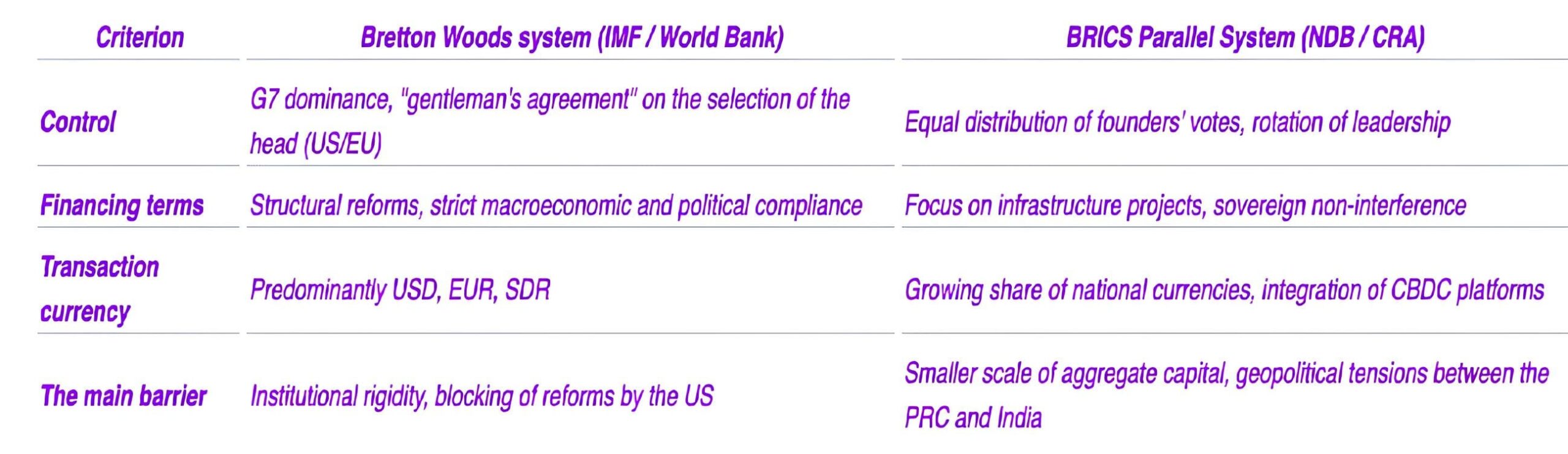
Consequently, rather than engaging in an open, head-on confrontation with the IMF or attempting to dismantle it, BRICS is employing a strategy of “redundant duplication.” Western nations will retain control over the Bretton Woods institutions, yet their global legitimacy and market share in developing regions will steadily decline.
Q4 – The NDB faces a fundamental institutional paradox: it must finance development projects across emerging economies while maintaining an exceptional credit rating within Western-dominated international capital markets. Does this dual institutional mandate inherently restrict the NDB’s capacity to serve as a genuine, unconstrained alternative to Western multilateral lenders?
A4 – You have touched upon what is arguably the primary systemic vulnerability in the New Development Bank’s (NDB) operating model. This paradox effectively ties the bank’s hands, preventing it from becoming a fully independent “anti-Western” player.
To maintain its top-tier credit rating and issue low-cost loans for infrastructure projects (the NDB currently holds an AA+ rating from Fitch and S&P), the bank is compelled to play by Western rules. The most striking manifestation of this paradox occurred between 2022 and 2023. To shield its credit rating from the risk of “toxicity” and a potential downgrade to default status, the NDB was forced to freeze funding for new projects in Russia—one of the bank’s five founding members, holding a capital share of approximately 20%.
Although the NDB advocates for de-dollarization, its balance sheet remains deeply tied to the US currency; the bank primarily issues loans in USD and EUR—which account for about 70% of its debt obligations—due to the high volatility of national currencies. To meet the criteria set by rating agencies, the NDB is required to employ credit scoring models that make it impossible to finance projects in certain developing nations, such as various countries across Africa and Latin America.
The NDB is well aware of this limitation and is systematically developing a counter-strategy that is set to ramp up by 2026. This includes issuing loans within China and floating bonds denominated in South African rand (on the Johannesburg exchange) and Indian rupees. The goal is to raise the share of financing in national currencies to at least 30–50% by the end of the decade. Meanwhile, BRICS is working toward the mutual recognition of assessments by national rating agencies (such as China’s Dagong or Russia’s ACRA). However, for the time being, these agencies do not command global authority among major capital holders.
Q5 – The bloc issued a robust critique against unilateral protectionism and non-tariff barriers, particularly those framed as environmental initiatives—such as carbon border adjustment mechanisms. Structurally, how can emerging economies insulate their industrial exports from these regulatory measures without precipitating systemic trade disputes with major Western consumer markets?
A5 – Criticism of mechanisms like the EU’s Carbon Border Adjustment Mechanism (CBAM) at the BRICS summit highlights a fundamental divide: developing nations view Western environmental levies as a form of covert neocolonial protectionism that strips them of their natural competitive advantage—cheap energy.
From the standpoint of trade policy and market structure, developing economies cannot simply ignore these barriers, as the loss of lucrative EU and US markets would deal a severe blow to their industrial sectors. To safeguard their exports and avoid exhausting, often deadlocked WTO disputes, BRICS+ nations need to employ a comprehensive set of structural countermeasures.
The architecture of the European CBAM itself contains a legal loophole: if an exporter has already paid a carbon levy domestically, that amount is deducted from the tax due at the EU border. For instance, by establishing national emissions trading systems (ETS), developing countries can retain tax revenues domestically rather than remitting them to the EU budget—a path China has taken, and one India is also pursuing through the active implementation of its own Carbon Credit Trading Scheme.
This same approach can be applied to ESG frameworks through the creation of local sovereign auditing bodies. Western regulatory barriers rely on the monopoly held by the “Big Four” audit firms and Western standardization bodies, which assess carbon footprints using their own—often opaque—methodologies. By anchoring BRICS standards within blockchain platforms, these nations would make it legally difficult for Western importers to reject the resulting certifications in court.
One of the most effective ways to fundamentally reduce vulnerability to EU and US regulations is to lower the share of these regions in the export mix; reorienting trade flows toward developing nations—where strict environmental restrictions are absent—would allow industrial conglomerates to maintain capacity utilization without undergoing the costly and forced decarbonization imposed by the West.
Q6 – The diplomatic and economic rapprochement between India and China served as a critical catalyst during this summit. From a macroeconomic standpoint, will enhance economic synchronization between the bloc’s two largest economies accelerate the formation of autonomous, closed-loop supply chains within the Global South, or do structural trade imbalances between the two nations remain a prohibitive barrier?
A6 – From a macroeconomic perspective, the diplomatic thaw between New Delhi and Beijing at the BRICS summit is unlikely to rapidly create fully autonomous, self-contained supply chains within the Global South. Despite strong political momentum toward de-dollarization and de-risking, deep structural imbalances and geoeconomic rivalry between India and China remain fundamental barriers to genuine economic synchronization.
Rather than forming a closed loop, the Global South’s macro-structure will likely evolve through a scenario of hybrid fragmentation, with India continuing to balance between Chinese raw materials and Western consumer markets. This trajectory is shaped by several key obstacles.
Economic synchronization is constrained by the fact that India and China pursue fundamentally different long-term goals within BRICS+: Beijing seeks to transform the bloc into an institutional counterweight to the G7 by anchoring the Global South’s supply chains to its own financial (CIPS, digital yuan) and logistical (Belt and Road Initiative) infrastructure, whereas New Delhi positions itself as a “bridge” between the Global South and the developed West, categorically refusing to participate in the formation of anti-Western blocs.
Q7 – Microeconomic initiatives, such as the BRICS Startup Innovation Fund and Digital Public Infrastructure (DPI) sharing portals, aim to foster high-tech integration among small and medium-sized enterprises (SMEs). Are these frameworks capable of generating sustainable high-value knowledge transfers, or does the bloc remain structurally constrained by its historical reliance on asymmetric energy and commodity flows?
A7 – The initiatives put forward at the New Delhi Summit—such as the BRICS Startup Innovation Fund, the creation of an incubator network, and the deployment of a Digital Public Infrastructure (DPI) repository—represent an attempt to shift the bloc from a “commodities alliance” model toward a framework of high-tech cooperation.
However, from a macro-structural perspective, the ability of these mechanisms to trigger sustainable, high-value knowledge exchange is structurally constrained by the stark gap between digital ambitions and the commodity- and energy-dependent reality of BRICS+.
India’s proposal to export its DPI model (comprising the Aadhaar architecture, the UPI payment system, and the ONDC logistics framework) to meet the needs of small and medium-sized enterprises (SMEs) in the Global South faces certain limitations. DPI technologies are effective only when a country possesses a developed foundational fintech layer and robust connectivity. Yet, a technological chasm separates the digital infrastructures of China, India, and the UAE from those of Ethiopia, Egypt, or Iran. The same applies to intellectual property protection—a prerequisite for the genuine exchange of “high-value knowledge” (such as deep-tech, AI models, and biotechnology).
Nevertheless, these DPI initiatives should not be dismissed. While they will not replace commodities trade, they can optimize it by creating new, niche channels for knowledge exchange. The summit also saw the announcement of a BRICS Digital Agriculture Network. Integrating Indian agritech expertise and Chinese AI capabilities (such as open models like DeepSeek) with major Latin American (Brazilian) and African agribusinesses could facilitate a sustainable transfer of applied technological knowledge, bypassing Western patents.
The primary benefit of DPI for SMEs is not the transfer of processor blueprints, but the reduction of cross-border trade costs. The interoperability of digital platforms and simplified compliance within the official BRICS framework enable small businesses to access partner-country markets directly, bypassing intermediaries from developed Western nations and lowering logistics costs.
Q8 – For the average Russian business or consumer, what is the most immediate, tangible takeaway from the 18th Summit? Will this accelerate domestic economic structural changes, or simply solidify existing wartime/sanction-era trade patterns?
A8 – For the average Russian business and consumer, the most immediate and tangible outcome of the BRICS summit in New Delhi will be the gradual acceleration and legalization of cross-border payments via the BRICS Pay and mBridge systems, alongside an expanded range of available goods and components from Global South partner nations.
However, from a long-term perspective, macro-structural analysis suggests that these outcomes will not trigger revolutionary changes; rather, they will institutionally cement and stabilize the trade model that emerged haphazardly in Russia during the period of harsh sanctions.
For the ordinary Russian citizen or entrepreneur, the summit’s results represent positive tactical news, promising greater predictability, a reduced risk of payment failures, and the maintenance of accustomed consumption levels. Yet, for the national macroeconomy, the summit marked the official recognition and consolidation of a new reality: Russia has definitively locked in its pivot toward the Global South, transforming forced crisis-response measures into a long-term economic strategy.
Q9 . Looking ahead, what constitutes the most critical internal macroeconomic vulnerability within the expanded BRICS framework—whether it be inflationary divergence, political heterogeneity, or asymmetric Chinese economic dominance—that could ultimately impede the operationalization of the summit’s declarations?
A9 – If risks are ranked by the degree of their destructive impact on the long-term macro-structure of BRICS+, China’s asymmetric economic dominance stands out as the bloc’s most critical and fundamental internal vulnerability.
It is precisely this factor—acting in synergy with geopolitical heterogeneity—that creates a systemic imbalance capable of transforming the summits’ declarations of a “multi-vector” approach into a tool for serving Beijing’s narrow national interests.
The economy of the expanded BRICS+ is deeply unbalanced. China’s aggregate GDP exceeds the economic weight of all other members combined, positioning the country as the primary provider of technology and credit. Any de-dollarization initiatives (such as CBDC interoperability via the mBridge platform or BRICS Pay) lead *de facto* to the “yuanization” of settlements [based on 2026 data], sparking legitimate concerns among other economies (such as India and Brazil). From a macroeconomic perspective, the financial systems of BRICS+ nations operate in vastly different phases and spheres, making the creation of unified monetary institutions impossible.
While inflation divergence is an operational challenge that can be mitigated through mBridge algorithms and digital swaps, and political friction can be temporarily smoothed over via diplomatic protocol (as seen at the New Delhi summit), China’s dominance represents an insurmountable tectonic shift.
It is the fear of Beijing’s economic hegemony that drives India to block PRC-led free trade initiatives within BRICS, compels Brazil to shield its industry from the dumping of Chinese electric vehicles, and causes the New Development Bank (NDB) to remain sensitive to Western credit ratings. Without establishing mechanisms for robust institutional balancing within the bloc itself, China’s economic gravitational pull will remain the primary obstacle to the practical realization of a multilateral architecture for the Global South.
However, this new global landscape differs significantly from the previous unipolar system. The era of absolute hegemons is likely becoming a thing of the past. Despite its immense economic gravity, China faces a far more complex and fragmented world: India, Brazil, and the Gulf states have grown and strengthened too much to simply swap one sovereign for another. They will fiercely defend their markets and sovereignty through strategic maneuvering—a balancing act clearly demonstrated by the New Delhi Summit.
The world of the future represents not merely a change of flag atop the global financial system, but a shift toward a complex, multi-vector, and often unstable mosaic-like architecture, in which every major regional player will seek to carve out its own share of sovereignty.
Tatiana Pokrovskaia – International business development expert, St. Petersburg, Russia.
Image Source: Tass/AAP