



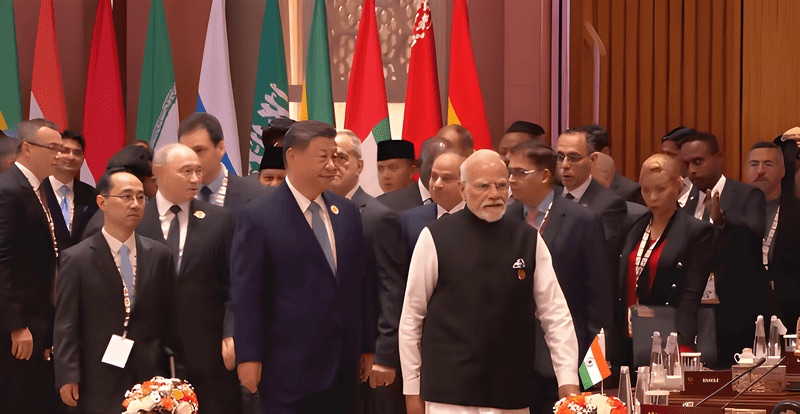
The 18th BRICS Summit, hosted at New Delhi’s Bharat Mandapam from September 12–13, 2026, under Indian presidency, represented a significant diplomatic moment for India and the wider Global South, demonstrating New Delhi’s ability to build consensus amid deep geopolitical divisions.
India’s leadership was particularly evident in bringing together members such as Iran, the UAE and Saudi Arabia, despite their complex regional differences, around a common Joint Statement.
Centered on the theme ‘Building for Resilience, Innovation, Cooperation and Sustainability,’ the summit featured dedicated discussions on strengthening cooperation to promote fair competition within renewable energy markets to support sustainable energy transitions. Furthermore, the resulting declaration strongly focused on condemning terrorism, preventing conflict, resolving disputes peacefully, strengthening multilateralism, and addressing concerns over unilateral trade measures.”
The Summit placed reform of multilateral institutions firmly on the agenda, including a call for a “structural update” of the United Nations Security Council to better reflect contemporary global realities. At the same time, the document rejected “unilateral acts of war” and called for the protection of seafarers and commercial shipping routes amid continuing military tensions in West Asia. Placing a humanity-first and people-centric approach at the heart of its Presidency, India sought to position the Global South not merely as the principal bearer of global crises, but increasingly as a rule-shaper in the evolving international order.
Opening the Summit on 12 September, Prime Minister Narendra Modi described BRICS as having reached a moment of “coming of age”, underscoring India’s vision of a grouping that advances through consensus, cooperation and inclusivity—not opposition to others, but by taking everyone along. As he stated, the task now is to translate BRICS’ internal unity into tangible outcomes on the global stage.
The participation of Russian President Vladimir Putin and Chinese President Xi Jinping gave considerable strategic weight and brought the leaders of three influential powers together on an important multilateral platform. It provided New Delhi with an opportunity to advance its vision of inclusive global governance, strengthen multilateralism and place development, resilience and cooperation at the centre of the international agenda. It helps in shaping a resilient multipolar world order.
The summit took place amid a significant transformation of the global order, characterized by developing countries demanding greater representation in international institutions, a stronger voice in global economic decision-making, and a more equitable distribution of development opportunities. Under India’s chairship, BRICS served as a constructive platform for emerging economies to shape global discourse on governance, finance, technology, energy, food security, and sustainable development. This was encapsulated by India’s central slogan for the summit, ‘United by Aspirations, Driven by Actions,’ a phrase that directly addresses the grouping’s core challenge: translating shared developmental ambitions into practical, measurable cooperation.
For India, the summit has been an opportunity to demonstrate diplomatic leadership, promote strategic autonomy and encourage cooperation without allowing differences among members to undermine the larger objective of strengthening multilateralism.
Inclusive Global Governance and Strengthening Multilateralism
Inclusive global governance and strengthening multilateralism constitute a central pillar of India’s 2026 BRICS Presidency, reflecting New Delhi’s effort to ensure that the institutions shaping the international order better represent contemporary global realities and the aspirations of the Global South. During his address at the 18th BRICS Summit on 12 September 2026, Prime Minister Modi underlined India’s broader approach to multilateralism—inclusive rather than confrontational, representative rather than exclusionary, and focused on solutions rather than blocs.
India’s BRICS leadership, therefore, sought to strengthen the voice and representation of developing countries in global decision-making while preserving dialogue and cooperation across geopolitical divides. In this regard, the Global South was positioned not merely as a passive recipient of global governance, but as an increasingly vital participant in shaping international rules, institutions, and outcomes.
Somewhere, India has given out a strong signal that the multipolar world order is becoming a reality and there is narrowing down on unipolarity or bipolarity hegemonic tendencies.
India’s Balanced Approach
India has resisted any attempt to frame BRICS as an anti-Western grouping. New Delhi supports reform of the international system, but it does not see confrontation with the West as necessary. India’s balancing and good relationship with almost all countries gives New Delhi the capacity to diverge resulting in resilience.
This is consistent with India’s broader foreign-policy strategy. New Delhi seeks to strengthen its partnerships with Russia and China while simultaneously expanding cooperation with the United States, Europe, Japan, Australia and the Gulf countries. BRICS, in this context, is an instrument of strategic autonomy and global engagement rather than an alliance directed against any particular power.
Throughout the summit, India’s focus remained firmly on development, innovative and sustainable financing, connectivity, health, food security, climate resilience, technology, and economic cooperation. By maintaining a broad and constructive agenda, New Delhi ensured that members with diverse political systems, strategic interests, and external partnerships could actively engage on a common platform.
During his opening address, Prime Minister Modi presented a visionary outlook for BRICS over the next two decades, emphasizing the critical need to sustain institutional momentum. He highlighted that BRICS’ continuity and implementation mechanisms would be vital, facilitated by the ‘Troika’ arrangement to ensure systematic follow-up on all initiatives and outcomes. To support this, Modi proposed the creation of a secure digital repository to monitor the nodal points, timeframes, and implementation status of every collective decision.
Economic and Development Agenda
The BRICS Business Forum held on 11 September 2026 focused on deepening business connectivity, innovation and technology cooperation. Prime Minister Narendra Modi highlighted initiatives such as the BRICS Incubator Network, MSME Portal and Startup Innovation Fund, while the Bharat Innovates Exposition showcased Indian startups and emerging technologies, creating opportunities for investment, partnerships and market access.
The Women’s Business Alliance was also emphasised to strengthen women-led enterprises and cross-border business linkages. Discussions on cross-border payments focused on making transactions faster, safer and more efficient, thereby supporting greater intra-BRICS trade and investment. Overall, the Forum sought to build a more integrated BRICS economic ecosystem anchored in innovation, technology, entrepreneurship and inclusive growth. The economic and development agenda has focused on building resilience and advancing practical cooperation among BRICS members.
A common BRICS currency was not adopted, which was unlikely, given the lack of monetary integration and institutional coordination among the members that is required for such an arrangement.
For India, the economic agenda remained paramount throughout the summit, as New Delhi actively sought to align BRICS deliberations with the critical priorities of developing nations. These priorities included access to affordable, innovative, and sustainable financing, technology transfer, energy security, resilient food supply chains, and sustainable infrastructure development. The provisions codified in the final joint declaration directly reflected this effort, underscoring India’s success in embedding Global South interests into the core economic outcomes of the summit.
Assessing the Summit’s Outcomes
Expectations were high for concrete outcomes, including a substantive leaders’ declaration, which was achieved. India demonstrated its diplomatic outreach by convening the expanded BRICS grouping, including Iran and a UAE representative plus the consensus among all on the joint statement.
Furthermore, the participation of Presidents Vladimir Putin and Xi Jinping highlighted the enduring relevance of the Russia–India–China (RIC) framework. By reconciling different political systems and divergent regional interests, New Delhi effectively transformed diversity and initial non-consensus into a tangible opportunity for cooperation across development finance, energy, food security, technology, and global governance.
Ultimately, the summit testifies to India’s successful diplomacy and growing role as a bridge among Global South members as well as between Global South and major powers.
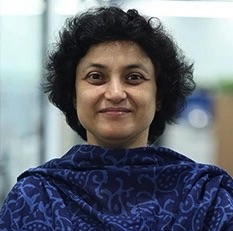
Author: Dr. Indrani Talukdar – Fellow at the Chintan Research Foundation, New Delhi.
(The opinions expressed in this article belong only to the author and do not necessarily reflect the views of World Geostrategic Insights).