



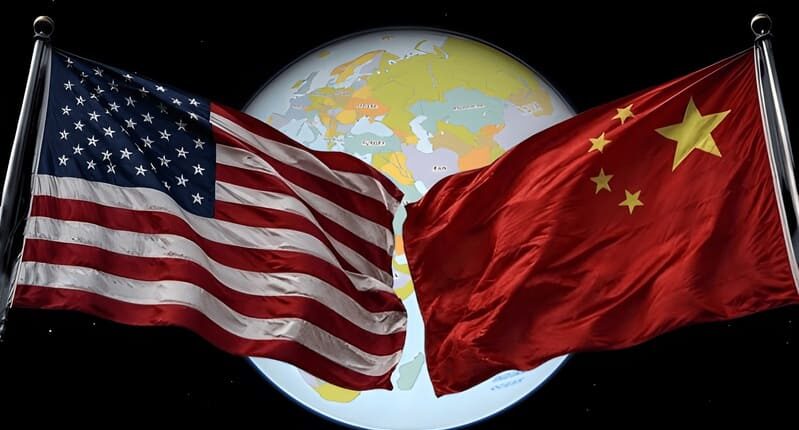
The last eight decades have brought fundamental changes both for the West and for China. Actually, the last 81 years in the case of the former and the last 77 in the case of the latter.
The Last Eight Decades

After two devastating world wars, and a fractured historical past, something extraordinary took place in the West. The United States and Western Europe built a system of political, economic, and military cooperation without precedent in the chaotic Western history. Bretton Woods, the Marshall Plan, NATO, European integration, and a sophisticated multilateral system, all contributed in creating a cohesive Western community centered around a group of shared values labelled as the International Liberal Order.
The post-1945 order not only established the American primacy over a fundamental part of the international system, but also succeeded in transforming the traditional internal rivalry of the West into a period of extraordinary political and strategic convergence. These last eight decades have been the longest period of continuous peace within the Western Civilization since its emergence. Moreover, parts of the Indo Pacific were incorporated into that system and its network of alliances, enjoying after 1953 the same peace dividend and strategic stability.
These years have also been epochal for China. In 1949 the country reversed the so called “century of humiliation”, which began with the end of the first of the opium wars against Great Britain in 1842. Mao Zedong achieved the country’s political reunification, Deng Xiaoping initiated its economic opening and transformation, and Xi Jinping has placed the strengthening of the state and the recovery of its past glory at the forefront of his political project. Indeed, China stood up under Mao, became wealthy under Deng, and became strong under Xi.
The World Turned Upside Down
These last few years, however, have turned things upside down. The post-1945 Western convergence period is experiencing profound upheavals that call its survival into question. These include: Political polarization in the United States and Europe; the erosion of U.S. liberal hegemony; the expansion of populism; the resurgence of nationalism; European fragmentation; huge transatlantic disagreements; U.S.-Canada feud, the deterioration of alliances; and the growing difficulty of maintaining a Western consensus on the organization of the international system. The International Liberal Order is in shambles. Indeed, the West seems to be returning to the kind of cracks that defined its past history.
Conversely, for Xi Jinping being strong it’s no longer enough for China. His aspirations are to return the country to the top of the international system. China, as perceived by him, is in the crest of a historical wave – the point in time when a major power pushover is attainable. In several of his foreign policy addresses since 2017, Xi has been insisting that the world is in the midst of “great changes unseen in a century”. This implies that thanks to unprecedented geopolitical and historical shifts, the world order, and not just simply the regional one, can be redefined in Chinese terms.
Xi’s “dream of national rejuvenation” is embedded within the context of civilizational continuity, historical memory, nationalism, the strengthening of the state, and the full recovery of the Confucian tradition. This translates into a full civilizational contest for supremacy with the West.
Strengths and Vulnerabilities
As China and the West are now involved in such a struggle, both need to assess their respective strengths and vulnerabilities. Which are they? Traditionally the main sources of Western power have been science and technological innovation; financial markets; the paramount position of the American dollar; military power; its system of alliances; its cultural influence; and its universities. Meanwhile, its vulnerabilities at the present time are political polarization; the loss of strategic consensus; fragmentation; weakening institutional trust; and the erosion of alliances.
China, on its turn, possesses extraordinary advantages. Among them the following ones: economic scale; industrial might; technological development; political continuity; state capacity; long-term strategic vision; civilizational cohesion; and substantial asymmetric military capabilities. But it also currently faces big vulnerabilities. Among others: demographic aging; indebtedness; political rigidity; dependence on external markets; and the many loose ends arising from the accelerated expansion of its strategic ambitions.
Who would be best placed at this point in time to win this contest? Within it, the West certainly find itself in a very difficult situation. The accelerated erosion of the Liberal International Order and the apparent return to the kind of fracture that has been the West’s historical hallmark, place it at an important disadvantage.
From the resurgence of Germany’s nationalist far right, susceptible of triggering European fragmentation and the dissolution of the European Union, to the growing disintegration of liberal convictions; from the utter decline of America’s leadership to its transformation into a source of threat and upheaval for its traditional allies; there are multiple factors of division and rivalry within the West. This, needless to say, seriously affects as well the network of alliances in the Indo Pacific region.
A Poorly Prepared West? An Overextended China?
Under such conditions, the West and its allies look poorly prepared to face its greatest strategic challenge since 1945. A challenge far more substantial than anything the Soviet Union ever represented, as in this case it encompasses economic scale; industrial might; state capacity; technological development; and civilizational cohesion.
Moreover, although China does not possess nuclear parity with the United States, it far surpasses it in the quantity and quality of its asymmetric weaponry. Precisely the kind of armament that forms the basis of modern warfare. Moreover, China controls the theatre of operations in its surrounding geographical areas, which would be the natural setting for a potential military confrontation.
From the opposite perspective, the main question to be asked is whether China did raise the stakes too high in its quest for global supremacy? This, given the magnitude of its vulnerabilities. Indeed, as mentioned before, these include demographic aging; indebtedness; political rigidity; and dependence on external markets. Moreover, modern China has a limited and not particularly successful experience in warfare. Meaning, it is fundamentally an untested warrior.
The problem arising from China’s overreaching of its strategic ambitions, under the conditions described above, could be failure. Indeed, China could be confronted by a network of alliances capable of overwhelming its capacities. If the strategic contest now underway were taking place against a cohesive West, in control of a fully functional system of alliances, China’s chances of succeeding in its ambitions would be seriously tested.
Fortunately for China, that is not the case. China’s greatest strength is its unity, while the West’s greatest weakness is the lack of it. Given the balance of strengths and vulnerabilities outlined above, the scales appear to be tipping in China’s favor. Specially so, as the West’s traditional strengths have somewhat diminished but its current vulnerabilities have skyrocketed.
That being the case, Xi Jinping’s bet may well succeed. We might be witnessing, indeed, the end of the period of Western centrality that prevailed during the last few centuries, and the return of China to the position of pre-eminence that it occupied during most of human history.
Author: Alfredo Toro Hardy, PhD – Retired Venezuelan career diplomat, scholar and author. Former Ambassador to the U.S., U.K., Spain, Brazil, Ireland, Chile and Singapore. Author or co-author of thirty-six books on international affairs. Former Fulbright Scholar and Visiting Professor at Princeton University. He is currently an Honorary Fellow of the Geneva School of Diplomacy and International Relations and a member of the Review Panel of the Rockefeller Foundation Bellagio Center.
(The opinions expressed in this article belong only to the author and do not necessarily reflect the views of World Geostrategic Insights).