



When President Donald Trump’s Air Force One touched down in Beijing this week, the shadow of West Asia hung heavily over the tarmac. Nine years after his first grand state visit, Trump returns to China that holds the literal keys to American foreign policy success. With the war in Iran choking global energy supplies and the Strait of Hormuz under siege, this is no longer a standard trade summit.

President Trump needs to squeeze Tehran while Chairman Xi needs the American leader to ease the economic vice. In the Great Hall of the People in Beijing, the two most powerful men on earth are rewriting the rules of international security. Not out of mutual friendship, but out of shared dread of a global economic collapse and a rapid fall of the liberal world order.
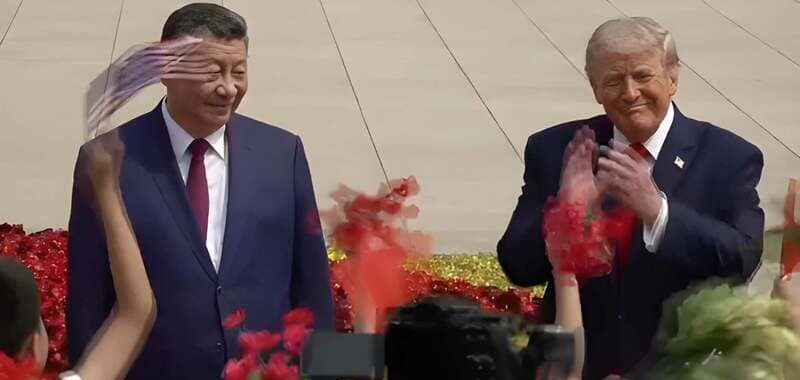
Lined up along the red carpet, schoolchildren energetically jumped, cheered, and chanted “Welcome!” to greet the two leaders as they vigorously waved miniature American and Chinese flags alongside colorful flowers. The warm display was part of a larger, high choreographed, defense-style spectacle that included a 21-gun salute, an honor guard demonstration, and national anthems displayed by a military brass band.
Overall, the grand gesture highlights Beijing’s tactical choice to deploy massive and curated hospitality, appealing directly to Trump’s fondness for personal recognition to set a cooperative tone before tough closed-door negotiations plausibly on the Iran war, agricultural products, energy, plastic, rare earth, tariffs, and AI.
Temple of Heaven, Theater of Power
The historic meeting at the temple of heaven, south of the forbidden city, projects China’s historical endurance and civilizational depth. President Xi positions himself as a long-term steward of global order unlike his American counterpart’s short-lived mandate. While Chinese emperors prayed for good harvests or qinian dian, the modern harvest both world leaders seek is transactional.
Trump wants a physical harvest to persuade China to restart massive purchases of American products while Xi desires a geopolitical harvest by securing an end to U.S. tariffs and extracting concessions on Taiwan. But the prominent altar of heaven and earth was rebuilt in the late 1800s using imported redwood from the United States.
The palace diplomacy is a strategic parlance of lavish historical ceremony to soften Trump’s aggressive stance at the negotiating table. The American leader is notoriously responsive to hyper-exclusive flattery. In 2017, Xi closed the forbidden city for his powerful western counterpart to create an illusion of ultimate respect.
Billionaire Delegation: Why Big Tech Accompanied Trump to China?
President Donald Trump’s billionaire delegation suggests a raw show of force and a deliberate reminder to Beijing that Washington remains the global economic power. Yet, the true gravity of the state visit was not delivered by political rhetoric, but by the billion-dollar entourage crowding the Chinese president’s office. By flanking the American leader with a unified front of Silicon Valley’s ultimate technocrats, the historic trade war transcended traditional diplomacy. It was an aggressive display of American geoeconomic statecraft, signaling that the instruments of power can be weaponized.
His May 2026 state visit to China has certainly yielded critical economic gains for the United States with key breakthroughs for the renewal of Chinese export licenses for hundreds of U.S. beef processing plants and the pursuit of regulatory clearances for advanced American technology. Success indicators paved the way for the establishment of a bilateral economic arbitration board to resolve ongoing tariff disputes and collaborating on global supply chain relief to leverage joint economic influence to reopen the critical Strait of Ormuz.
Why Trump 2.0 Faces a Much Confident China
President Xi Jinping has forcefully pushed back against the narrative of an inevitable Cold War, telling Trump that the two superpowers must strive to be partners but not adversaries. During the official state banquet toast, the Chinese chairman directly linked their respective political platforms, declaring that the ‘great rejuvenation of the Chinese nation and making America great again can go hand in hand.’
But amid the trade concessions and diplomatic photographs, President Xi Jinping quietly but firmly laid down Beijing’s thinnest and non-negotiable red line: absolute non-interference in the Taiwan issue. He used the joyful occasion to remind Washington that some boundaries cannot be bought, bartered, or softened by market access. If mishandled, the celebrated U.S.-China relations would lead to ‘extremely dangerous situation,’ exposing the fragility of the historic trade guardrails.
By shifting the geopolitical narrative from purely symbolic government mandates to concrete boardroom milestones, Silicon Valley’s elite corporate titans—spanning aggressive institutional investors to high-growth tech disruptors—have successfully stabilized volatile global supply chains. In doing so, these executives secured the critical market parameters necessary to preserve American competitive dominance.
Crucially, the summit does not undermine the formidable economic milestones of China, whose near-peer status has forced an undeniable realization in Washington that the United States must constructively engage with, rather than isolate, the Chinese economy. By commanding the world’s dominant electric vehicle market, a massive manufacturing engine, and an increasingly sophisticated domestic tech ecosystem, China’s industrial parity has achieved equal respect.
The fragile truce has just begun. The two powerful leaders possess the centralized economic and diplomatic leverage to effectively halt global spillovers when their core national interests align. The world felt a bit relieved as the groundbreaking convalescence serves as a definitive study of today’s ambiguous world politics.
Author: Dr. Chester Cabalza – Founding President of the Manila-based think tank International Development and Security Cooperation (IDSC).
(The views expressed in this article belong to the author and do not necessarily reflect the views of World Geostrategic Insights).