



By Farzin Zandi
“Operation Freedom”, paused after just one day, was Donald Trump’s latest gambit to force Iran into reopening access through the Strait of Hormuz before his trip to China, allowing him to gain diplomatic leverage.

It was a move designed to put the ball in Iran’s court, effectively shifting the risk of response—namely the violation of the ceasefire and the potential resumption of war—onto Tehran. However, in the very first minutes following the U.S. announcement of the operation, Iran initiated a form of preemptive actions. A step it had so far refrained from taking, but which this time caught Washington off guard.
Iran first issued warnings to vessels stationed in Ras Al Khaimah, United Arab Emirates, instructing them to leave the area toward Dubai, and then officially published a new map of the authorized shipping lanes through the Strait of Hormuz. In doing so, it explicitly placed both sides of the Strait of Hormuz—and specifically the UAE coastline—under a form of navigation restriction. Minutes later, reports emerged of an oil tanker explosion off the eastern coast of the United Arab Emirates, in the port of Fujairah, located at the entrance to the Sea of Oman and widely considered a bypass route for the Strait of Hormuz. Iran demonstrated that it was acting on its threats. This can be interpreted as an escalation in the closure of the Strait of Hormuz, centered on a maritime blockade of the United Arab Emirates.
Following this, the Fujairah authorities in the emirate confirmed a major fire in the Fujairah oil industrial zone, apparently caused by a drone strike originating from Iran. On the western side of the UAE in the Persian Gulf, a missile attack on the port of Jebel Ali and an assault on a vessel belonging to the Abu Dhabi National Oil Company while transiting the Strait of Hormuz further escalated the situation and made Iran’s insistence on keeping the Strait closed even more explicit.
These developments came at a time when U.S. forces in the region did not respond proportionately to Iran’s attacks, stating that they had only struck several IRGC fast boats. At the same time, Naftali Bennett, in a call with Emirati officials, referred to the UAE for the first time as Israel’s strategic ally. Meanwhile, Trump, reacting to the events in the Persian Gulf, limited his response to a post on his Truth Social, merely referring to an incident involving a South Korean vessel and calling on that country to join the operation, without mentioning the UAE at all.
This set of reactions could be interpreted as indicating an Israeli inclination toward initiating military escalation, alongside a U.S. reluctance to do so. Taken together, these developments show that so far the military operation has not only failed to achieve U.S. objectives, but the situation in the Strait of Hormuz has become significantly more complex. In particular, Iran’s imposition of a maritime blockade on the UAE has pushed the crisis into a more severe phase.
Under normal conditions, the UAE exported around 1.7 million barrels of oil per day to global markets via the port of Fujairah while bypassing the Strait of Hormuz. With Iran’s blockade in place, this flow has likely come to a halt as well.
Return to Sub-Threshold Warfare
Just one week after the announcement of a ceasefire between Iran and the United States brokered by Pakistan, the U.S. Treasury Secretary spoke of the launch of an “Economic Fury Operation” against Iran. What Scott Bessent announced was, in effect, a process that—by his own admission—had long been underway under the framework of “maximum pressure.” In the early days of the war, he acknowledged that Washington had been engineering a dollar shortage in order to drive down the value of the Iranian currency and generate economic strain aimed at fueling unrest and protests inside Iran.
This dynamic directly contributed to the ignition of economic protests in Iran and, subsequently, the large-scale killing of demonstrators in January. This point, combined with revelations of extensive Mossad operatives’ presence and orchestration of the January protests, clearly indicates the implementation of a plan that some gray zone—conflict between peace and war that deliberately avoids crossing the threshold into open warfare—specialists had previously described as the appropriate response to Iran’s own sub-threshold warfare: using Gray Zone against Gray Zone.
In essence, the United States, through sub-threshold measures, created conditions conducive to what it ultimately sought as a decisive blow against Iran—namely, the large-scale assassination of political and military officials or, in other words, “preparing the operational environment” for regime collapse.
However, Iran’s resilience in the face of military strikes and political assassinations—through rapid replacement of officials and preservation of institutional structures—pushed the United States and Israel into a different phase. In the final days leading up to the ceasefire, attacks on key Iranian industrial infrastructure such as steel plants, petrochemical facilities, rail networks, and others were placed on the agenda. These strikes inflicted extensive damage on Iran’s industrial economy and appeared to pursue longer-term objectives.
Iran, which during years of severe sanctions had managed to meet a significant share of domestic demand by relying on these internal industries, now faced a deep and serious crisis. According to U.S. officials’ statements, these actions were aimed at paralyzing production, expanding unemployment, increasing economic dissatisfaction, and ultimately triggering large-scale rebellion against the Islamic Republic.
Scott Bessent, the U.S. Treasury Secretary—who has been playing a role almost commensurate with that of Secretary of War Pete Hegseth in intensifying the “maximum pressure” campaign against Iran—has announced an aggressive strategy aimed at “cutting off the financial lifelines” of the Islamic Republic. He described this approach as the “financial equivalent of a bombing campaign.” According to him, the strategy is designed to destroy Iran’s economic infrastructure, targeting everything from shadow banking networks and cryptocurrency access to the clandestine tanker fleet, commercial intermediaries, and even independent Chinese refineries known as “teapots.”
He also reported the seizure of nearly half a billion dollars in Iranian digital assets, consideration of freezing foreign accounts linked to pension funds, and threats to sanction companies cooperating with Iranian airlines. Bessent further emphasized that restrictions on maritime trade directly strike at Tehran’s primary sources of revenue. He claimed these measures have already contributed to rising inflation and a rapid depreciation of Iran’s national currency, warning that if the trend continues, even crises such as fuel shortages cannot be ruled out.
If these claims are situated within the analytical framework of gray zone warfare, the core logic of such a campaign is that even without a continuation of open war, the manipulation of financial networks and market expectations can activate a cascading crisis within Iran’s economy.
In a financial-economic gray zone campaign, what U.S. officials describe as “cutting financial lifelines”, coercion operates through the activation of transnational financial networks rather than direct state enforcement. The United States primarily generates signaling effects—such as sanctions threats, asset freezes, and secondary restrictions—while compliance is effectively delegated to decentralized actors including banks, shipping firms, insurance companies, cryptocurrency platforms, and risk-sensitive market participants. This produces a systemic “chilling effect,” in which economic actors preemptively reduce exposure to Iran even before formal restrictions are fully enforced, thereby amplifying financial isolation and accelerating domestic economic stress.
The immediate outcome of this networked pressure is a sharp contraction in foreign currency inflows combined with rising precautionary demand for the U.S. dollar. This creates persistent liquidity pressure and accelerates depreciation of the Iranian rial. Currency devaluation feeds directly into inflation through higher import costs and supply-side constraints, while the Central Bank responds with tighter monetary controls and higher interest rates, deepening recessionary dynamics.
Collectively, these mechanisms generate a self-reinforcing macroeconomic adjustment process characterized by stagflation, where inflation, currency collapse, and output contraction reinforce one another rather than stabilizing. This process is often described as the transformation of “external financial pressure” into “internal instability”: a campaign conducted without bullets, but through financial leverage and market expectations, capable of pushing an economy to the point where social dissatisfaction becomes a decisive political variable.
Iran’s experience between 2018 and 2026 shows that currency and inflation shocks have consistently coincided with spikes in social unrest. For instance, the fuel price hike in 2019 and dollar shortage in 2026—partly driven by fiscal pressure on the state—triggered widespread protests across dozens of cities. In the Iranian case, however, this situation has been compounded by targeted strikes on industrial infrastructure during wartime, amplifying its impact and likely accelerating the materialization of public grievances.
This broad-based economic pressure, combined with Donald Trump’s repeated acknowledgments of providing military support to certain separatist groups—and his expressed dissatisfaction that such weapons were not fully delivered into Iran—has been interpreted not only as an indication of a willingness to intensify domestic unrest, but in some analyses as an attempt to increase instability through the empowerment of non-state armed actors inside the country and along its border regions, particularly in the Kurdish-populated areas of western Iran.
At the same time, references to extensive U.S.–Israeli strikes on police, intelligence, and security facilities in major cities and border regions in the early days of the war are framed within this context as evidence of a simultaneous expansion of insecurity in both urban centers and peripheral zones. Under such conditions, the combination of external economic pressure and internal security threats may create a complex environment in which managing urban unrest coincides with parallel challenges in border regions.
This potential overlap between economic crisis, social protest, and security conflict can be understood as a factor increasing the risk of large-scale instability or weakening the central government’s capacity for control in certain extreme scenarios. In its most severe form, this dynamic is sometimes discussed in terms of civil war trajectories and the possible fragmentation of state authority into a de facto field-state condition.
Gray Gulf
Overall, the recent spillover of tensions into the Persian Gulf suggests that both principal actors currently prefer to sustain hostility within a Gray Zone framework rather than escalate into open warfare. Iran has officially stated that it played no role in the attacks carried out against Emirati positions, while the US has likewise declared that Monday’s developments do not constitute a violation of the ceasefire by Iran. At the same time, Rubio officially announced that “Operation Epic Fury” was over.
From another perspective, it can be argued that the US is attempting to avoid direct military engagement while gradually pushing toward Iran’s red lines, effectively dulling Tehran’s sensitivity to those thresholds. At the same time, it is seeking to compel Iran to cross those very red lines first—to move beyond the Gray Zone threshold—so that the costs of any potential renewed war can be attributed to Iran.
Nevertheless, what can be inferred from current developments is that, despite Iran’s stronger preference for ending the war, the Trump administration does not demonstrate a clear or firm commitment to reaching a durable agreement. Trump’s repeated emphasis on wanting “everything” and demanding Iran’s “complete surrender” does not reflect diplomatic language oriented toward a mutually respected deal. At the same time, this posture aligns with Israeli interests.
Accordingly, the United States is likely to maintain the current “neither war nor peace” condition until a point of economic and social collapse is reached in Iran. However, it remains unclear how Washington will manage the significant economic costs that a prolonged closure of the Strait of Hormuz would impose on the regional and global economy—particularly East Asia.
All of this is in addition to Iran’s new maritime blockade against the UAE, which is expected to further intensify tensions in the Persian Gulf and, by extension, deepen the scope of U.S. involvement, pushing the situation into a more volatile phase.
A war that, according to U.S. Secretary of State Marco Rubio, the US was aware of an impending Israeli strike on Iran prior to its escalation, and which influenced the timing of U.S. preemptive actions, has now expanded into the Persian Gulf. This complexity may ultimately be resolved not by the United States itself, but by Israel, which acted as the primary driver and catalyst of the conflict, as well as by Arab monarchies, which have already paid the highest cost of the escalation in the Persian Gulf, and their lobbying networks in Washington. While Trump may have hoped for a favorable deal in Beijing, it is unlikely to make much difference. China does not seem willing to act in favor of the United States, and the situation in which the US is currently stuck may instead allow China to extract greater advantage.
Author: Farzin Zandi – Geopolitical analyst, PhD student, and research assistant in political science at the University of Kansas, specializing in Middle Eastern politics and Iran’s gray zone strategies.
(The views expressed in this article belong only to the author and do not necessarily reflect the editorial policy or views of World Geostrategic Insights).
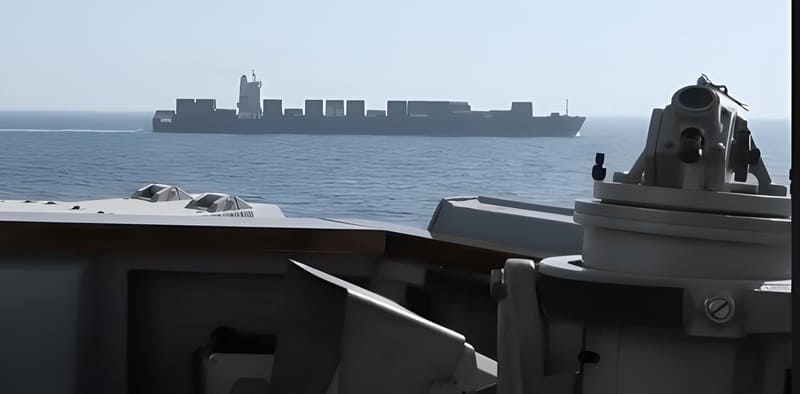
Image Source: CENTCOM, the U.S. Central Command (The United States struck and seized the Touska, an Iranian merchant ship that attempted to breach the U.S. naval blockade in the Strait of Hormuz, on April 19, 2026.