




World Geostrategic Insights interview with Netanel Balmas on how hybrid threats have evolved by exploiting systemic vulnerabilities, particularly in critical sectors, the convergence of AI-enabled hybrid operations and communally orchestrated agentic platforms, and on how companies must adopt a proactive approach to intelligence and robust strategies—including through dual-use platforms—to strengthen their resilience in the face of emerging risks.

Dr. Netanel Balmas is an intelligence and defense technology expert who serves as the CEO and Founder of Strategic Mind Inc, operating across Israel, with planned activity in the U.S., Europe, and the UAE. He holds a Ph.D. in Terrorism and Counter-Terrorism from the University of Vechta. Dr. Balmas has over a decade of operational experience, including as a Foreign and Government Relations Liaison Officer for homeland security defense firms. Under his leadership, Strategic Mind Inc. developed CASANDRA, an AI-driven dual-use platform designed as a global defensive cybersecurity solution.
Q1 – Dr. Balmas, how has the definition of “hybrid threat” evolved in recent years, and what are the most critical vulnerabilities that modern nation-states currently face?
A1 – The definition of “hybrid threat” has undergone a fundamental transformation. What was once understood as a blended instrument — cyberattacks layered with propaganda and proxy actors — is now a precision-engineered, multi-domain campaign architecture. Modern adversaries do not simply combine tools; they synchronize them across cognitive, technical, infrastructural, and geopolitical seams simultaneously.
From a geo-strategic standpoint, the critical evolution is the shift from tool-mixing to system-exploitation. Adversaries now deliberately target the relationships between systems rather than the systems themselves — exploiting the friction between civilian and military infrastructure, between public and private responsibility, between ground-truth data and perception.
The most critical structural vulnerabilities confronting modern nation-states and their strategic corporate partners are no longer perimeter-defined. They are relational and cognitive:
- Cognitive vulnerability — adversarial shaping of public trust, institutional legitimacy, and decision-maker perception under conditions of information saturation.
- Critical infrastructure dependency — digitally interdependent energy, water, logistics, telecom, finance, ports, healthcare, and emergency systems create cascading exposure.
- Data integrity risk — in crisis conditions, the operational question is not whether data was exfiltrated, but whether decision-makers can trust the data they act on.
- Attribution latency — hostile actors deliberately exploit the temporal gap between detection, confident attribution, and authorized response.
- Fragmented intelligence architectures — governments and enterprises often hold complementary fragments of the same threat picture, lacking a shared operational fusion layer.
Q2 – Which civilian sectors are most vulnerable to disinformation and asymmetric threats?
A2 – The civilian sectors at highest strategic risk share three structural characteristics: they depend on real-time data integrity for operational decisions; they are acutely sensitive to behavioral contagion through public-facing narratives; and they carry symbolic or systemic value that adversaries exploit for disproportionate strategic effect.

- Energy and utilities — limited technical disruption is amplified when synchronized with false sabotage narratives and manipulated sensor imagery, inducing public panic disproportionate to the technical event.
- Healthcare — hospitals operate under continuous pressure with hard dependencies on data integrity; panic-inducing disinformation during a healthcare incident causes behavioral harm independent of any technical breach.
- Financial services — disinformation targeting perceived liquidity, bank solvency, or payment-system integrity generates real economic effects without requiring a primary technical compromise.
- Transportation and logistics — ports, aviation, rail, and supply chains — are structurally susceptible to rapid, cascading disruption; small, coordinated interference produces outsized systemic damage.
- Media, elections, and civic infrastructure — the strategic goal is not opinion change but erosion of confidence in institutional legitimacy and democratic process integrity.
- Strategic corporations — large enterprises with supply-chain roles, sensitive data holdings, geopolitical footprint, or symbolic value are increasingly treated as primary hybrid operation targets.
Q3 – Strategic Mind Inc bridges the gap between national defense and corporate resilience through dual-use platforms (Technologies originally designed for national defense and the protection of critical infrastructure, but which can also be successfully applied to enhance business resilience). What is the most difficult operational challenge when adapting military-grade intelligence systems to the private sector?
A3 – The most significant operational challenge in deploying military-grade intelligence architecture within a corporate environment is not the underlying technology. It is the translation problem: converting classified, analyst-centric intelligence logic into a legally defensible, explainable, and business-integrated decision-support model.
Military and national-security intelligence systems are architected around mission priorities, classified-source protection, adversarial attribution, and command authority structures. Corporate environments impose a fundamentally different operating logic: explainability for legal and regulatory defensibility, privacy compliance, seamless integration with SOC, GRC, and C-suite workflow, and continuous business continuity requirements.
The Audit Proclamation: Why Traceability Is a Strategic Asset
In a corporate intelligence environment, auditability is not merely a compliance requirement — it is a foundational operational and legal asset. Every intelligence recommendation that reaches an executive decision-maker, a board, a regulator, or a legal proceeding must carry a verifiable chain of custody: which signals were ingested, which analytical logic was applied, at what confidence level, and at what moment in time.
The audit proclamation principle holds that an intelligence platform which cannot explain its own reasoning is not operationally trustworthy at the enterprise level. When an organization acts on an intelligence recommendation — isolating a network segment, triggering a business continuity protocol, escalating to law enforcement, or communicating to investors — the integrity of that decision depends entirely on whether the underlying assessment can be audited, challenged, and defended.
- Full chain-of-custody logging — every signal, enrichment step, assessment, and recommendation is timestamped and attributed to source and analytical method.
- Confidence score transparency — decision-makers see not only the conclusion but the evidentiary basis and confidence calibration that produced it.
- Regulatory and legal defensibility — audit trails support incident post-mortems, regulatory reporting, law enforcement coordination, and litigation readiness.
- Bias and error accountability — documented analytical methodology enables systematic review of false positives, false negatives, and model drift over time.
- Board and executive reporting integrity — when intelligence informs material decisions, audit-grade documentation protects the organization and its leadership.
Countering Deepfakes: The New Frontier of Cybersecurity and Intelligence Integrity
Deepfake technology represents one of the most consequential threats to intelligence integrity, corporate security, and geopolitical stability in the current era. Synthetic media — AI-generated audio, video, and imagery indistinguishable from authentic content — has migrated from a theoretical concern to an active operational weapon deployed in corporate fraud, political influence operations, executive impersonation, and crisis fabrication.
In the global context, nation-state adversaries and sophisticated non-state actors are increasingly using synthetic media to fabricate executive communications, manufacture crisis events, discredit legitimate intelligence, and shape the decision-making environment of corporate leaders, government officials, and the public in real time.
– Executive impersonation and corporate fraud — synthetic voice and video clones of C-suite executives are used to authorize fraudulent transfers, manipulate partner negotiations, and create false internal communications that bypass organizational trust hierarchies.
- Countermeasure: biometric baseline profiling of senior executives combined with real-time anomaly detection on audio-visual communications entering decision-critical workflows.
– Intelligence pipeline contamination — adversaries inject synthetic media into OSINT collection streams and news aggregation layers to corrupt analytical inputs before enrichment.
- Countermeasure: source-level authenticity scoring using multi-modal forensic analysis — compression artefact detection, temporal inconsistency mapping, and provenance chain verification — before any media enters the enrichment layer.
– Geopolitical and crisis fabrication — state-sponsored deepfake operations target political leaders, military communications, and civic infrastructure narratives to manufacture crises, destabilize alliances, and manipulate public and elite perception at scale.
- Countermeasure: geo-strategic synthetic media monitoring integrated with geopolitical tension indices — alerting when fabricated content aligns with known adversary interests, timing patterns, or active influence operation signatures.
– Decompose intelligence into signals, indicators, assessments, and confidence levels — with synthetic media flags embedded at every ingestion stage.
– Map threat intelligence to business-critical assets and process dependencies, not solely to technical IOCs.
– Integrate natively with SIEM, SOAR, EDR, GRC, ticketing, risk management, and executive decision dashboards.
– Preserve full audit traceability: every recommendation linked to source evidence, confidence score, and analytical method.
– Maintain legal defensibility: privacy-compliant telemetry collection, explainable analytical logic, and documented assessment methodology.
Q4 – For a global enterprise looking to implement dual-use technologies, what should be the first step in upgrading their infrastructure from reactive cybersecurity to proactive threat intelligence?
A4 – The first operational step from reactive cybersecurity toward proactive threat intelligence is the construction of an asset-threat-context map. Most enterprise security postures begin with tooling — EDR, SIEM, vulnerability scanners, TI feeds — which remain fundamentally reactive because they are disconnected from the organization’s strategic exposure profile.
A proactive model asks a different question: not “was a breach detected?” but “which assets carry existential risk, which threat actors have demonstrated interest or capability against them, and what signals indicate hostile preparation before a breach materializes?”
- Correlate cyber telemetry, OSINT, legally accessible dark-web signals, social-media narrative vectors, geopolitical events, supply-chain exposure, executive targeting indicators, and infrastructure dependencies.
- Use intelligence to prioritize protective action based on exposure, demonstrated intent, assessed capability, and business impact severity.
Q5 – You often point out that hostile actors deliberately fragment their signals across multiple platforms and languages to evade traditional security systems. How does your methodology reassemble these fragmented hostile signals into a coherent and actionable intelligence picture?
A5 – Modern hostile actors deliberately fragment their activity across platforms, languages, communities, and technical environments to defeat pattern-matching and delay attribution. A single coordinated campaign may involve Telegram channels, social media accounts, fringe forums, paste sites, compromised infrastructure, bot networks, regional-language narratives, and cyber indicators that appear entirely unrelated in isolation.
The methodology is multi-layer correlation: transforming scattered weak signals into a coherent intelligence graph — mapping entities, events, infrastructure, narrative vectors, confidence levels, and recommended defensive actions. The analytical discipline is to assign probability and operational relevance rather than forcing premature certainty.
Domain Typology: A Structured Framework for Signal Correlation
Effective signal reassembly requires a rigorous domain typology — a structured map of the distinct operational layers across which hostile actors distribute their activity. CASANDRA’s correlation architecture is organized around seven primary domain layers. The power of the framework lies not in any single domain but in detecting meaningful convergence across multiple domains simultaneously.
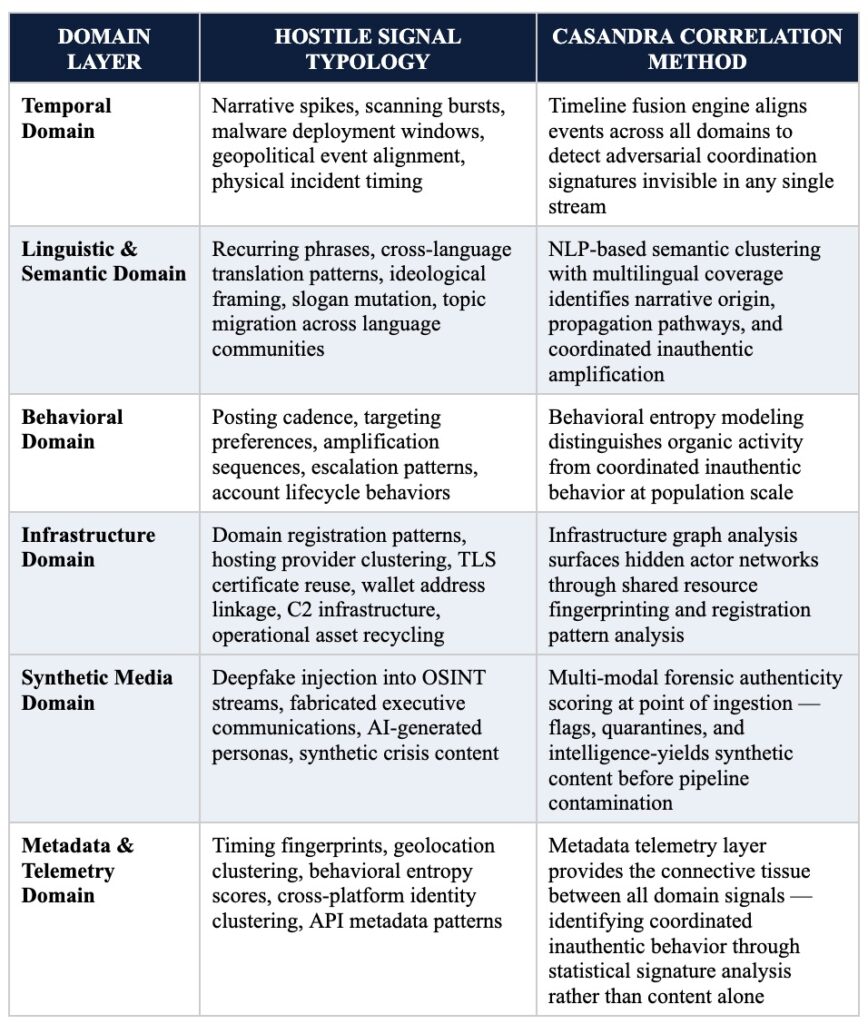
The domain typology framework is operationally significant because sophisticated adversaries deliberately distribute their footprint to fall below the detection threshold of any single-domain monitoring system. CASANDRA’s correlation engine is specifically designed to detect this form of deliberate distribution — where each individual domain signal sits at noise level while the aggregate cross-domain pattern constitutes a high-confidence hostile preparation signature.
Q6 – Geopolitical alliances are shifting, with a number of state actors increasingly relying on proxy networks, non-state hacktivists, and transnational criminal syndicates to carry out cyber operations. How does Strategic Mind Inc. track and attribute threats when the boundary between a sovereign nation-state’s actions and a rogue actor’s campaign is intentionally blurred?
A6 – Attribution in modern hybrid operations is rarely binary. The operational question is not “state or non-state?” but rather: what is the assessed relationship between the actor, the infrastructure, the timing, the target selection pattern, and the strategic interests of a potential state sponsor?
Strategic Mind’s methodology applies layered attribution rather than single-point attribution. Because modern adversaries deliberately use proxy structures to establish plausible deniability, attribution is expressed as a confidence-based assessment across multiple analytical dimensions — providing decision-makers with an actionable picture rather than a political slogan.
- Technical attribution — infrastructure fingerprinting, malware family lineage, TTPs, C2 behavior, exploit chains, and forensic artifacts.
- Behavioral attribution — operational tempo, target selection logic, language use, working-hour patterns, campaign sequencing, and known tradecraft signatures.
- Narrative attribution — messaging themes, propaganda alignment, ideological framing, and amplification network analysis.
- Strategic attribution — beneficiary analysis and alignment with geopolitical interests, military timing, diplomatic pressure cycles, or proxy doctrine.
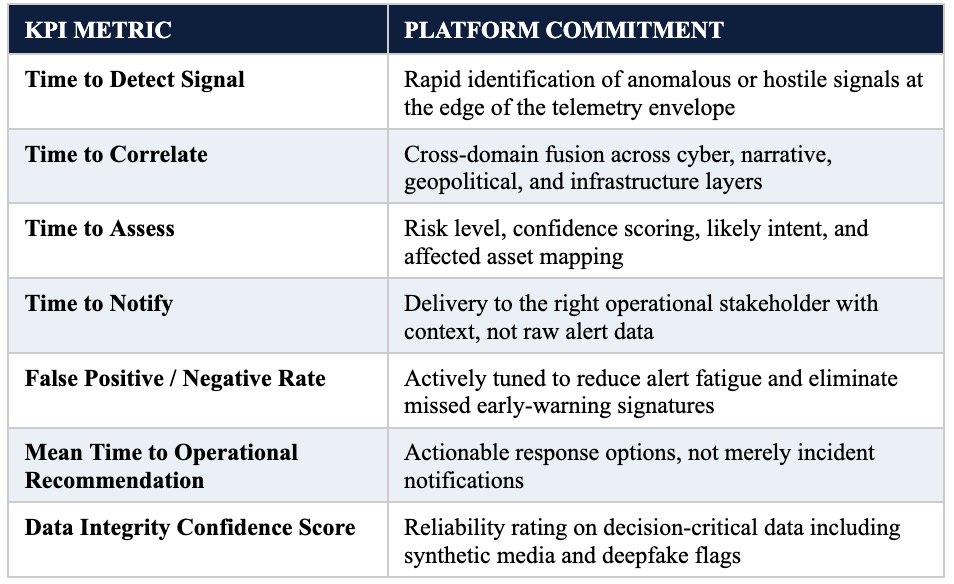
Q7 – What specific SLA parameters (Service Level Agreement) and KPIs (Key Performance Indicators) are applied to critical infrastructure?
A7 – For critical infrastructure, specific SLA parameters are calibrated to deployment architecture, level of data access, scope of integration, regulatory environment, and risk thresholds defined by the partners.
The KPI framework governing Strategic Mind’s engagements combines technical performance, analytical performance, and operational usefulness as an integrated measurement architecture.
In machine-speed threat environments, latency matters — but the decisive measure is whether intelligence arrives early enough to change the operational outcome.
 Q8 – How will generative AI reshape the Cybers threat landscape, and what are the key structural developments expected in the field of defensive intelligence over the next three to five years?
Generative AI will transform the threat landscape across three primary dimensions: scale, personalization, and speed. Each creates qualitatively new challenges for defenders. But the deepest strategic risk is not any single AI-enabled attack vector. It is the convergence of AI-enabled hybrid operations and communally orchestrated agentic platforms — in which cyberattacks, disinformation, synthetic media, financial manipulation, and physical-world disruption are synchronized into a single coordinated campaign with machine-speed decision cycles.
- Scale — AI dramatically reduces the cost of influence operations. Adversaries generate multilingual propaganda, synthetic personas, fabricated media, and localized crisis narratives at a volume that fundamentally changes the information environment.
- Personalization — AI-crafted phishing and social engineering reflects a target’s language, writing style, professional context, emotional triggers, and relationship network with a fidelity that defeats conventional awareness training.
- Speed — semi-automated reconnaissance, faster exploit chaining, and adaptive attack infrastructure compress the adversarial decision-action cycle to machine speed.
- Deepfake escalation — synthetic crisis narratives, AI-generated fake evidence, and deepfake executive impersonation become standard components of sophisticated hybrid campaigns.
- AI-assisted supply chain attacks — automated vulnerability exploitation across interconnected supplier networks enables adversaries to compromise targets indirectly at scale.
- Adversarial AI manipulation — model poisoning, adversarial inputs, and training data contamination become significant threat categories targeting the intelligence platforms themselves.
Communal Agentic Orchestration: The Strategic Shift in Defensive AI
The single most important structural development in defensive intelligence over the next three to five years is the emergence of communal agentic platforms — architectures in which multiple specialized AI agents operate as a coordinated network, each contributing a discrete analytical or operational function, all governed by a shared orchestration layer with unified data audit and authenticity standards.
This represents a fundamental departure from single-model AI deployment. Where a single AI model answers a query, a communal agentic platform continuously monitors, correlates, enriches, validates, and acts across multiple intelligence domains in parallel — at machine speed, with human oversight structured into the governance layer rather than inserted as a bottleneck.
The importance of communal orchestration is not efficiency alone. It is the ability to maintain coherent analytical integrity across a distributed, multi-domain intelligence environment — where each agent contributes a piece of the picture, the orchestration layer assembles it, and the audit framework ensures that no synthetic, corrupted, or unauthenticated data contaminates the shared intelligence commons.
Data Auditory and Authenticity in Critical Infrastructure Layers
For critical infrastructure operators — energy grids, water systems, transportation networks, financial clearing systems, emergency communications, and defense-adjacent industrial facilities — the integrity of the data environment is not an IT governance question. It is an existential operational question. An agentic intelligence platform deployed across critical infrastructure must enforce data audity and authenticity at every layer, because the consequences of acting on corrupted, synthetic, or adversarially manipulated data in these environments are not financial or reputational. They are physical.
Communal agentic platforms operating across critical infrastructure layers must enforce a layered data authenticity framework:
– Source authentication at ingestion — every data stream entering the agentic network is verified against provenance metadata, source reputation scores, and cryptographic integrity checks before any agent processes it.
-
- This includes sensor telemetry from operational technology (OT) environments, SCADA systems, and industrial control networks where spoofed or injected data has historically preceded physical sabotage.
– Cross-agent consensus validation — when multiple agents independently assess the same data element and their outputs diverge, the orchestration layer flags the divergence as a potential data integrity incident rather than accepting the majority result.
-
- Adversaries targeting agentic systems will attempt to corrupt a subset of agents rather than the entire platform; consensus divergence is the early warning signature.
– Temporal audit chains — every data element carries a timestamped, immutable audit record of its ingestion, processing, and enrichment history, enabling post-incident reconstruction of what was known, when, and by which agent.
– Synthetic media and sensor spoofing detection — agentic nodes dedicated to authenticity verification apply forensic analysis to both digital media and physical sensor outputs, identifying statistical signatures of manipulation before data enters shared analytical workflows.
– Segregated confidence tiers — data that cannot be fully authenticated is processed in a quarantine tier with restricted downstream access, preventing unauthenticated inputs from propagating through the communal intelligence network.
The Kinetic Warfare Nexus: When Digital Orchestration Enables Physical Consequences
The most strategically significant and underappreciated dimension of communal agentic orchestration is its direct nexus to kinetic warfare. The boundary between the cyber domain and the physical world has dissolved. Agentic platforms operating across critical infrastructure are not managing abstract data flows — they are managing the nervous system of physical operational environments whose disruption or manipulation translates directly into kinetic effects.
This nexus operates in both directions. Adversaries use cyber and agentic means to create kinetic effects. Defenders use agentic intelligence to detect, attribute, and preempt physical attacks that originate or are coordinated in the digital domain. The communal agentic platform is therefore not only a cybersecurity tool — it is a component of national and organizational resilience against physical-world adversarial action.
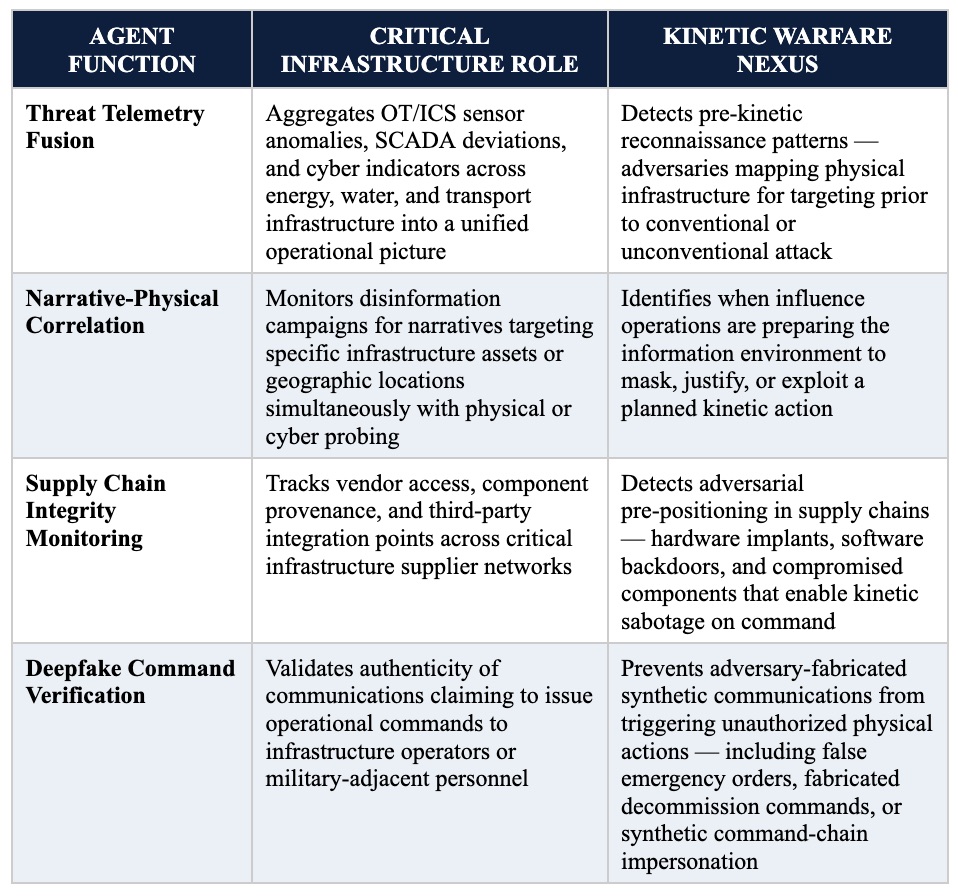
The contribution of communal agentic orchestration to kinetic warfare resilience is not theoretical. Modern conflicts have demonstrated that adversaries treat cyber operations, agentic manipulation of automated systems, and kinetic action as a unified operational continuum. Power grid disruptions preceding ground offensives, water system manipulations synchronized with civilian pressure campaigns, and GPS spoofing coordinated with physical territorial operations are documented patterns — not hypothetical scenarios.
Defensive communal agentic platforms must therefore be designed from inception with the kinetic warfare nexus as a core architectural requirement — not an edge case. This means integrating physical consequence modeling into threat assessment workflows, maintaining direct channels to national resilience and emergency response authorities, and ensuring that agentic recommendations in critical infrastructure environments carry the confidence and audit standards required for decisions with potential physical-world consequences.
Dr. Netanel Balmas – CEO and Founder of Strategic Mind Inc.
Note: The above responses are designed only for an interview to be published in World Geostrategic Insights and are written in a professional public-facing voice. They convey deep technical credibility while avoiding disclosure of proprietary platform architecture, sensitive customer guarantees, or operationally exploitable details. Each answer is framed through the lens of Strategic Mind Inc.’s superior intelligence platform — the CASANDRA system — positioning geo-strategic deep tech analysis, context enrichment, predictive intelligence, audit-grade transparency, communal agentic orchestration, and deepfake countermeasures as core differentiators in the global dual-use intelligence market.