



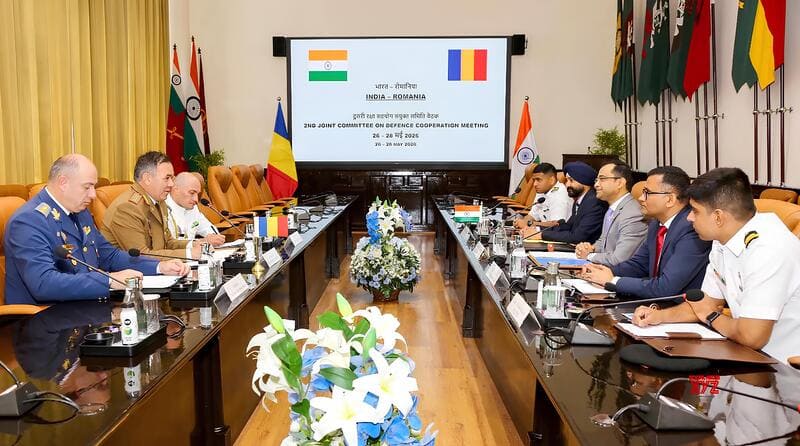
The contemporary international order is being shaped by simultaneous crises in Europe and West Asia. The continuing Russia–Ukraine war has transformed the security architecture of Europe, while tensions surrounding Iran have highlighted the interconnected nature of global energy security, maritime trade, and geopolitical stability.
Against this backdrop, relations between India and Romania have acquired renewed strategic relevance. Although traditionally cordial and free from major political disagreements, bilateral ties are increasingly being influenced by broader geopolitical developments, particularly the Ukraine conflict and instability in the Black Sea and West Asian regions.
India and Romania established diplomatic relations in 1948, making Romania one of the first countries in Eastern Europe to develop formal relations with independent India. During the Cold War, the relationship remained stable despite differing political alignments. Following Romania’s transition to democracy and market reforms after 1989, bilateral engagement expanded to include trade, education, technology, energy, and cultural exchanges.
Today, Romania occupies an important position within the European Union and NATO, while India has emerged as a major global power and a leading voice of the Global South. These changing realities create new opportunities for cooperation at a time when both countries are navigating an increasingly uncertain international environment.
The Ukraine war has fundamentally elevated Romania’s strategic importance within Europe. As a NATO and EU member sharing a border with Ukraine and possessing access to the Black Sea, Romania has become a critical logistical, economic, and security hub in the region. Since the Russian invasion of Ukraine in February 2022, Romania has played a significant role in facilitating the transit of Ukrainian grain exports, supporting refugee flows, strengthening NATO’s eastern flank, and assisting Ukraine’s defence and reconstruction efforts. Romania has also emerged as an important actor in Black Sea security, a region that has become central to European strategic calculations.
According to official agreements signed between Romania and Ukraine, Bucharest has committed itself to strengthening defence cooperation, energy connectivity, military training, and Black Sea security initiatives. Romania and Ukraine further elevated their relationship through a Strategic Partnership signed in Bucharest in March 2026, which includes cooperation in defence production, energy, infrastructure, and support for Ukraine’s European integration aspirations.
For India, developments in the Black Sea region have direct implications despite the geographical distance. The Russia–Ukraine war has disrupted global food supply chains, affected energy markets, and accelerated geopolitical fragmentation. India has consistently advocated dialogue, diplomacy, and peaceful resolution of the conflict while maintaining strategic relations with both Russia and Western countries. New Delhi’s approach reflects its broader commitment to strategic autonomy and multipolarity. In this context, Romania’s role as a bridge between Eastern Europe, the European Union, and the Black Sea region creates opportunities for deeper engagement with India.
Economic cooperation constitutes one of the most promising areas of India–Romania relations. In recent years, both countries have sought to strengthen trade and investment ties. During the nineteenth session of the India–Romania Joint Economic Commission held in Bucharest in November 2025, both sides reaffirmed their commitment to expanding economic cooperation and identified new areas for collaboration in manufacturing, digitalisation, infrastructure, entrepreneurship, and technology. Romanian officials explicitly described Romania as a potential strategic partner for India in Central and Eastern Europe, highlighting its access to the European Union’s single market and its growing logistical significance amid the Ukraine crisis.
The war in Ukraine has also highlighted the importance of resilient supply chains and diversified economic partnerships. As European countries seek to reduce strategic vulnerabilities and diversify their economic relationships, India presents an attractive partner due to its large market, technological capabilities, skilled workforce, and growing manufacturing base. Romania, meanwhile, offers India access to European markets, transportation corridors, and emerging opportunities in sectors such as information technology, renewable energy, pharmaceuticals, automotive manufacturing, and defence production.
Defence and security cooperation represent another area with significant future potential. Although defence ties between India and Romania have traditionally remained modest, evolving geopolitical realities may create new opportunities for collaboration. Romania’s growing role in NATO’s eastern flank, its expanding defence-industrial sector, and its strategic location in the Black Sea region have increased its importance within European security frameworks. At the same time, India has emerged as a major defence producer and is actively promoting defence exports under its broader goal of defence self-reliance.
The Ukraine war has accelerated defence-industrial cooperation across Europe. Romania’s recent agreements with Ukraine regarding joint production of defence systems, including drones (under a new EU defence funding mechanism, SAFE), illustrate its interest in expanding indigenous defence manufacturing capabilities and strengthening regional security cooperation. Such developments may create opportunities for future partnerships involving Indian defence manufacturers, particularly in areas such as unmanned systems, cybersecurity, artificial intelligence, maintenance services, and defence technology cooperation.
The Black Sea region also presents opportunities for strategic dialogue between India and Romania. While India is not directly involved in Black Sea security, the region’s stability affects global trade routes, energy supplies, and broader European security. India’s growing maritime interests, reflected in initiatives such as SAGAR (Security and Growth for All in the Region) and its Indo-Pacific vision, indicate an increasing recognition of the importance of maritime security in global affairs. Romania’s expertise in Black Sea security and its experience as a frontline NATO state could contribute to broader exchanges on maritime resilience, port infrastructure, and strategic connectivity.
The Iran crisis introduces another dimension to India–Romania relations. Although Romania’s primary security concerns remain focused on the Black Sea and Eastern Europe, instability in West Asia directly affects European energy security and broader economic interests. For India, the stakes are even higher. West Asia remains crucial for India’s energy imports, diaspora interests, trade routes, and strategic connectivity initiatives. Successive Indian governments have pursued a carefully balanced policy in the region, maintaining productive relations with Iran, Israel, Gulf Arab states, and Western partners simultaneously.
India’s response to tensions involving Iran has consistently emphasised restraint, dialogue, and diplomatic engagement. New Delhi has repeatedly highlighted the importance of regional stability and freedom of navigation, recognising that disruptions in maritime routes can have significant consequences for global commerce and energy markets. Prime Minister Narendra Modi recently welcomed efforts aimed at restoring stability and ensuring freedom of navigation in the Strait of Hormuz, underscoring India’s long-standing commitment to diplomatic solutions.
Romania shares similar concerns regarding the implications of instability in West Asia. As a member of the European Union, Romania is affected by fluctuations in energy markets, migration pressures, and disruptions to international trade routes. The interconnected nature of modern supply chains means that instability in the Strait of Hormuz or other strategic maritime corridors has consequences extending far beyond the immediate region. These shared concerns create opportunities for India and Romania to cooperate more closely on issues related to energy security, maritime connectivity, and economic resilience.
Energy cooperation deserves particular attention in future bilateral relations. Both countries are actively pursuing energy diversification strategies in response to changing geopolitical realities. Romania has emerged as an increasingly important energy actor in Europe, particularly through its offshore natural gas projects in the Black Sea. Bucharest is working on its Neptun Deep Black Sea gas project which is supposed to become one of the European Union’s most significant energy deposits with an estimated 100 billion cubic meters of recoverable gas. These developments have gained additional significance as European countries seek alternatives to Russian energy supplies following the Ukraine war. India, meanwhile, remains one of the world’s fastest-growing energy consumers and continues to diversify its energy partnerships. Cooperation in renewable energy, energy transition technologies, hydrogen development, and energy infrastructure could become important pillars of bilateral engagement.
Another promising area is technology and innovation. India has established itself as a global leader in information technology, digital public infrastructure, and software services. Romania possesses a highly skilled technological workforce and has developed a growing reputation as a technology and innovation hub within Eastern Europe. Collaboration in digital transformation, cybersecurity, artificial intelligence, fintech, and research and development could strengthen economic ties while contributing to broader strategic cooperation. India in November 2025 invited Romanian companies to participate in India’s dynamic manufacturing and innovation ecosystem under the ‘Make in India’ and ‘Production-Linked Incentive’ (PLI) schemes. Also, a lot of avenues between the two countries’ businesses in the IT sector are being discussed. This is becoming an important platform for strengthening India-Romania cooperation in the technology domain.
Education and people-to-people ties also provide a strong foundation for future engagement. Thousands of Indian students have studied medicine and other disciplines in Romania over the years, creating enduring social and professional connections between the two societies. Academic exchanges, research partnerships, and educational cooperation can contribute to a deeper and more sustainable bilateral relationship.
The broader geopolitical environment further enhances the significance of India–Romania cooperation. Both countries support a rules-based international order, respect for sovereignty, and peaceful resolution of disputes. While their foreign policy priorities may differ in certain respects, both recognise the importance of multilateral cooperation in addressing complex global challenges. Romania’s membership in the European Union and NATO, combined with India’s growing international influence through platforms such as the G20, BRICS, and the Quad, creates opportunities for dialogue on issues ranging from global governance reform to climate change and economic development.
The future trajectory of India–Romania relations will likely be shaped by the evolving international environment. The Ukraine war has reinforced Romania’s importance as a strategic gateway to Eastern Europe and the Black Sea region, while instability involving Iran has highlighted the interconnected nature of global security and economic systems. These developments underscore the value of diversified partnerships capable of enhancing resilience amid uncertainty.
As geopolitical competition intensifies and traditional assumptions about global order are increasingly challenged, India and Romania possess complementary strengths that can support a deeper partnership. Romania offers India a valuable entry point into Central and Eastern Europe, while India provides Romania access to one of the world’s most dynamic economies and an increasingly influential global actor. Their shared interest in stability, connectivity, economic growth, and multilateral cooperation provides a solid foundation for future engagement.
In an era marked by conflict and uncertainty, India–Romania relations are gradually evolving from a traditionally friendly bilateral relationship into a partnership with broader strategic significance. The Ukraine war and the Iran crisis have not diminished the prospects for cooperation; rather, they have highlighted the importance of stronger economic, technological, energy, and diplomatic ties between the two countries. By building on existing strengths and adapting to emerging geopolitical realities, India and Romania can contribute not only to their mutual prosperity but also to the stability and resilience of the wider international order.
Author: Dr. Indrani Talukdar – Fellow at the Chintan Research Foundation, New Delhi.
(The opinions expressed in this article belong only to the author and do not necessarily reflect the views of World Geostrategic Insights).
Image Credit: @Spokesperson MoD (New Delhi: India Romania Defence Cooperation Meeting 26-28 May 2026).