



World Geostrategic Interview with Irina Mironova on Russian gas production potential and limitation, the technological constraints, the feasibility of a large-scale shadow fleet, the reconfiguration of Russia’s pipeline export system, with the structural reorientation of Russian LNG flows toward Asia, and the scenarios for Russian LNG supply by 2030.

Irina Mironova is an energy markets analyst specialising in global natural gas and LNG markets, energy transition and energy geopolitics. She is currently an independent consultant providing analytical and advisory support on global gas and LNG markets and is a contributor to Cedigaz research and publications. Previously, she worked as a Senior Research Analyst at Gazprom and as a researcher at the Energy Research Institute of the Russian Academy of Sciences.
Her recent report, Russia and LNG Supply in the Period 2026–2030: Constraints, Strategic Niches, and Scenarios, examines what relief, if any, Russia can offer to international gas markets in the context of the Middle East disruption by assessing the constraints, export potential and strategic role of Russia’s LNG industry.
Q1 – In your report titled “Russia and LNG Supply in the Period 2026–2030: Constraints, Strategic Niches, and Scenarios,” you emphasize that maritime transport, rather than upstream gas availability, will be the main constraint for Russian LNG between 2026 and 2030. Could you elaborate on this point here? Specifically, could you quantify the current shortage of Arc7-class LNG carriers and indicate to what extent this will delay the launch of Arctic LNG 2 and future projects such as Murmansk LNG?
A1 – Indeed, it is my understanding that Russia’s gas resource base is not the main constraint on future LNG supply. Russia retains significant gas production potential and has sufficient installed and planned liquefaction capacity to support higher LNG output than is currently observed. The key limitation lies in the ability to move LNG to market.
This limitation has two dimensions: the route itself (i.e. the ability to use the shorter Northern Sea Route to Asia in the context of Europe’s progressing phase-out of Russian gas) and the availability of vessels capable of operating on this route.
The availability of specialised Arc7 ice-class LNG carriers required for Arctic operations defines the effective export ceiling. Sanctions-related restrictions on vessel construction at foreign shipyards result in the relatively slow pace of domestic shipbuilding.
The precise shortage of Arc7-class vessels is difficult to quantify. However, industry estimates suggest that more than 30 additional LNG carriers may be required to sustain year-round exports from Yamal LNG and Arctic LNG 2. Modelling by the Centre for High North Logistics indicates that, if all Yamal volumes are redirected to Asia after 2027, the existing fleet would be able to complete only around 120–130 voyages per year, less than half the number completed in 2024–2025 (around 270 voyages from Sabetta in 2025, including 206 directed to Europe). This would create a gap between nominal liquefaction capacity and effectively realisable export capability, as vessel shortages that were not previously apparent could emerge once cargoes are redirected to Asia and Arctic LNG 2 expands.
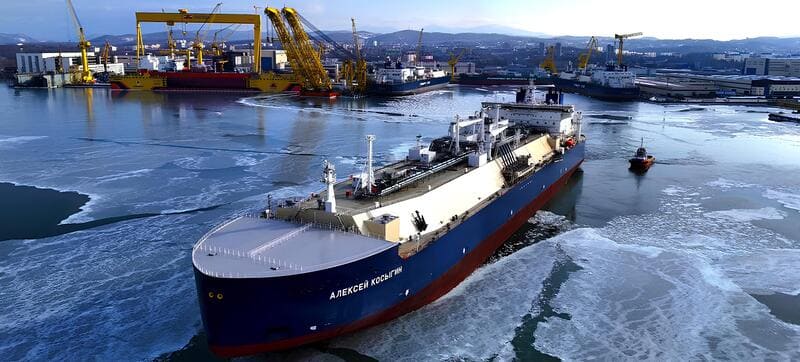
The Russia-linked LNG transport system currently comprises more than 60 LNG carriers, of which more than 50 are operational, alongside 13 vessels under construction. Operational Arctic fleet currently stands at 17 Arc7 vessels, only two of them were delivered at Zvezda shipyard. Throughout 2025, the overwhelming majority of Yamal LNG exports were carried by Arc7 vessels, while Arc4 and conventional vessels played only a supplementary and seasonal role. Winter exports from Arctic projects in the Ob Bay remain structurally constrained regardless of liquefaction readiness.
Murmansk LNG would represent a different story. Because of its ice-free location, it would not depend on Arc7 vessels or Northern Sea Route navigation. However, the project remains subject to substantial execution uncertainty related to sanctions, domestic technologies and regulatory arrangements.
Q2 – You outline several scenarios for Russian LNG supply by 2030. In your “Base” or “Conservative” scenario, what is the realistic annual export capacity that Russia will achieve, compared to the Kremlin’s official target of 100 million tons per year?
A2 – The report develops three scenarios for Russia’s gas and LNG exports through 2030:
- The base case assumes that existing export channels remain in place, core LNG projects maintain broadly stable output, and sanctioned projects continue to operate intermittently without full commercial normalisation.
- The upside case assumes partial stabilisation, with incremental improvements in LNG utilisation.
- The constrained case envisages further fragmentation of export channels and additional pressure on LNG logistics and European pipeline exports.
In terms of liquefaction capacity, both the base and constrained cases assume the same capacity as is currently available, around 36 mtpa. The difference lies in the effective exports from projects that are technically operational but remain under sanctions, namely Arctic LNG 2, Portovaya LNG and Cryogas Vysotsk. In the upside case, Arctic LNG 2 expands from 6.6 mtpa to 13.2 mtpa and one additional project, Ust-Luga (Baltic LNG, 13.1 mtpa), becomes operational by 2030. This would bring total liquefaction capacity, including projects under sanctions, to around 56 mtpa and provide additional upside for exports. Actual exports may still be lower depending on adaptive logistics, transshipment and fleet expansion.
All of the scenarios discussed in the report remain significantly below Russia’s official ambitions. The Energy Strategy to 2050 envisages LNG accounting for 48% of gas exports by 2030 and is associated with the objective of reaching 100 mtpa of liquefaction capacity.
Q3 – Western sanctions have targeted critical liquefaction technologies (such as large gas turbines and specialized heat exchangers). How successful have proprietary Russian technologies (e.g., Novatek’s “Arctic Cascade” or “Arctic Mix”) been in replacing Western equipment? Are they meeting expectations in terms of efficiency and scale?
A3 – Technology availability remains one of the key constraints on Russia’s future LNG expansion. At the same time, it would be incorrect to say that Russia has not developed domestic liquefaction technologies. Over the past several years, Novatek has patented three proprietary technologies: Arctic Cascade for trains of around 1 mtpa, a modified Arctic Cascade for trains of around 3 mtpa, and Arctic Mix for trains above 6 mtpa. A special feature of these technologies lies in the use of Arctic cold as part of the liquefaction process.
Importantly, lines using Russian liquefaction technologies are already operational. The fourth train of Yamal LNG operates using the Arctic Cascade technology, while two trains of Arctic LNG 2 are reported to be operational and use the Arctic Mix technology, which broadly replicates the MFC4 process. Russian companies have also developed proprietary technologies, including Gazprom’s Gazprom MR.
A key recent development has been the progress in equipment localisation. In June, Kazankompressormash commissioned a large assembly and testing facility for domestically produced mixed-refrigerant compressors intended for large-scale LNG plants. According to the company, the prototype compressors can be powered either by a 130 MW gas turbine or an 80 MW electric drive, configurations that correspond to the requirements of future projects such as Ust-Luga LNG and Murmansk LNG. This suggests that Russia is gradually building a domestic technological base for large-scale LNG development.
Q4 – To circumvent Western maritime transport restrictions, there is increasing discussion of a “shadow fleet” for LNG, similar to that seen in the oil sector. Given the highly specialized, capital-intensive, and traceable nature of LNG carriers, how feasible is a large-scale LNG shadow fleet for Russia?
A4 – You are absolutely right to frame this question around the feasibility of a large-scale shadow fleet. The LNG case differs substantially from the oil shadow fleet model. Russia-linked LNG carriers remain comparatively traceable. The fleet includes dedicated Arctic carriers, conventional vessels repositioned into Russian trade, and ships under construction for Arctic LNG 2. Several vessels have changed flags or ownership structures, but they remain commercially identifiable and retain traceable name histories.
Russia’s LNG shipping adaptation therefore cannot be described as a large-scale shadow fleet. Rather, it is a case of sanctions-adaptive logistics. This includes reflagging, ownership restructuring, ship-to-ship transfers and some reliance on floating storage and transshipment units. These arrangements help preserve a high degree of export continuity.
For a more detailed analysis of the fleet based on my hand-collected database, please see: The Russian LNG Fleet: Sanctions Adaptation vs. the Shadow Fleet Narrative (part 1 and part 2).
Q5 – The geopolitical crisis in the Middle East and the closure of the Strait of Hormuz triggered a severe energy shock, pushing European TTF prices to high levels (around €48/MWh) and driving up inflation. In your view, if this bottleneck had continued throughout the summer, what impact would it have had on Europe’s ability to fill its gas reserves (which are currently much lower than last year, standing at around 40–67 per cent) ahead of the coming winter?
A5 – As of late June, the situation has changed: an MoU and ceasefire have been reached between Iran and the US. TTF prices reacted immediately by moving lower. Immediately after the US and Iran reached a preliminary framework agreement aimed at ending the conflict and reopening the Strait of Hormuz, European natural gas prices fell by ~6%, reaching their lowest level in over a month. Front-month TTF contract dropped to around €43.8/MWh as geopolitical risk premiums retreated.
Another important development is that arbitrage for U.S. LNG via the Cape of Good Hope started pointing toward Europe, unlike during most of the Middle East crisis. This slightly eases the situation for European storage refill, but the challenge remains significant because heatwaves are increasing gas demand from the power sector. At the same time, market fundamentals still point to relatively tight supply, as many cargoes had already been committed to Asia during the period of stronger Asian premiums, constraining prompt availability for Europe.
Europe’s main vulnerability in the Middle East crisis is not direct dependence on Qatari LNG, but exposure to a tighter global LNG balance. Despite the ceasefire and MoU, Hormuz traffic remains substantially limited, and Qatari supply is not expected to return fully to the market for at least another month. Flexible cargoes continue to be drawn toward higher-priced markets, and in June this has increasingly meant Asian markets, where LNG demand has shown signs of recovery. In this context, a prolonged summer bottleneck would still make European storage refills more difficult and expensive.
Q6 – In your analysis of the Central Asian corridors (Kazakhstan and Uzbekistan), are these regional transit agreements economically viable enough to allow Gazprom to recoup its European losses, or are they primarily geopolitical maneuvers aimed at consolidating regional influence at a high financial cost?
A6 – These routes form part of the broader reconfiguration of Russia’s pipeline export system after the decline of the European direction. Since October 2023, Russian gas has been supplied to Uzbekistan via Kazakhstan using the Central Asia–Center IV and V pipelines in reverse mode. During the winter of 2023/2024, deliveries to Uzbek consumers reached the maximum technical capacity of the route. Long-term contracts for supplies to Kyrgyzstan for 2025–2040 were also concluded in June 2024.
These Central Asian routes could be seen as operational and regional export corridors, but not as a replacement for the lost European market. Russia’s external gas position is increasingly shaped by a narrower set of export options, with China becoming the main outlet for redirected gas volumes.
Q7 – Once Europe closes its doors to Yamal LNG (which absorbed nearly 97% of that plant’s production in the first quarter of 2026), Russia will be forced to redirect massive volumes to Asia in the middle of winter. Will Moscow dump its LNG at heavily discounted prices on Asian markets? This could create a two-tier market: “discounted” Asian LNG and “premium” European LNG.
A7 – The progressive loss of the European market implies a structural reorientation of Russian LNG flows toward Asia. This redirection is not operationally neutral. Deliveries to Asia require significantly longer voyage times than deliveries to Europe, reducing effective fleet availability and tightening existing constraints in Arctic-class shipping. As a result, the ability to redirect all volumes from Europe to Asia is constrained not only by demand, but also by logistics and vessel availability.
China already receives redirected pipeline gas and discounted LNG from Russia, and a second Chinese terminal has reportedly been identified as a destination for Russian LNG, likely in the context of the second train of Arctic LNG 2. The relationship is becoming increasingly asymmetric, with Russia more dependent on China as an outlet for its gas exports. At the same time, China treats LNG as a flexible balancing source. Consequently, Russia may face a more limited and concentrated buyer base in Asia.
The question of a two-tier market, with discounted Asian LNG and premium European LNG, is an interesting one. It does look possible, as Europe will have to compete for LNG in a tighter supply environment. In addition to the largely ongoing Middle East disruption, this spring and summer also saw several issues affecting Australian supply, including extreme weather events and labour action at the Ichthys terminal. However, at this stage I would refrain from making definitive conclusions regarding future pricing differentials between Asian and European LNG markets.
Q8 – China and India have shown interest in discounted Russian energy commodities, but LNG infrastructure requires a long-term commitment. How willing are Asian buyers to sign new long-term contracts for sanctioned Russian LNG, and what kind of price discounts are they demanding to offset the geopolitical risk?
A8 – I would start by noting that Russia’s operational and under-construction liquefaction capacity appears to be fully covered by contracts. Therefore, there is little opportunity to sign a flexible FOB contract from unsanctioned projects such as Yamal LNG or Sakhalin-2. Both projects have a mix of FOB and DES contracts with European and Asian buyers. The remaining opportunity lies in Arctic LNG 2 volumes, which are contracted by Novatek on an FOB basis.
For buyers, this has two implications. First, flexibility rests with Novatek (if the buyer seeks flexibility, the preference would be receiving FOB volumes directly from the project). Second, it can be said with a high degree of certainty that the LNG would originate from a sanctioned project, potentially creating complications with sanctioning authorities.
As a result, willingness to commit to new long-term arrangements remains limited and highly selective. Arctic LNG 2, despite having substantial volumes formally contracted, has struggled to establish stable commercial operations because of U.S. sanctions and the absence of a stable offtake network willing to assume secondary sanctions risk.
India has explored opportunities to import Russian LNG, and discussions on supply arrangements have taken place. However, the scope for such imports is constrained by India’s price sensitivity, logistical considerations (including the unavailability of the Suez route following the attack on Arctic Metagaz) and broader policy considerations.
Irina Mironova – Energy markets analyst specialising in global natural gas and LNG markets, energy transition and energy geopolitics.
Image: Zvezda Shipbuilding Complex