



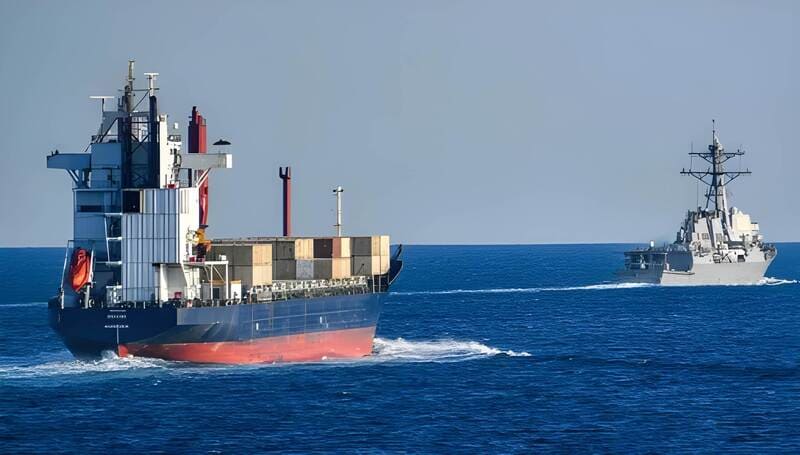
The map of the Middle East is no longer defined by borders, it is defined by chokepoints under fire. From the Strait of Hormuz to the Persian Gulf and stretching into the Arabian Sea, the arteries of global energy and trade are being transformed into zones of contestation.

What is unfolding is not merely a war of states, but a struggle over the control, disruption, and redesign of global connectivity, geo-economics and the arteries of the 21st century world order.
In this volatile environment, Pakistan had stepped forward with unusual diplomatic activism. Islamabad had conveyed proposals between Washington and Tehran and hosted high-level talks involving regional actors such as Turkiye, Saudi Arabia, and Egypt in an efforts to engineer de-escalation.
Yet even as these efforts unfold, Pakistan’s aspiration to act as a mediator appears increasingly out of sync with the strategic realities of a conflict where instability is not an obstacle to peace, it is part of the design. The current phase of the Iran-Israel-U.S. war underscores this reality with brutal clarity. The conflict has expanded beyond bilateral strikes into a regional theatre, targeting energy infrastructure, maritime chokepoints, and strategic depth across multiple fronts.
The Strait of Hormuz, carrying a significant portion of the world’s oil, faces persistent threats of disruption; the Persian Gulf has witnessed strikes on energy facilities and heightened naval tensions; and the Arabian Sea has emerged as an extended zone of strategic maneuvering, with increased military deployments and surveillance activities.
These interconnected waters, once the backbone of global trade, are now spaces of uncertainty. The result is not merely military escalation, but a cascading disruption of global supply chains, energy security, and economic stability. Within this volatile landscape, Pakistan has stepped forward with diplomatic intent, offering to host talks, facilitating back-channel communication, and positioning itself as a neutral interlocutor.
On paper, Pakistan’s credentials appear compelling; historical ties with Iran, working relations with the United States, and deep engagement with Gulf States. Yet, in practice, these very linkages expose the limitations of its role. Mediation requires leverage, neutrality, and timing. Pakistan, however, operates within a web of competing alignments. Its economic future is closely tied to the Belt and Road Initiative (BRI), which depends on regional stability and open connectivity.
At the same time, Pakistan cannot afford strategic divergence from Gulf partners and the United States, both of whom are central to alternative connectivity framework such as the India-Middle East-Europe Economic Corridor (IMEC). This duality transforms Pakistan from a neutral bridge into a perceived stakeholder, complicating trust from all sides.
The inclusion of India in this evolving geopolitical equation further reshapes the dynamics and, crucially, undermines Pakistan’s mediation space. India’s approach to the conflict has been marked by strategic restraint combined with calculated alignment. Publicly, New Delhi calls for de-escalation, protection of energy routes, and stability in the Middle East positions consistent with its status as a major energy importer.
However, beneath this diplomatic language lies a more structured geo-economic calculation. India is a principal architect of IMEC, a corridor that seeks to connect India to Europe via the Gulf and Israel, deliberately bypassing Iran. In this context, the weakening or isolation of Iran whether through sanctions, conflict, or strategic marginalization indirectly enhances the viability of IMEC.
A fragmented Iran reduces competition from alternative routes such as those linked to Eurasian land corridors and strengthens the appeal of India-centric connectivity frameworks embedded within U.S.-aligned security architectures. This creates a subtle but powerful incentive structure.
Unlike Pakistan, which depends on stability for the success of its connectivity vision, India’s IMEC model can coexist with, and even benefit from, a controlled level of regional instability, provided key partner states remain secure under Western-backed arrangements. The conflict, therefore, does not disrupt India’s long-term strategic trajectory to the same extent – it may, in fact, accelerate its integration into a preferred connectivity order.
India’s deepening ties with Israel and growing strategic convergence with the United States further reinforce this position. These relationships provide India with access, influence, and alignment within the very bloc shaping post-conflict regional architecture. As a result, India is not positioned as a mediator, but as a beneficiary and participant in the emerging order.
For Pakistan, this contrast is consequential. While Islamabad seeks to mediate, New Delhi is effectively consolidating its position within a competing connectivity paradigm. This asymmetry reduces Pakistan’s diplomatic leverage and reinforces perceptions among key actors that the region’s future connectivity and by extension, its strategic alignment may increasingly revolve around India-led initiatives rather than Pakistan-centered frameworks.
The roles of other actors deepen this complexity. Turkiye, often viewed as a parallel mediator, reflects similar constraints. While actively supporting diplomatic engagement and participating in mediation forums alongside Pakistan, Ankara remains deeply embedded within NATO’s security structures and pursues its own regional ambitions. Its balancing act mirrors Pakistan’s own dilemma – but without delivering decisive influence.
China, meanwhile, supports diplomatic engagement and backs Pakistan’s mediation rhetorically, yet adopts a cautious and calculated posture. Its primary concern remains the protection of its economic interests and the long-term viability of BRI. The disruption of maritime flows through the Strait of Hormuz, the volatility in the Persian Gulf, and the expanding strategic activity in the Arabian Sea directly threaten China’s energy lifelines and trade routes.
Beijing seeks stability, but not at the cost of overexposure in a volatile conflict. As such, its support for Pakistan’s role remains strategically limited rather than operationally transformative. These overlapping dynamics reveal a deeper structural truth; this conflict is not merely about war and peace – it is about competing models of global connectivity.
In such a contest, mediation is often secondary to alignment. States are evaluated not by their neutrality, but by their position within emerging geo-economic blocs. The ongoing geo-economic war amplifies this reality. Rising energy prices, disrupted trade flows, and financial uncertainty are reshaping global markets.
For Pakistan, these shocks driven in part by instability in the Persian Gulf and risks to shipping through the Arabian Sea – translate into heightened vulnerability; currency pressures, fiscal strain, and reduced economic maneuverability. A state under such constraints finds it difficult to project the kind of influence required for effective mediation.
India, by contrast, while not immune to these disruptions, is better positioned to absorb shocks due to its larger economic base and diversified partnerships. More importantly, its strategic alignment within IMEC provides it with a forward-looking framework that integrates trade, energy, and technology within a relatively secure geopolitical umbrella.
Thus, the contrast becomes stark, leaving no room for ambiguity or misunderstanding. Pakistan seeks to mediate a conflict that demands stability. India positions itself within a system that can operate through structured instability. One attempts to bridge divides; the other adapts to, and potentially benefits from, their persistence.
Considering all factors, Pakistan’s mediation effort is constrained not by lack of intent, but by the structural realities of an emerging world order. It is attempting to resolve a conflict that is not yet ripe for resolution, in a system where instability is not merely a disruption, but a strategic instrument.
To cut to the chase, Pakistan may have succeeded in hosting dialogues, facilitating communication, and advocating restraint. But it is unlikely to alter the trajectory of a conflict driven by forces far larger than any single mediator. Because this is not just a war that can be negotiated – it is a war that is redrawing the map of global connectivity itself, where some states mediate, others align, and a few quietly shape the future.
Author: Mirza Abdul Aleem Baig – President of Strategic Science Advisory Council (SSAC) – Pakistan. He is an independent observer of global dynamics, with a deep interest in the intricate working of techno-geopolitics, exploring how science & technology, international relations, foreign policy and strategic alliances shape the emerging world order.
(The opinions expressed in this article are solely those of the author and do not necessarily reflect the views of World Geostrategic Insights).