



By Indrani Talukdar
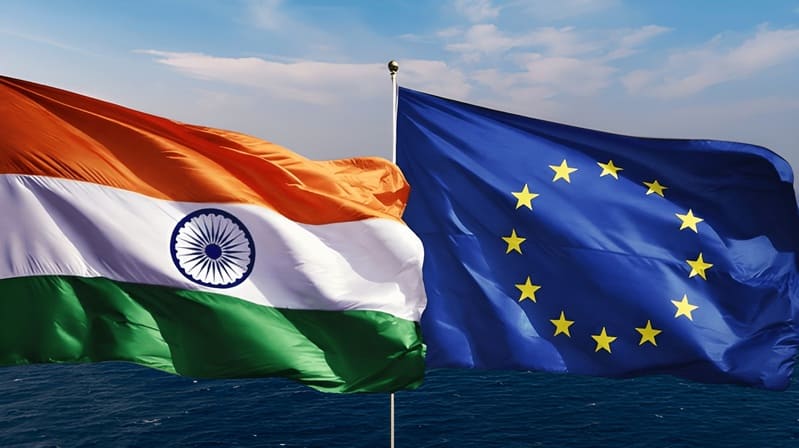
The European Union’s growing interest in India and the Indo-Pacific is often described through summit diplomacy, trade negotiations and naval visits. Given the opportunities in Northeast India and the Bay of Bengal it will be interesting to watch the reach of the EU in this region.

It is because this is one of the regions where economics, geography and security meet. Northeast India and the Bay of Bengal are such places. They connect India’s continental frontier to Bangladesh, Myanmar and Southeast Asia; they also sit beside sea lanes, ports, river systems and digital infrastructure on which Asian and European prosperity increasingly depends given the shifting dynamics in the international system.
The political foundation is stronger than at any earlier point. At the January 2026 summit, India and the EU concluded negotiations on a free-trade agreement, signed a security and defence partnership, and adopted a joint strategic agenda toward 2030. The partnership explicitly covers maritime security, defence technology, cyber and hybrid threats, space and counterterrorism. The EU is India’s second-largest goods trading partner, while together the two account for roughly one-fifth of global trade. There is no longer a ceremonial partnership; it is becoming an instrument of economic and geopolitical resilience.
What it Means for India
For India, European engagement can help balance the region from the many external actors’ influence as well as convert the Northeast to a more productive gateway. Delhi has already placed the region at the centre of its Act East policy. The Kaladan multimodal project links Mizoram to Myanmar’s Sittwe port, while road, rail and inland-waterway links through Bangladesh are intended to improve access to ASEAN markets. Yet infrastructure alone does not create a corridor. It requires bankable projects, customs interoperability, reliable power, digital systems, climate resilience, skilled workers and confidence among local communities.
Here Europe has useful comparative strengths—patient infrastructure finance, high environmental and social standards, logistics technology, renewable energy, vocational training and transparent procurement. The EU’s Global Gateway already supports Indian work on sustainable cities, clean energy, digital standards, agriculture and regional energy trade. The bilateral Trade and Technology Council adds cooperation on semiconductors, artificial intelligence, digital public infrastructure, clean technologies and resilient supply chains. The strategic implication for India is diversification—more sources of capital and technology, more export pathways for small firms, and less dependence on any single market, supplier or transit route.
A Compact for Northeast India
The first pillar should be a Northeast India–EU Connectivity and Resilience Facility, designed with state governments and local stakeholders rather than imposed from national capitals. It could blend European grants, development-bank finance and private investment for river ports, cold chains, border logistics, renewable microgrids, flood-resilient roads and secure digital links. Priority sectors should reflect regional capabilities—bamboo and forest products, tea, horticulture, sustainable tourism, handloom, healthcare and digital services—not merely the demands of distant supply chains.
Blue Valley: Turn Regional Strengths into Local Opportunity
The Blue Valley Cluster offers a concrete example of this regional approach. Launched in Guwahati on 9 June 2026 by the Assam government and the EU delegation, the Assam-led cluster focuses on flavours, fragrances and AYUSH and forms part of the broader Blue Valleys initiative. It aims to connect European and Indian businesses, research institutions and entrepreneurs through research, innovation, investment and industrial cooperation. Its stated ambitions include opportunities for farmers, women entrepreneurs, young people and MSMEs—not merely stronger links between large companies.
From the Northeast’s perspective, Blue Valley should be judged by how much value remains in the region. European partnerships want to support local processing, product testing, certification and skills, helping producers move beyond supplying raw materials. The proposed connectivity facility could complement this effort with reliable logistics and secure digital links. Safeguards for biodiversity and traditional knowledge, transparent benefit-sharing and meaningful community participation should be central to the approach. These are recommendations for implementation, not claims of outcomes already achieved—success should be measured in better market access, stronger local enterprises and sustainable livelihoods.
The second pillar could be people-centred. European universities and firms can partner with institutions in Guwahati, Shillong, Imphal, Aizawl and Agartala on maritime logistics, disaster science, cybersecurity, languages and technical skills. India’s 2025 waterways programme envisaged maritime training for 50,000 young people from the Northeast over a decade. European certification, apprenticeships and industry partnerships could improve employability while anchoring growth locally. Connectivity that bypasses communities will breed mistrust; connectivity that creates ownership can reinforce peace.
The third pillar could be ecological and conflict-sensitive. The Brahmaputra-Barak system and the eastern Himalayan landscape are exposed to floods, erosion, landslides and climate stress. Every EU-backed corridor should therefore include transparent consultation, biodiversity safeguards, benefit-sharing and independent grievance mechanisms. These will help in building legitimacy. In a diverse border region, legitimacy is infrastructure.
From the Bay of Bengal to the Wider Indo-Pacific
The Bay of Bengal offers the natural maritime extension of this agenda. BIMSTEC’s Maritime Transport Cooperation Agreement entered into force in 2026 for its initial ratifying states. It provides a framework to streamline procedures, improve port efficiency and strengthen maritime safety and environmental cooperation. India and the EU could support its implementation through port digitalisation, customs data standards, green-shipping pilots, hydrographic training and interoperable search-and-rescue procedures. Such assistance could be channelled through BIMSTEC and shaped by its members, avoiding the impression of an external power importing a strategic template.
Security cooperation should remain practical and non-escalatory. Indian and European navies and coastguards can expand exercises in humanitarian assistance, disaster relief, anti-piracy, pollution response and protection of critical maritime infrastructure. The EU’s CRIMARIO programme and Indo-Pacific Regional Information Sharing platform provide experience in maritime-domain awareness. India brings operational reach, coastal surveillance and relationships across the Indian Ocean. Together they can help smaller littoral states improve awareness without forcing them into rival blocs. This matters because undersea cables, ports, shipping lanes and energy infrastructure are vulnerable to accidents, sabotage, coercion and extreme weather.
The EU’s 2025 Indo-Pacific forum placed protection of critical maritime infrastructure at the centre of its agenda. A joint India–EU initiative could map vulnerabilities in the Bay of Bengal, conduct tabletop exercises, develop rapid-repair protocols and train civilian agencies. Resilience is deterrence by another name—it reduces the rewards of disruption without militarising every challenge.
Stability Through Shared Capacity
The larger strategic dividend is a more balanced Indo-Pacific. India seeks strategic autonomy, not alliance dependency; Europe seeks reliable partners and open routes, not a new sphere of influence. Their interests converge around international law, freedom of navigation, resilient supply chains and institutions that give rising, middle and smaller powers room to act. Cooperation in the Northeast and Bay of Bengal can show that strategy need not begin with military hardware. It can begin with reliable ferries, trusted customs systems, early-warning networks, skilled workers and ports that remain open after a cyclone.
There are risks. European standards can become costly if financing and technology transfer do not accompany them. Indian security imperatives can crowd out local participation. Political instability in Myanmar and bilateral tensions elsewhere can delay cross-border projects. Tensions within the Northeast region could also bring cautiousness from the EU side. However, both partners should therefore start with modular initiatives that produce visible benefits, publish financing terms and measure local employment and invite Bangladesh, Bhutan, Nepal, Sri Lanka and other willing partners to co-design programmes. Close consultation and involvement of the Northeastern states would be important in this endeavour.
The opportunity is nevertheless historic. The Northeast can become India’s bridge to Southeast Asia rather than its distant edge; the Bay of Bengal can become a zone of connected resilience rather than strategic neglect; and India-EU ties can become a public good rather than another exclusive alignment. The test of the partnership will not be the number of declarations signed in Brussels or New Delhi. It will be whether a farmer in Assam or Meghalaya or Manipur or Arunachal Pradesh or Mizoram or Tripura or Nagaland or Sikkim reaches a new market, a port in the Bay withstands disruption, a cable is repaired quickly, and regional states feel safer without feeling constrained.
That is how India and Europe can contribute to stability in the larger context—by linking prosperity to security, national ambition to regional ownership, and strategic cooperation to tangible human outcomes.
Author: Dr. Indrani Talukdar – Fellow at the Chintan Research Foundation, New Delhi.
(The opinions expressed in this article belong only to the author and do not necessarily reflect the views of World Geostrategic Insights).